







This article introduces stair treads in the order of types of stair treads, features of stair treads and basic concepts. Each part gives actionable judgment methods as far as possible; if you only need a quick conclusion, start with the key points at the beginning of each part. The same method applies to hot-dip galvanized steel grating.
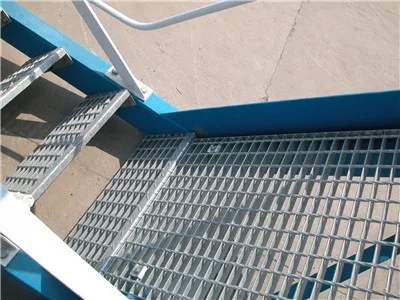
Stair treads are fabricated from steel grating (steel grating is a steel product made by arranging flat bearing bars and cross bars at set intervals in a cross pattern and welding them into a square grid). The surface is generally hot-dip galvanized or electro-galvanized (hot-dip galvanizing is recommended for longer rust protection).
Types of Stair Treads
Main types are classified as follows:
(1) By installation, stair treads are divided into welded-fixed and bolt-fixed types. Welded-fixed treads are simply steel grating; bolt-fixed treads need a 65X5mm flat bar added as a side plate.
(2) By anti-slip requirement, stair tread grating is divided into treads with a front nosing plate (checkered plate or bar) and treads without one. T325/30/100 (for tread widths greater than 215mm and not more than 305mm) and T255/30/100 (for tread widths greater than 215mm and not more than 305mm). For safety reasons, customers are advised to use treads with a front nosing plate.
Uses of grating stair treads: stair tread grating is mainly used for industrial platforms, stair treads, handrails, walkway flooring, railway bridge side walks, high tower platforms, drainage trench covers, manhole covers, road screens, multi-story parking, and fencing for institutions, schools, factories, enterprises, sports grounds and garden villas; it can also be used for residential exterior windows, balcony guards, and highway and railway guardrails.
Determine the category first and then the specific model; this saves detours and makes comparison with other materials easier.
Installation quality of stair treads depends largely on preparation: whether the bearing surface is level, whether beam spacing matches the layout, and whether fasteners are ready in advance. With these in place, installation itself is not complicated. If cutting is needed on site, the cut-edge treatment requirements for hot-dip galvanized steel grating should also be specified clearly.
Features of Stair Treads
Its overall performance focuses on the following aspects; we suggest comparing item by item in actual selection:
- Stair treads are very simple to install and need no complex installation
- Good ventilation, lighting, heat dissipation, explosion-proof and anti-slip performance
- Stair treads offer high strength, light structure and long durability
- Maintenance is very simple and dirt does not accumulate.
Stair treads are widely used in power plants, waterworks and other factories, as well as platforms and walkways in municipal engineering and environmental sanitation, and ground platforms in theaters, viewing platforms, parking areas and other large venues.
Common platform tread grating models are G303/30/100, G323/30/100, G255/30/100, G305/30/100 and G325/30/100, and can be customized. The standard size is 1*1m, also customizable; customers provide the required dimensions and our factory produces to them.
Overall, selection should weigh span, load and service environment together.
For the installation sequence, lay out first, then fix; avoid changing while laying. Once the layout drawing of stair treads is confirmed, avoid random cutting on site; if adjustment is really needed, the fixing and edging of galvanized grating should be adjusted accordingly to avoid leaving a loosening hazard.
Further notes: How to combine hot-dip galvanized steel grating and galvanized grating in use
In engineering, galvanized grating is often used together with the components mentioned in this article. The two differ in load carrying and installation practices; when combining them, pay special attention to the connection of support conditions and fixing methods, as junction treatment is often where problems arise. For unified drawings, submit dimensions of both types and our technicians will process them under the same layout logic.
- For all product specifications and theoretical weights by series, visit Steel Grating Product Center
- To estimate cost by size and quantity, use Instant Quote PageSubmit Requirements
- To see how similar projects were executed, refer to Project Cases field applications
FAQ
Why do different manufacturers quote different weights for the same specifications?
The main difference lies in the actual measured thickness and tolerance control of the bearing bars. When bars are supplied at the lower tolerance limit, weight per unit area falls below the theoretical value, and load capacity drops accordingly. We recommend specifying thickness tolerance clearly when purchasing.
What information is needed for custom sizes?
Usually you need to provide the panel dimensions (length x width), bearing bar specs and direction, center-to-center pitch of bearing bars and cross bars, surface treatment, and special requirements such as cutouts, corner notches and banding. Site photos or sketches are even better.
What maintenance is required during daily use?
Maintenance mainly involves periodically checking whether fasteners are loose, whether touch-up paint has peeled off, and whether the panel surface shows obvious deformation or rust. Issues found should be dealt with promptly; overall maintenance is minimal.
The above is for sizing and construction reference. To verify specific parameters or request a quotation, please visitInstant Quote Page, or contact our technical staff.
Note that this article presents sizing approaches and general practice, and does not constitute a strength commitment for any specific project. For load-bearing safety-critical areas, the design drawings and on-site calculations shall prevail; contact our technical staff if in doubt.