
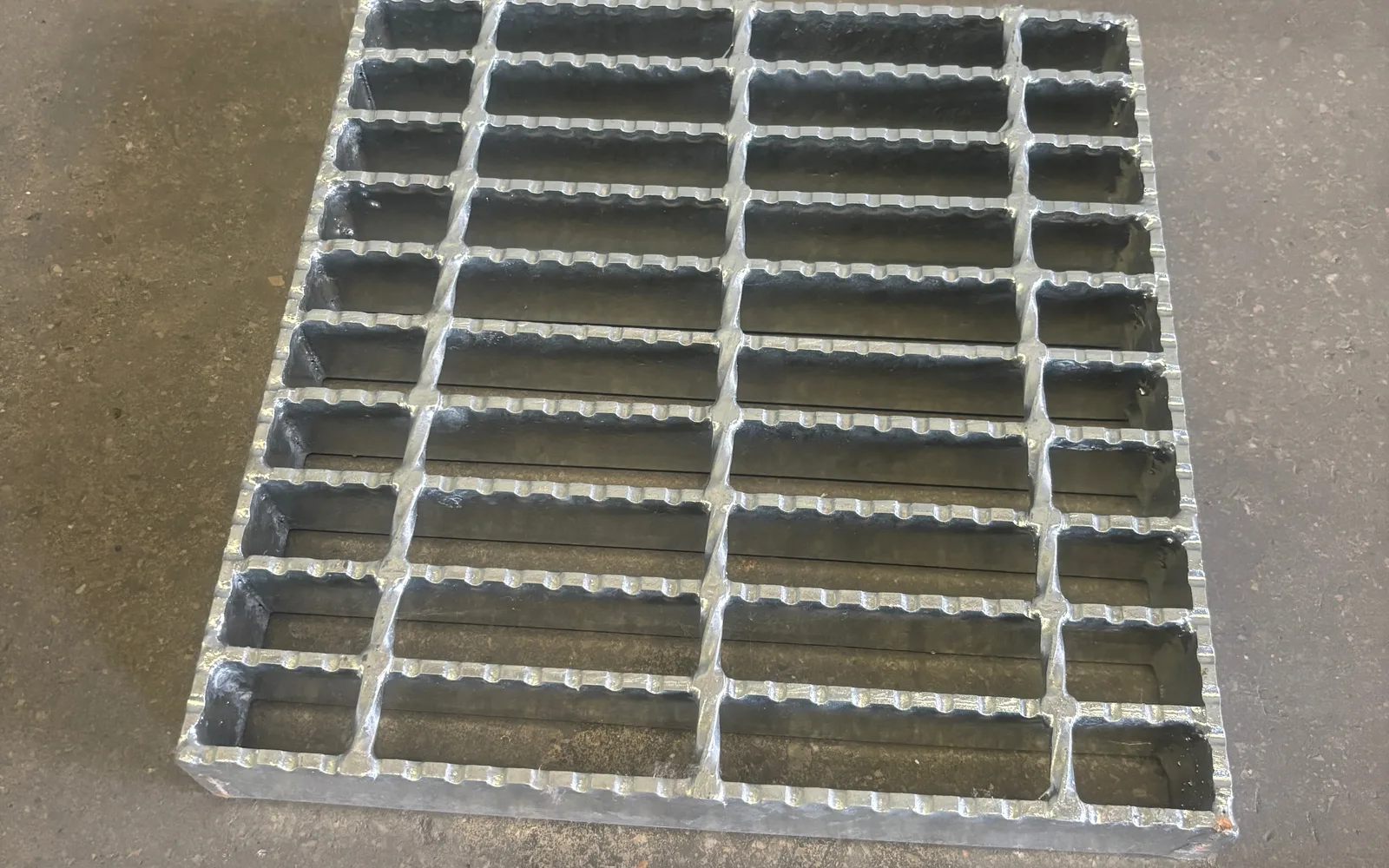
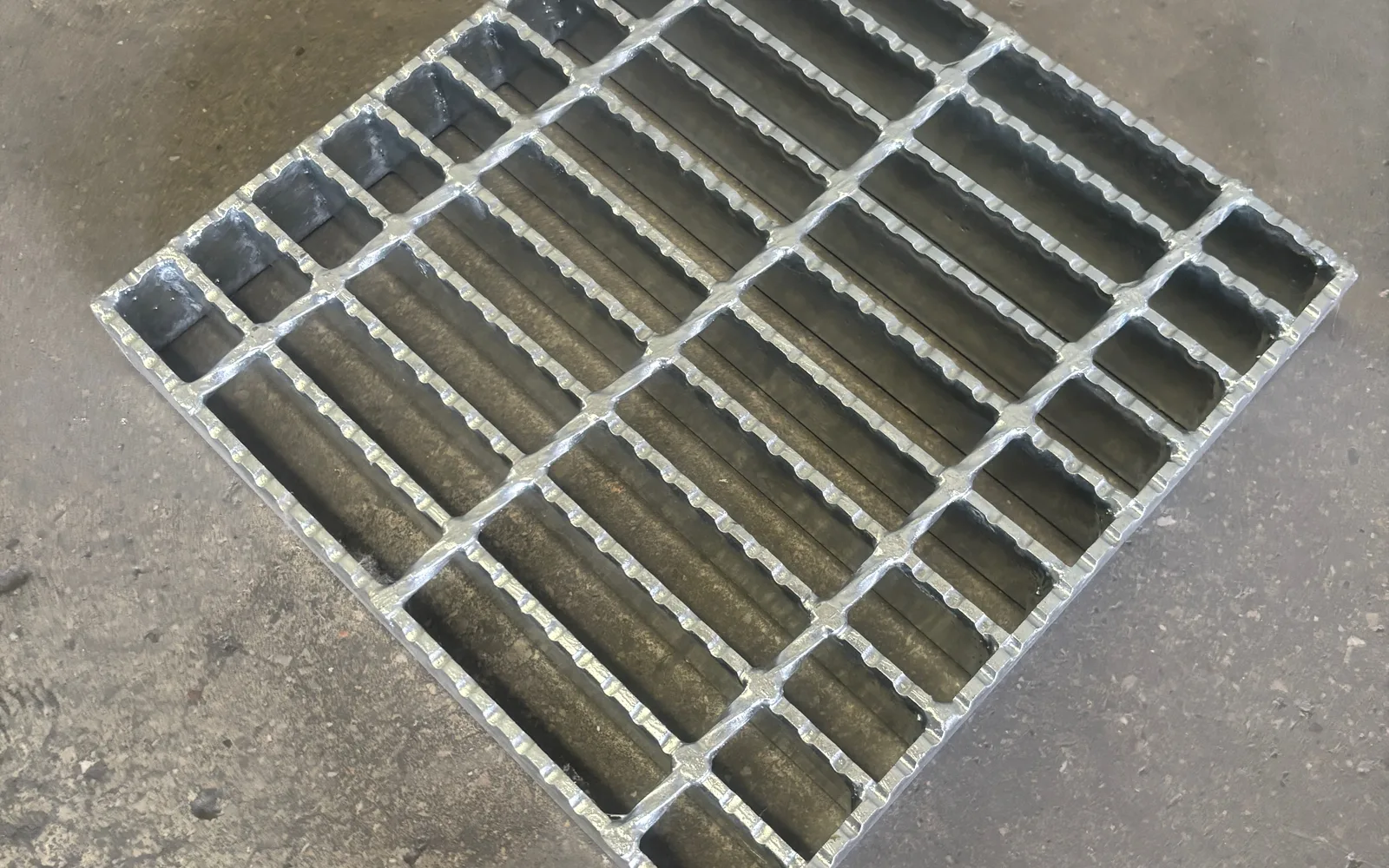
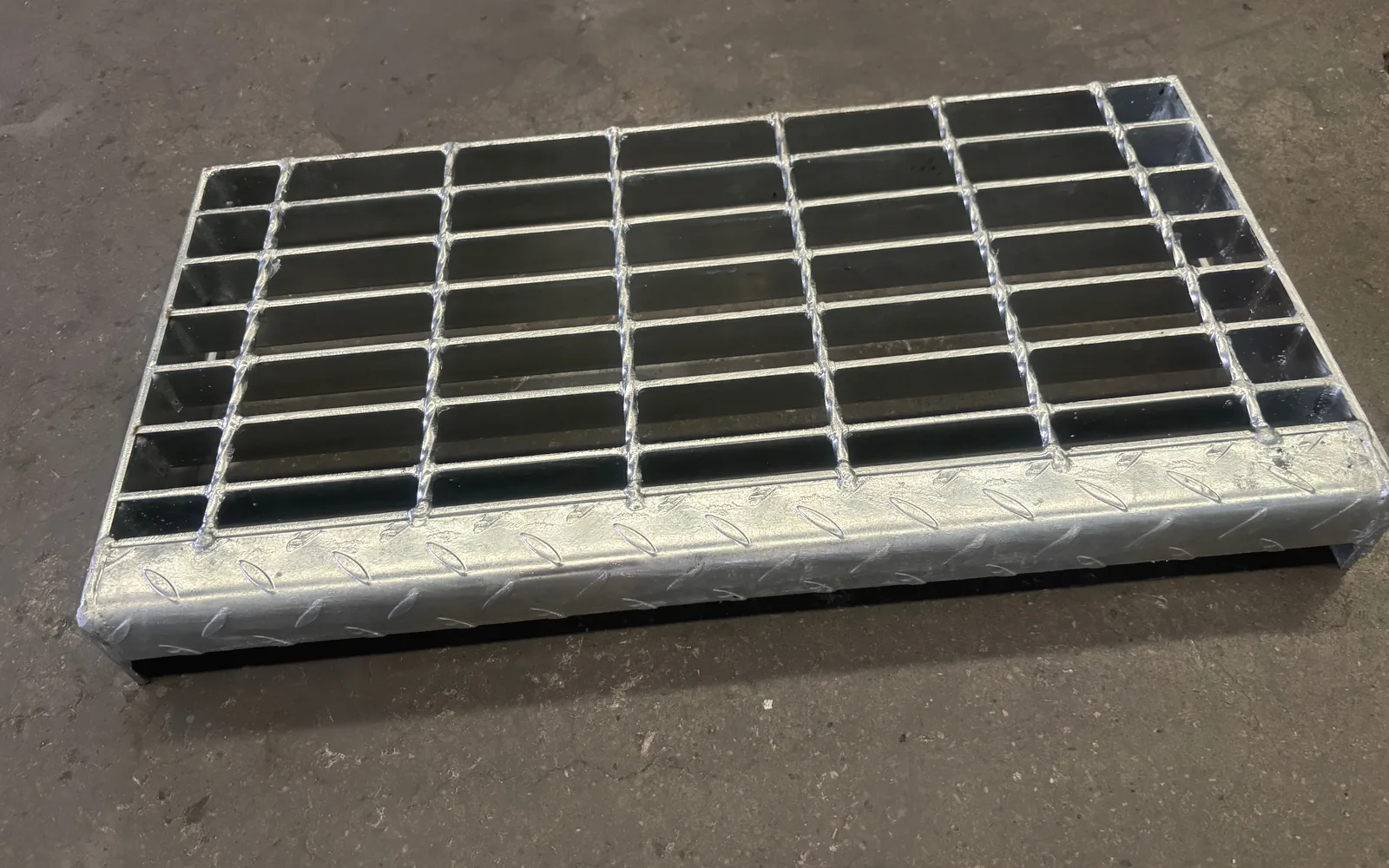




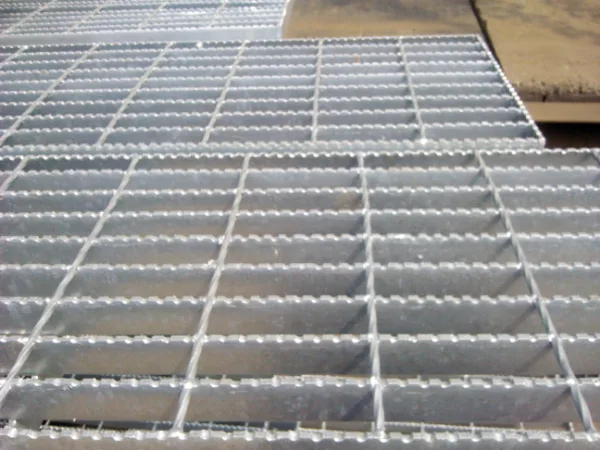
Serrated steel grating is welded from flat bars with one serrated edge. Besides the features and uses of ordinary steel grating, it has strong anti-slip performance, especially suitable for wet, greasy places such as offshore oil platforms. Serrated steel grating uses a hot-dip galvanized surface treatment with strong rust resistance. This product can be used as a trench cover hinged to the frame, offering anti-theft safety and easy opening.
Serrated steel grating is one of the most widely used steel grating products in industrial and municipal engineering, and platform steel grating is a common name for the matching or same-series product. This page explains specification reading, material and surface treatment, applicable conditions, installation and fixing, and customization and quotation item by item. If you already have drawings or site dimensions, you can check them directly against the entries here, or go toInstant Quote Page to estimate quantities.
Items to Confirm When Selecting Serrated Steel Grating
This page does not list a fixed specification table, as such products are usually custom-fabricated to site conditions. We recommend confirming each item in the table above before inquiry: once mismatched with actual site conditions, refabrication is often required later.ProductsCommon specifications are organized by series for reference.
| Items to Confirm | What Needs to Be Clarified | Common Practices |
|---|---|---|
| Span and Support | Clear span between support beams and support surface width | Determine by field-measured dimensions |
| Service Load | Pedestrian, maintenance access or vehicle traffic | Verify by actual traffic type |
| Material Requirements | Carbon steel or stainless steel, grade requirements | Determine by corrosion grade of service environment |
| Surface Treatment | Hot-dip galvanized, painted, or untreated | Hot-dip galvanizing recommended for outdoor and humid environments |
| Fixing Method | Welded fixing or special clips | Removable covers recommended for positions requiring maintenance |
| Acceptance Requirements | Acceptance Criteria for Flatness, Tolerances and Appearance | Recommended to specify in the technical agreement |
Features of Serrated Steel Grating
The main performance features of serrated steel grating can be summarized as follows, for checking one by one during option comparison and technical briefings:
Serrated steel grating uses high-strength carbon steel, giving the grating very high strength: strength and toughness far exceed cast iron, suitable for docks, airports and other large-span, heavy-load environments. The product features large mesh openings with the best drainage: open area reaches 83.3%, more than twice that of cast iron. Attractive appearance: clean lines, silver finish, modern look; economical material use, saving investment: lower in price than cast iron for large spans and heavy loads; and it saves the cost of replacing cast iron covers stolen or crushed.
Raw Material Composition of Serrated Steel Grating
1. Ordinary flat bar: generally Q235. Common models are 253 255 303 305 323 325 403 404 405 503 505 605 705 and other specifications. We mainly use longitudinally slit flat bars cut from steel plate.
2. Serrated flat bar: the models are the same as ordinary flat bars, except that one side of the bar has uneven serrations, mainly for anti-slip performance.
3. I-type flat bar: thick on both edges and thin in the middle.
4. Twisted square bar: also called twisted square cross bar, generally made from 5x5 6x6 8x8 square bars twisted into shape.
Overall, selection should weigh span, load and service environment together.
Selection Points for Serrated Steel Grating
Confirm each item in the order below during selection to avoid most later rework. Record the conclusion of each step and submit it with your inquiry:
- Step 1 · Define Span and Support Conditions: First measure the clear span between support beams, then confirm the support surface width is sufficient; these two items determine the usable series range.
- Step 2 · Verify Service Load: Check separately for pedestrian, maintenance or vehicular traffic; maintenance and vehicular use differ greatly in bearing bar requirements.
- Step 3 · Determine Material and Surface Treatment: Ordinary carbon steel works for dry indoor environments; hot-dip galvanizing is recommended for outdoor or humid environments; chemical and coastal environments need separate confirmation.
- Step 4 · Confirm Shape and Fixing Method: Including whether cutouts, corner notches and banding are needed, and whether to use welded fixing or special clips.
Once the above conditions are confirmed, proceed to Instant Quote PageEstimate quantities by dimensions, or send the condition list to customer service for model recommendations from our technicians.
Typical Application Scenarios of Serrated Steel Grating
Based on completed projects, serrated steel grating is mainly used in the following types of places, which similar conditions can reference directly:
- Industrial Platforms & Maintenance Walkways: equipment platforms and inspection passages in power plants, chemical plants and steel-structure workshops;
- Municipal & Landscape: road drainage trench covers, rainwater grates, tree grates, park boardwalks;
- Transportation & Ports: wharf trestles, multi-story parking garage lanes, railway bridge walkways;
- Environmental & Water Treatment: walkways in wastewater treatment plants, tank platforms, screening machine platforms;
- Others: elevated tower platforms, stair treads, fences and railings, etc.
If your working conditions fall outside the above range, you can provide site photos and dimensions, and our technicians will help assess them.
Key Conditions to Confirm During Selection
- First clarify the span and support beam spacing to determine the required series;
- Then check load requirements by usage type (pedestrian, maintenance, vehicular);
- Finally, determine the surface treatment by service environment (dry indoor, outdoor, coastal, chemical).
Applicable Condition Comparison for Serrated Steel Grating
The same specifications last very differently in different environments. The table below gives recommended practices by common service environment for your selection reference:
| Operating Environment | Recommended Practices | Note: |
|---|---|---|
| Indoor Dry Environments | Made of standard carbon steel with surface treatment as required | Focus on span and load; environmental impact is minimal |
| Outdoor and Open-Air Environments | Hot-dip galvanized surface treatment recommended | Check zinc coating integrity and re-zinc cut edges |
| Vehicle Traffic Areas | Check load class against vehicle types | Note that bearing bars must run parallel to traffic direction |
| Pedestrian and Maintenance Walkways | Choose standard series, balancing walking comfort | Focus on surface flatness and end banding |
| High-Temperature or Large Temperature-Difference Environments | Select material and connection method by temperature | Watch for loosening caused by thermal expansion and contraction |
| Temporary or Short-Term Use | Can be configured with the light-duty series | For short schedules, prioritize easy disassembly and turnover |
Custom Fabrication & Quotation
Serrated steel grating supports made-to-drawing customization: overall dimensions, flat bar size and pitch, banding form, cutouts, and corner cuts can all be processed to site conditions. Special-shaped parts and bulk orders can be confirmed with a layout drawing before production. To estimate quantities, you canInstant Quote PageTry a size-based estimate; for model recommendations, browse ProductsCompare with similar specifications, then confirm with our service team.
FAQ
Can it be custom-made to site dimensions?
Yes. Bearing bar specs, pitch, panel dimensions and banding forms can all be custom-made to drawings; cutouts, corner notches and shaped cutting are also supported. For bulk orders, a layout drawing can be confirmed before production.
How Is the Price of Serrated Steel Grating Calculated?
Usually calculated as the theoretical weight for the model times the material unit price, plus hot-dip galvanizing or other surface treatment costs, and fluctuating with steel and zinc prices. You canInstant Quote PageEnter specifications and dimensions for a quick estimate.
Which surface treatment should I choose?
Hot-dip galvanizing is recommended for outdoor or humid environments; for dry indoor environments, untreated or painted is fine; coastal, chemical and other strongly corrosive environments need thicker zinc coatings or stainless steel, depending on the expected service life.
Once the specification and surface treatment of serrated steel grating are confirmed, a quotation can be given. For made-to-drawing customization or load calculation, you canInstant Quote PageSubmit dimensions, or contact us directly for technical support.