







When purchasing welded steel gratings, many projects focus only on price while neglecting specification matching and anti-corrosion requirements, which easily leads to rework later. This article lists the conditions to be confirmed one by one, in the order of what welded steel grating model selection is, common models of welded steel grating selection, and basic concepts of welded steel grating selection, and explains how to make trade-offs based on common working conditions. The content related to galvanized gratings can be directly used as a reference for technical disclosure.
What is welded steel grating model selection
This section first clarifies the basic concepts, structural forms and common names, laying the groundwork for what follows.
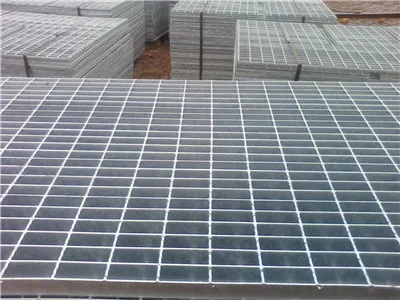
The span of welded steel grating refers to the span of the load-bearing flat bars, that is, the length of the flat bars. Taking a trench as an example, the width of the trench is the span of the trench cover, that is, the length of the load-bearing flat bars. With the same type of material, the larger the span, the smaller the load-bearing parameter value.
Once you grasp these basic concepts, the specifications and sizing recommendations that follow will be much easier to understand.
Actual parameters of the same model may differ slightly between manufacturers; acceptance should be based on measured values. Spot checks of the key dimensions of welded steel gratings are recommended, especially for bulk deliveries. The corresponding parameters of galvanized gratings can be checked in the same way; communicate promptly if deviations are found.
Common models and dimensions for welded steel grating model selection
Main specification comparison is as follows:
When the span of the steel grating is too large and exceeds the load-bearing requirement range, the possible solutions to explore are: whether a support beam can be added in the middle of the span to shorten it; or changing the flat bar type by increasing the flat bar width and thickness. Service environment: explain the use of the grating clearly to the grating manufacturer; for example, if it is for export, specify which country it is exported to, as different countries have different export standards.
The above are common specifications; actual ordered dimensions and tolerance requirements shall be confirmed against the layout drawing.
Bigger specifications are not always better. The selection of welded steel gratings should be as economical as possible while meeting load requirements; excessive thickening increases weight and cost and causes inconvenience in installation. The product page provides more complete comparison notes on hot-dip galvanized steel gratings for reference before making a decision.
Basic concepts of welded steel grating model selection
This section first clarifies the basic concepts, structural forms and common names, laying the groundwork for what follows.
Use: for example, is it for a road channel or a factory work platform? For gratings used on ships, docks, or in chemical scenarios, the corrosion resistance requirements of the gratings are generally high. The thickness of the galvanized layer and other details can all be communicated in advance.
Once you grasp these basic concepts, the specifications and sizing recommendations that follow will be much easier to understand.
The easiest things to overlook in specification tables are tolerances and end treatment. Welded steel gratings usually leave machining allowance in the length direction; if the site uses recessed installation, the edge banding and corner-cut requirements should be stated in advance. Galvanized gratings are handled similarly in such details, and it is recommended to mark them clearly on the drawings.
Specification parameters of welded steel grating model selection
There are gaps between the cross bars and flat bars of welded steel gratings, yet every contact point can be welded to achieve the same melted connection between the flat bars and twisted square bars; thus the welding is stronger and the strength is improved, but the appearance is not as attractive as press-welded ones. Welded steel gratings are suitable for alloy, building material, power station, boiler, shipbuilding, petrochemical, chemical, and general industrial plant, municipal construction, and other industries.
There is a practical technique for confirming specifications: write the flat bar specification, flat bar center pitch, cross bar pitch, and overall dimensions into the purchase list at the same time; writing only one or two of them easily leads to mismatched deliveries. The specification notation of welded steel gratings is fully compared on the product page; before ordering, number and check panel by panel against the layout drawing; the same applies to hot-dip galvanized steel gratings.
Performance features of welded steel grating model selection
Steel gratings have advantages such as ventilation and light transmission, anti-slip performance, strong load capacity, durability, easy cleaning, and simple installation. Steel gratings have been widely used in various industries at home and abroad, mainly as industrial platforms, stair treads, handrails, passage floors, railway bridge side walkways, high-altitude tower platforms, drainage trench covers, manhole covers, road grilles, multi-story parking, and fences of institutions, schools, factories, enterprises, sports fields, and garden villas.
The easiest things to overlook in specification tables are tolerances and end treatment. Welded steel gratings usually leave machining allowance in the length direction; if the site uses recessed installation, the edge banding and corner-cut requirements should be stated in advance. Galvanized gratings are handled similarly in such details, and it is recommended to mark them clearly on the drawings.
Scope of Application & Engineering Fields
Steel gratings can also be used as exterior windows of residences, balcony railings, highway and railway guardrails, etc. As a new type of engineering material, welded steel gratings are mainly used in metallurgy, energy, shipping, municipal, petrochemical, transportation, building materials, national defense, and other fields as platforms, trestles, bridges, highway guardrails, trench covers, fences, gates, and other facilities.
Different application scenarios place different emphases on welded steel gratings: pedestrian walkways value anti-slip and comfort, vehicle areas value panel stiffness and fixing reliability, and drainage trench covers value open water area and anti-theft. Clarify the use first, then look at the specifications to avoid detours; the same approach applies to galvanized gratings.
Further notes: Common combinations of galvanized grating and hot-dip galvanized steel grating
If a project uses both galvanized grating and hot-dip galvanized steel grating, we recommend planning them on the same layout drawing. This way edge closing, fixing and cutouts at junctions can be handled uniformly, avoiding dimension conflicts during installation and making later maintenance easier.
- For all product specifications and theoretical weights by series, visit Steel Grating Product Center
- To estimate cost by size and quantity, use Instant Quote PageSubmit Requirements
- To see how similar projects were executed, refer to Project Cases field applications
FAQ
Why do different manufacturers quote different weights for the same specifications?
The main difference lies in the actual measured thickness and tolerance control of the bearing bars. When bars are supplied at the lower tolerance limit, weight per unit area falls below the theoretical value, and load capacity drops accordingly. We recommend specifying thickness tolerance clearly when purchasing.
What maintenance is required during daily use?
Maintenance mainly involves periodically checking whether fasteners are loose, whether touch-up paint has peeled off, and whether the panel surface shows obvious deformation or rust. Issues found should be dealt with promptly; overall maintenance is minimal.
What is most often overlooked during installation and acceptance?
First, bearing bars installed in the wrong direction reduce load capacity; second, insufficient fixing points or missing zinc touch-up paint; third, support beam spacing inconsistent with the layout drawing. These three items are most often overlooked on site.
The above is for sizing and construction reference. To verify specific parameters or request a quotation, please visitInstant Quote Page, or contact our technical staff.
If you already have drawings or site dimensions, submit them directly and we will help verify specifications and layout, avoiding on-site cutting and rework caused by mismatched models. Without drawings, site photos and approximate dimensions are enough for an estimate.