







This article introduces steel grating in the order of the 35mm red line, why the cross bar pitch is 150mm, and basic concepts. Each section gives practical, actionable criteria; if you only need quick conclusions, start with the key points of each section. The same approach applies to steel grating specifications.
The 35mm Red Line
Clause 7.1.1.3 of YB/T 4001.1-2019 states: for steel grating used on working platforms or walkways, the maximum clear opening between bearing bars shall be less than 35mm, and the maximum clear pitch of cross bars shall be not more than 150mm.
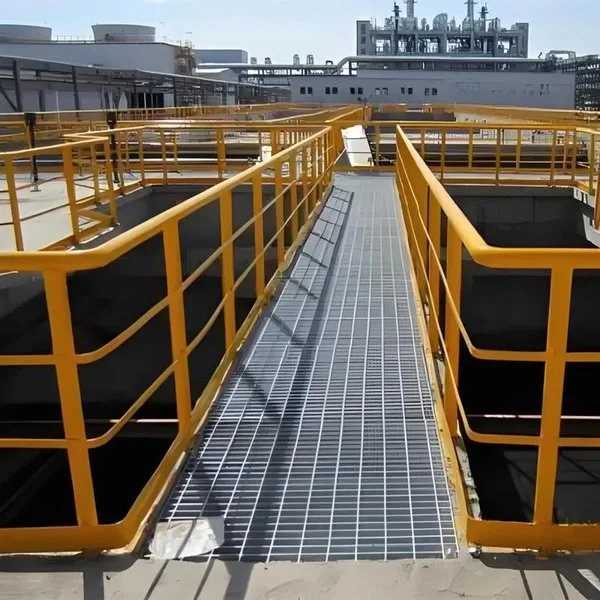
▲ Industrial platform steel grating - clearances kept within the safe range
Why 35mm? This was not decided off the top of someone's head.The heel width of an adult male is usually 40-45mm, so a 35mm opening ensures a foot will not wedge through. This figure has been verified by engineering practice and safety testing.
What is easiest to overlook in spec sheets are tolerances and end treatment. Steel grating usually leaves machining allowance along the length; if field installation is recessed, state the edge banding and corner-notching requirements in advance. Steel grating specifications are handled similarly in these details; mark them clearly on the drawings.
And why a 150mm cross bar pitch?
A cross bar pitch of no more than 150mm ensures the lateral stability of the grating. Cross bars too sparse and the flat bars deform sideways; too dense and material is wasted. 100mm is the most common industry pitch, balancing stability and economy.
Special scenario note:
In areas where high heels are worn, a clear opening of no more than 20mm is recommended. For maintenance passages, temporary platforms, and other non-regular-traffic areas, the standard may be relaxed, provided there is a clear safety assessment.
In one sentence: the clearance is the essence of the word "grating" - too large is unsafe, too small blocks drainage and light. 35mm is the best balance of safety and function.
-- Lao Liang @ Anping Steel Grating Factory, July 2026
Bigger is not always better. The selection of steel grating should be as economical as possible while meeting load requirements; excessive thickness increases weight and cost and complicates installation. The product page offers a more complete cross-reference of steel grating specifications; consult it before deciding.
Further Notes: Common Combinations of Steel Grating Specifications and Steel Grating Series
If a project uses both steel grating specifications and steel grating series, consider them together on the same layout drawing. The benefit: edging, fixing, and openings at junctions can be handled uniformly, avoiding size conflicts during on-site installation and making later maintenance easier.
- For all product specifications and theoretical weights by series, visit Steel Grating Product Center
- To estimate cost by size and quantity, use Instant Quote PageSubmit Requirements
- To see how similar projects were executed, refer to Project Cases field applications
If you already have drawings or site dimensions, submit them directly and we will help verify specifications and layout, avoiding on-site cutting and rework caused by mismatched models. Without drawings, site photos and approximate dimensions are enough for an estimate.