







This article introduces platform steel grating in the order of fabrication and installation, marine platform steel grating, and the number of installation clips by grating size. Each part provides actionable judgment methods as far as possible; if you only need a quick conclusion, start with the key points at the beginning of each part. The same approach applies to hot-dip galvanized steel grating.
Many factors are involved, and equipment dimensions and positions carry some uncertainty, so during installation prefabricated reserved holes often fail to meet site needs. To address this, ensure a high yield of finished grating and improve design and production efficiency, small-diameter holes whose positions are hard to determine are generally not custom-designed or machined; instead, they are drilled on site during grating installation according to actual conditions.
Platform Steel Grating Fabrication and Installation
Key points for construction and fixing are as follows:
- Fabrication of platform steel grating shall comply with the requirements of YB4001-2007, the industry standard of the People's Republic of China.
- The supporting beams of a frame platform shall be installed strictly at the same level according to the design elevation, to ensure the flatness of prefabricated steel grating.
- Steel grating should be hoisted in sequence and promptly welded to the supporting beams or fixed with saddle clips.
- Holes cut during installation shall be reinforced around the perimeter with flat bars; the reinforcing bars shall be securely welded and the anti-corrosion protective coating reapplied."
Take 255/30/100 as an example: when drawings are available, the bearing bar direction is usually marked on the drawing with a capital letter"N"to indicate it. As shown in Figure 2, 2340mm is the length of the bearing bars and 1000mm is the length of the cross bars. In Figure 1, the bearing bar pitch is 30mm. The length of B is the load-bearing direction of the grating, and the length of the cross bars with a 100mm pitch is A.
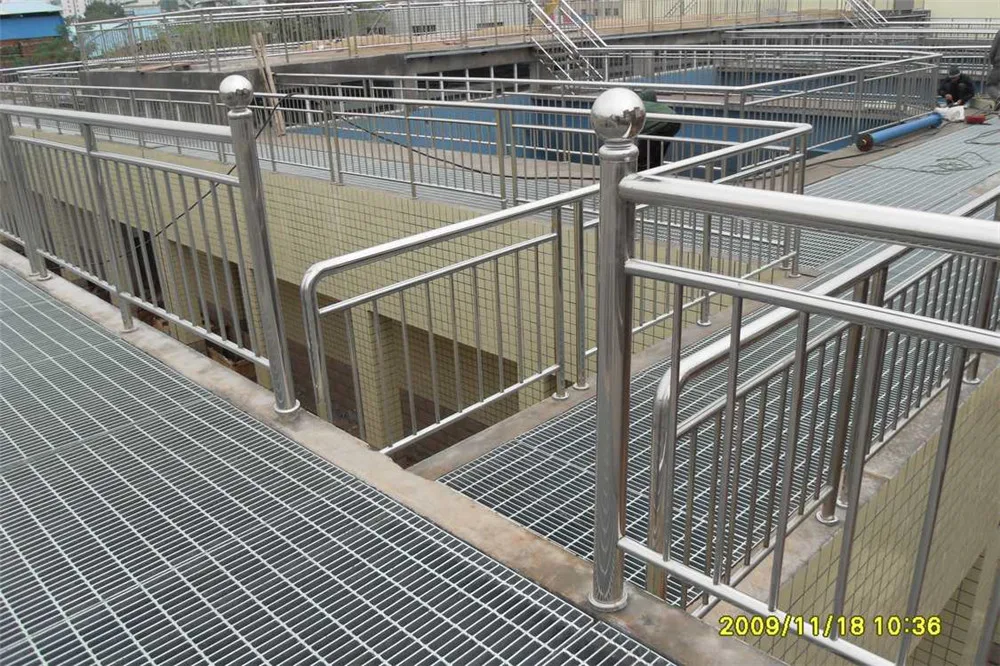
After installation, check each panel's fixing points and flatness; put into use only after confirming no warping or looseness.
Installation most affects the later user experience. When laying platform steel grating, the direction must not be reversed; the bearing bars should align with the main load direction, which is the point most easily overlooked on site. The number of fasteners should also be complete as per the layout drawing; a single missing one may cause local loosening. This requirement applies equally to hot-dip galvanized steel grating.
Marine Platform Steel Grating
The following aspects most need to be confirmed in advance in actual procurement and use:
Steel grating platforms have become basic supporting products in shipbuilding and ship repair. CB/T608-1998 has served as the marine steel grating standard for nearly 20 years, and the adoption of steel grating has greatly accelerated shipbuilding production.
Steel grating on ships is mainly used for decks, cargo holds, engine and boiler room passages, funnel platforms, wheelhouse platforms, lashing platforms and the like; abroad it is also called grating. Common models include G403/40/100 PG,"
"but if the steel grating is long and there are supporting beams in the middle of the panel, the clips can be configured in the following quantities.
The above points can serve as a pre-purchase checklist; confirm each item before moving to the quotation stage.
From order to delivery, the main intermediate steps for platform steel grating are layout confirmation and surface treatment, both taking a relatively fixed time. If the schedule is tight, confirm the layout drawing first so that production of hot-dip galvanized steel grating can proceed in parallel.
Number of Installation Clips by Steel Grating Size (Bearing Bar Length)
Main specification comparison is as follows:
500~1500mm 4
1500~3000mm 6
3000~4000mm 8
4000~5000mm 10
5000~6000mm 12
The above are common specifications; actual ordered dimensions and tolerance requirements shall be confirmed against the layout drawing.
Bigger is not always better. Platform steel grating should be selected as economically as possible while meeting load requirements; excessive thickening increases weight and cost and complicates installation. The product page offers a more complete comparison of galvanized grating for reference before deciding.
2: Each clip set consists of an upper clip, a lower clip, a bolt, a nut and a spring washer
On-site construction generally follows the steps and technical requirements below; complete the technical disclosure before starting work:
3: Once steel grating is placed on the beam, secure it immediately (welding or clips) to prevent displacement and safety accidents.
4: After installation, users should pay attention to maintenance; if any clip is found loose, tighten it promptly."
The zinc coating weight of hot-dip galvanized steel grating depends on the thickness of the bearing bars: the thicker the bar, the higher the zinc coating, and vice versa. According to GB/T 13912-2002, the hot-dip galvanizing standard of the People's Republic of China, the zinc coating standards for hot-dip galvanized steel grating are as follows:
1 For hot-dip galvanized steel grating with a thickness of 6mm or more, the average zinc coating thickness shall exceed 85 microns and the local thickness shall exceed 70 microns.
2 For hot-dip galvanized steel grating with a thickness between 3mm and 6mm, the average zinc coating thickness shall exceed 70 microns and the local thickness shall exceed 55 microns.
3 For hot-dip galvanized steel grating with a thickness between 1.5mm and 3mm, the average zinc coating thickness shall exceed 55 microns and the local thickness shall exceed 45 microns."
Purchase notes: when inquiring about twisted square cross bar grating, please specify the width, thickness and pitch of the bearing bars, and the surface treatment method. Prices vary greatly with different surface treatments. If you are unsure of the specifications for your site, tell the manufacturer the application and the required load capacity, and whether the dimensions are center-to-center or clear opening. The manufacturer will quote based on your requirements.
After the harsh environmental protection storm, most steel grating enterprises suffered heavily. Round after round of central environmental inspections has been fully launched, keeping the whole industry on edge. The first half of the year saw the grating industry beset on all sides, with enterprises struggling; opinions differ widely on what the second half will bring.
The checkered plate of compound steel grating is steel plate with patterns on the surface: lentil, diamond, round bean and mixed flat-round shapes, with the lentil pattern most common on the market. Checkered plate offers good looks, slip resistance, enhanced performance and steel savings, and is widely used in transportation, construction, decoration, equipment base plates, machinery, shipbuilding and other fields.
"Steel grating clips are made of quality steel plate by machine bending and punching. They are sturdy, durable and easy to install; galvanized clips are attractive, secure and rust-resistant, and can fix steel grating very well.
Fixing methods for steel grating: welding or clip fastening. Welding offers permanent fixing that never loosens; clips avoid damaging the hot-dip galvanized coating and allow easy removal. The safest method is to omit the lower clip and directly tack-weld the screw head onto the beam, ensuring the grating cannot slide off the beam even if a clip loosens."
After installation, check each panel's fixing points and flatness; put into use only after confirming no warping or looseness.
The installation quality of platform steel grating depends largely on preparation: whether the bearing surface is flat, whether beam spacing matches the layout, and whether fasteners are prepared in advance. With these in place, installation itself is not complicated. If on-site cutting is needed, the cut-edge treatment requirements for galvanized grating should also be clarified.
Further reading: Selection points for hot-dip galvanized steel grating and galvanized grating
Besides what this article covers, hot-dip galvanized steel grating is also common in actual projects. It shares similarities with this article's subject in structure and fabrication; for selection, check span, load and service environment in the same order. If both types of components are used in the same project, we recommend unifying material and surface treatment to avoid later galvanic corrosion or inconsistent appearance.
- For all product specifications and theoretical weights by series, visit Steel Grating Product Center
- To estimate cost by size and quantity, use Instant Quote PageSubmit Requirements
- To see how similar projects were executed, refer to Project Cases field applications
FAQ
What is most often overlooked during installation and acceptance?
First, bearing bars installed in the wrong direction reduce load capacity; second, insufficient fixing points or missing zinc touch-up paint; third, support beam spacing inconsistent with the layout drawing. These three items are most often overlooked on site.
What maintenance is required during daily use?
Maintenance mainly involves periodically checking whether fasteners are loose, whether touch-up paint has peeled off, and whether the panel surface shows obvious deformation or rust. Issues found should be dealt with promptly; overall maintenance is minimal.
Why do different manufacturers quote different weights for the same specifications?
The main difference lies in the actual measured thickness and tolerance control of the bearing bars. When bars are supplied at the lower tolerance limit, weight per unit area falls below the theoretical value, and load capacity drops accordingly. We recommend specifying thickness tolerance clearly when purchasing.
The above is for sizing and construction reference. To verify specific parameters or request a quotation, please visitInstant Quote Page, or contact our technical staff.
The above is general guidance. For a specific project, we still recommend submitting span, load class and service environment to our technicians for review. Steel grating is a load-bearing component; rework caused by wrong specification choices costs far more than the time spent on upfront calculation.