







This article focuses on power plant steel grating, covering what it is, its main advantages, and production standards, with practical suggestions added after each section. If you are comparing options or preparing a purchase, check each item in the order given; items involving galvanized grating can be checked against this article, adjusting for actual site conditions.
What is power plant steel grating
This section first clarifies the basic concepts, structural forms and common names, laying the groundwork for what follows.
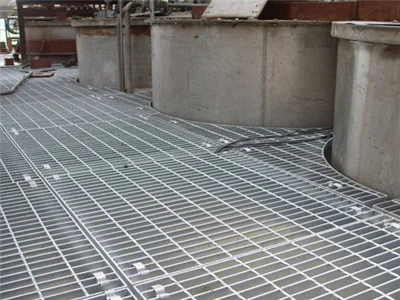
How power plant steel grating is made: steel grating consists of bearing bars and cross bars arranged at set spacing, welded into parent panels by 200-ton hydraulic resistance welding automation equipment, then cut, punched, and banded into products meeting customer requirements. Bearing bar pitch: the center distance between adjacent bearing bars, commonly 30, 40, and 50mm. Cross bar pitch: the center distance between adjacent cross bars, usually 50, 76, 80, 100mm, etc.; other pitches can be produced on request, and various models can be customized to customer needs.
Once you grasp these basic concepts, the specifications and sizing recommendations that follow will be much easier to understand.
Bigger is not always better. The selection of power plant steel grating should be as economical as possible while meeting load requirements; over-thickening increases self-weight and cost and complicates installation. The products page offers a more complete comparison of hot-dip galvanized steel grating; refer to it before deciding.
Key Advantages
Main features can be summarized as follows:
Steel grating is generally made of carbon steel with a hot-dip galvanized surface to prevent oxidation. It can also be made of stainless steel. Steel grating offers ventilation, daylighting, heat dissipation, anti-slip, and explosion-proof performance.
Overall, selection should weigh span, load and service environment together.
Regarding corrosion protection, one thing is easily overlooked: on-site cutting and welding damage the original coating, and these areas need zinc touch-up after construction, otherwise rust often starts from the cut edges. Galvanized grating has the same issue; it is best to include this in the technical requirements at the construction disclosure.
Production standards
The standards and inspection items to check are as follows:
The production standard for power plant steel grating is YB/T 4001.1-2007 (the latest Chinese steel grating standard, 2007 edition); the United States, the United Kingdom, Australia, and New Zealand also have their own standards. Steel material standards follow GB700-88 and GB1220-92.
Surface treatments for power plant steel grating: hot-dip galvanizing, cold galvanizing, and spray painting.
We recommend checking each clause above during acceptance and keeping the factory inspection records.
Material and surface treatment determine the durability of power plant steel grating on site. For the same steel grating, the treatment differs greatly between dry indoor use and coastal or chemical environments, so the service environment should be stated as the primary condition when selecting. The same applies to hot-dip galvanized steel grating.
How power plant steel grating is made
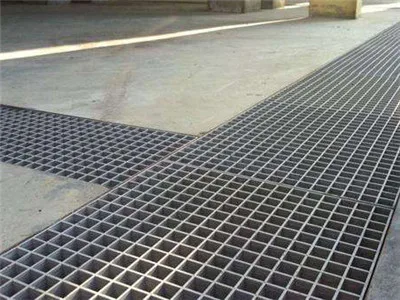
Welded steel grating consists of bearing bars and cross bars arranged at set spacing, welded into parent panels by 200-ton hydraulic resistance welding automation equipment, then cut, punched, and banded into products meeting customer requirements.
Bearing bar pitch: the center distance between two adjacent bearing bars, commonly 30mm or 40mm.
Cross bar pitch: the center distance between two adjacent cross bars is usually 50mm or 100mm; other pitches can be produced on request.
Actual parameters of the same model may differ slightly between manufacturers; acceptance should be based on measured values. Spot-check key dimensions of power plant steel grating, especially for bulk deliveries. Check the corresponding parameters of hot-dip galvanized steel grating the same way and communicate any deviations promptly.
Product features of power plant steel grating
Attractive appearance: clean lines and a silvery finish with a modern look.
Best drainage: the open area reaches 83.3%, more than twice that of cast iron.
Hot-dip galvanized: strong rust resistance, maintenance- and replacement-free.
Design: the cover is hinge-connected to the frame for safety and easy opening.
Investment savings: for large spans and heavy loads, it costs less than cast iron and avoids the costs of theft, crushing, and replacement.
High strength: strength and toughness far exceed cast iron; suitable for docks, airports and other large-span, heavy-load environments.
Wide range of specifications: meets requirements for different environments, loads, spans, sizes, and shapes.
Material and surface treatment determine the durability of power plant steel grating on site. For the same steel grating, the treatment differs greatly between dry indoor use and coastal or chemical environments, so the service environment should be stated as the primary condition when selecting. The same applies to galvanized grating.
Further notes: How to combine galvanized grating and hot-dip galvanized steel grating in use
In engineering, hot-dip galvanized steel grating is often used together with the components mentioned in this article. The two differ in load carrying and installation practices; when combining them, pay special attention to the connection of support conditions and fixing methods, as junction treatment is often where problems arise. For unified drawings, submit dimensions of both types and our technicians will process them under the same layout logic.
- For all product specifications and theoretical weights by series, visit Steel Grating Product Center
- To estimate cost by size and quantity, use Instant Quote PageSubmit Requirements
- To see how similar projects were executed, refer to Project Cases field applications
FAQ
What information is needed for custom sizes?
Usually you need to provide the panel dimensions (length x width), bearing bar specs and direction, center-to-center pitch of bearing bars and cross bars, surface treatment, and special requirements such as cutouts, corner notches and banding. Site photos or sketches are even better.
What maintenance is required during daily use?
Maintenance mainly involves periodically checking whether fasteners are loose, whether touch-up paint has peeled off, and whether the panel surface shows obvious deformation or rust. Issues found should be dealt with promptly; overall maintenance is minimal.
Can the values in the article be applied directly?
Values in this article come from relevant standard clauses or common industry practice. For actual selection, recalculate based on site span, load class and service environment; direct copying is not recommended.
The above is for sizing and construction reference. To verify specific parameters or request a quotation, please visitInstant Quote Page, or contact our technical staff.
Note that this article presents sizing approaches and general practice, and does not constitute a strength commitment for any specific project. For load-bearing safety-critical areas, the design drawings and on-site calculations shall prevail; contact our technical staff if in doubt.