







This article focuses on steel stair treads, covering what they are and their classification, installation and fixing methods, and their classification and applications, with practical suggestions after each section. If you are comparing solutions or preparing procurement, check item by item in the order of this article; for parts involving hot-dip galvanized steel gratings, cross-check with the items here and adjust to site conditions where inconsistent.
What Is the Classification of Steel Stair Treads
Below we first briefly explain the relevant concepts and basic construction to make the following parameters and sizing content easier to understand.
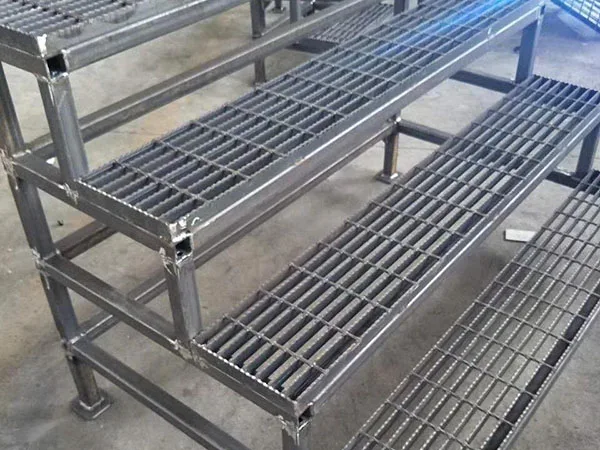
Steel grating stair treads can be divided by installation method and presence of front nosing into T1 grating stair treads, T2 steel grating stair treads, T3 stair treads and T4 steel grating treads. Stair treads, also called steel ladder treads, are stair panels of steel grating used on platforms, depending on installation method.
Once you grasp these basic concepts, the specifications and sizing recommendations that follow will be much easier to understand.
What is most easily overlooked when reading specification tables is tolerances and end treatment. The length direction of steel stair treads usually has machining allowance; if embedded installation is used on site, trimming and corner-cutting requirements need to be stated in advance. Galvanized steel gratings are handled similarly in such details; it is recommended to mark them clearly on the drawings as well.
Installation and Fixing Method
Key points for construction and fixing are as follows:
There are generally two major types: welded connection and bolted connection; they are mainly used as treads on steel stairs, hence the name stair treads. According to installation, stair treads can be divided into welded-fixed stair treads and bolt-fixed stair treads. Welded-fixed stair treads are ordinary steel gratings; bolt-fixed stair treads require 65X5mm flat bars added to the grating as side plates.
After installation, check each panel's fixing points and flatness; put into use only after confirming no warping or looseness.
For installation sequence, it is recommended to lay out first and then fix; avoid changing while laying. Once the layout drawing of the steel stair treads is confirmed, avoid random cutting on site; if adjustment is truly needed, the fixing and edge-trimming practices of hot-dip galvanized steel gratings should be adjusted accordingly to avoid leaving hidden looseness risks.
Application Scenarios of Steel Stair Treads
Main applications are as follows:
According to whether there are anti-slip strips, there are two types: stair treads with front nosing (checkered plate or flat bar) and without front nosing. Customers are advised to choose stair treads with front nosing.
How to choose stair treads: there are roughly four types, T1, T2, T3, T4.
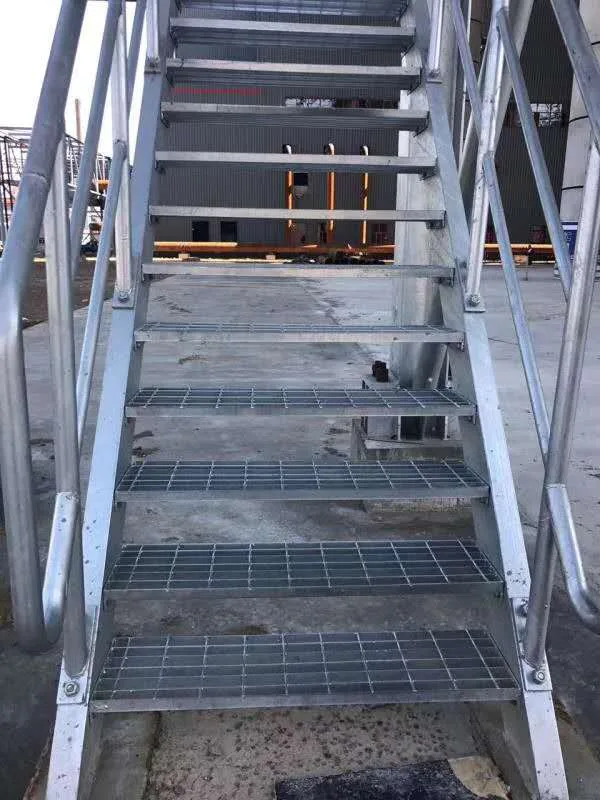
If your working conditions fall outside the above range, you can provide site photos and dimensions, and our technicians will help assess them.
To judge whether a location can use steel stair treads, quickly check three aspects: whether there are corrosive media, whether the traffic is people or vehicles, and roughly what the span range is. With these three points clear, the required specifications and surface treatment of the galvanized steel grating can basically be determined.
Common Models and Dimensions of Steel Stair Treads
T1 treads are ordinary and low in cost, made of bearing bars and cross bars arranged longitudinally and transversely at certain pitches; the grating is generally welded and fixed, with hot-dip galvanized surface. Due to its relatively low price, it is popular among steel grating customers.
A practical tip for specification confirmation: write all four items - bearing bar specification, bearing bar center pitch, cross bar pitch and overall dimensions - into the purchase list at the same time; writing only one or two easily leads to delivery mismatches. The specification notation of steel stair treads is fully compared on the product pages; before ordering, number and check each panel against the layout drawing; the same applies to galvanized steel gratings.
Basic Concepts of Steel Stair Treads
T2 treads consist of bearing bars and cross bars arranged longitudinally and transversely at certain pitches, with side plates on both sides fixed by bolts. Mainly used on steel stairs, easy to install.
T3 treads add a protective front nosing in the bar direction on the basis of T1 treads; the anti-slip front nosing is usually made of checkered plate, enhancing the slip resistance of the steel grating stair treads.
A practical tip for specification confirmation: write all four items - bearing bar specification, bearing bar center pitch, cross bar pitch and overall dimensions - into the purchase list at the same time; writing only one or two easily leads to delivery mismatches. The specification notation of steel stair treads is fully compared on the product pages; before ordering, number and check each panel against the layout drawing; the same applies to hot-dip galvanized steel gratings.
Installation and Construction Points of Steel Stair Treads
T4 treads have side plates on both sides fixed by bolts, with a protective front nosing added at the front; they are the most expensive of the four tread types.
The installation stage most affects later user experience. When laying steel stair treads, the direction must not be reversed; the bearing bar direction should match the main load direction, which is most easily overlooked on site. The number of fasteners should also be complete per the layout drawing; a missing one can cause local loosening. This requirement applies equally to hot-dip galvanized steel gratings.
Further notes: Common combinations of hot-dip galvanized steel grating and galvanized grating
In engineering, galvanized grating is often used together with the components mentioned in this article. The two differ in load carrying and installation practices; when combining them, pay special attention to the connection of support conditions and fixing methods, as junction treatment is often where problems arise. For unified drawings, submit dimensions of both types and our technicians will process them under the same layout logic.
- For all product specifications and theoretical weights by series, visit Steel Grating Product Center
- To estimate cost by size and quantity, use Instant Quote PageSubmit Requirements
- To see how similar projects were executed, refer to Project Cases field applications
FAQ
How to choose between hot-dip galvanizing and cold galvanizing?
The two anti-corrosion mechanisms differ: hot-dip galvanizing immerses steel in molten zinc to form a metallurgically bonded coating, thick and long-lasting, suitable for outdoor and humid environments; cold galvanizing is electrochemical deposition with a thinner, more uniform appearance, suitable for dry indoor environments or applications requiring high dimensional precision.
What maintenance is required during daily use?
Maintenance mainly involves periodically checking whether fasteners are loose, whether touch-up paint has peeled off, and whether the panel surface shows obvious deformation or rust. Issues found should be dealt with promptly; overall maintenance is minimal.
Where can I find specific specifications?
our websiteProductsCommon specifications and theoretical weights are organized by series, also available in Instant Quote PageEstimate by size, or contact us directly for sizing advice.
The above is for sizing and construction reference. To verify specific parameters or request a quotation, please visitInstant Quote Page, or contact our technical staff.
The above is general guidance. For a specific project, we still recommend submitting span, load class and service environment to our technicians for review. Steel grating is a load-bearing component; rework caused by wrong specification choices costs far more than the time spent on upfront calculation.