







In actual engineering, applying hot-dip galvanized steel grating is not complicated; the difficulty lies in matching specifications, material and service environment. This article covers in turn how hot-dip galvanized steel grating prevents oxidation, typical application scenarios and basic concepts; after reading you will have a complete framework for judging galvanized grating.
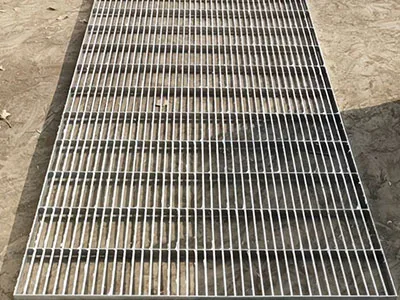
Methods to Prevent Oxidation of Hot-Dip Galvanized Steel Grating
Material and surface treatment are key to service life. Common practices and suitable environments are as follows:
Hot-dip galvanized steel grating is what people commonly call steel grating: load-bearing galvanized flat bars and cross bars are arranged at set intervals and welded into a full panel on a high-pressure resistance welding machine, then cut, trimmed, punched and banded into finished galvanized grating to customer requirements. The surface is specially hot-dip galvanized, with very stable chemical and physical properties: not only excellent corrosion resistance, but also high strength and light structure. The robust welded grid structure gives high load capacity, light weight and easy lifting, with an attractive appearance and long durability.
Hot-dip galvanized steel grating has quite strong corrosion resistance: over 50 years of service is no problem in dry environments, and over 10 years even in humid welded conditions. Service life is short only in industrial environments with particularly strong acidity or alkalinity, because the zinc layer cannot withstand strong acid and alkali corrosion; once the zinc layer is damaged, the product corrodes quickly.
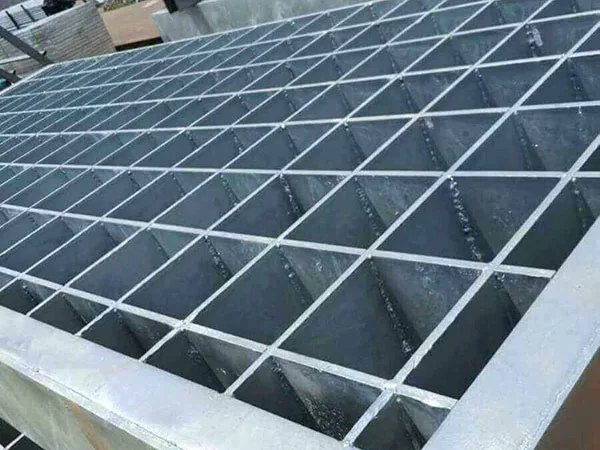
So if your situation is not a strong acid or alkali environment, hot-dip galvanizing will not oxidize. One point: hot-dip galvanized steel grating is very bright right after galvanizing, and after a few days the zinc layer forms an oxide film - this is how hot-dip galvanized coatings behave. If by oxidation you mean the gloss becoming dull, that is normal; if you mean the iron itself oxidizing, that is not normal
Once material and surface treatment are decided, we recommend writing zinc coating thickness and appearance requirements into the technical agreement.
The choice of surface treatment is essentially a trade-off between initial investment and later maintenance. Requirements can be relaxed appropriately when hot-dip galvanized steel grating is used in dry indoor environments, and should be raised accordingly for outdoor or humid environments. The selection of hot-dip galvanized steel grating can be judged the same way.
Typical Applications
Main applications are as follows:
- Industrial Platforms & Maintenance Walkways: equipment platforms and inspection passages in power plants, chemical plants and steel-structure workshops;
- Municipal & Landscape: road drainage trench covers, rainwater grates, tree grates, park boardwalks;
- Transportation & Ports: wharf trestles, multi-story parking garage lanes, railway bridge walkways;
- Environmental & Water Treatment: walkways in wastewater treatment plants, tank platforms, screening machine platforms;
- Others: elevated tower platforms, stair treads, fences and railings, etc.
If your working conditions fall outside the above range, you can provide site photos and dimensions, and our technicians will help assess them.
To judge quickly whether hot-dip galvanized steel grating suits a given site, three angles suffice: whether there are corrosive media, whether the traffic is pedestrians or vehicles, and roughly what span is involved. With these three points clear, the required specifications and surface treatment of hot-dip galvanized steel grating can basically be determined.
Key Conditions to Confirm During Selection
- First clarify the span and support beam spacing to determine the required series;
- Then check load requirements by usage type (pedestrian, maintenance, vehicular);
- Finally, determine the surface treatment by service environment (dry indoor, outdoor, coastal, chemical).
A practical tip for specification confirmation: write the bar size, bearing bar center pitch, cross bar pitch and overall dimensions together into the purchase list; specifying only one or two easily leads to mismatched deliveries. The specification labeling of hot-dip galvanized steel grating is fully compared on the product page; number and check each panel against the layout drawing before ordering, and the same applies to hot-dip galvanized steel grating.
Further reading: Selection points for galvanized grating and hot-dip galvanized steel grating
In engineering, hot-dip galvanized steel grating is often used together with the components mentioned in this article. The two differ in load carrying and installation practices; when combining them, pay special attention to the connection of support conditions and fixing methods, as junction treatment is often where problems arise. For unified drawings, submit dimensions of both types and our technicians will process them under the same layout logic.
- For all product specifications and theoretical weights by series, visit Steel Grating Product Center
- To estimate cost by size and quantity, use Instant Quote PageSubmit Requirements
- To see how similar projects were executed, refer to Project Cases field applications
FAQ
What is most often overlooked during installation and acceptance?
First, bearing bars installed in the wrong direction reduce load capacity; second, insufficient fixing points or missing zinc touch-up paint; third, support beam spacing inconsistent with the layout drawing. These three items are most often overlooked on site.
What maintenance is required during daily use?
Maintenance mainly involves periodically checking whether fasteners are loose, whether touch-up paint has peeled off, and whether the panel surface shows obvious deformation or rust. Issues found should be dealt with promptly; overall maintenance is minimal.
How to choose between hot-dip galvanizing and cold galvanizing?
The two anti-corrosion mechanisms differ: hot-dip galvanizing immerses steel in molten zinc to form a metallurgically bonded coating, thick and long-lasting, suitable for outdoor and humid environments; cold galvanizing is electrochemical deposition with a thinner, more uniform appearance, suitable for dry indoor environments or applications requiring high dimensional precision.
The above is for sizing and construction reference. To verify specific parameters or request a quotation, please visitInstant Quote Page, or contact our technical staff.
If you already have drawings or site dimensions, submit them directly and we will help verify specifications and layout, avoiding on-site cutting and rework caused by mismatched models. Without drawings, site photos and approximate dimensions are enough for an estimate.