







Many projects focus only on price when purchasing steel grating, ignoring specification matching and anti-corrosion requirements, which often leads to rework. This article lists, in the order of carefully confirming flat bar direction before installation, basic concepts, and specification parameters, the conditions to confirm one by one, and explains how to make trade-offs under common working conditions; the content related to hot-dip galvanized steel grating can be used directly as technical disclosure reference.
Installation and construction points of carefully confirming flat bar direction before steel grating installation
On-site construction generally follows the steps and technical requirements below; complete the technical disclosure before starting work:
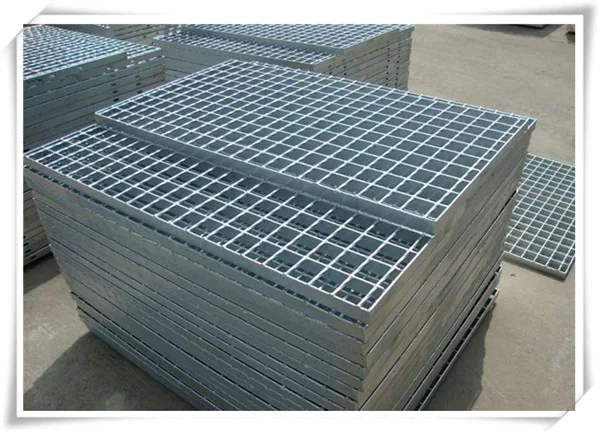
Before installation, carefully read the drawings and packing list, then unpack according to them. Steel grating is installed on steel structural flat members and must not move laterally or detach from the supports after installation. There are mainly two methods: welding and special mounting clips. If the grating does not need to be removed or moved after installation, welding is recommended to fix it.
After installation, check each panel's fixing points and flatness; put into use only after confirming no warping or looseness.
Installation most affects the later user experience. The grating must not be laid in the wrong direction; the bearing bar direction should be consistent with the main load direction - the most easily overlooked point on site. Fixings should also be fully provided according to the layout drawing; missing one may cause local loosening. The same requirement applies to hot-dip galvanized steel grating.
Common models and sizes for carefully confirming flat bar direction before steel grating installation
Main specification comparison is as follows:
Flat bar insert grating is an extended product of press-locked steel grating, made by inserting small flat bars between large flat bars and welding. It is similar to press-locked grating and round-bar pierced grating. The advantage of flat bar pierced grating is good product quality, sturdiness, durability and high aesthetics. It is often used in playgrounds, city squares and other civilian places, or industrial platforms with high requirements.
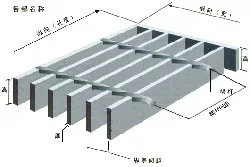
Determining the load direction of steel grating is a rigorous issue that every user must understand clearly, so as to avoid errors when communicating with the manufacturer and prevent the purchased product from failing to meet the load requirements of the site. What is the load direction of steel grating? The load direction is the flat bar direction. The bearing bars are what bear the main load of the grating; the twisted square cross bars mainly support the bearing bars and have little load-bearing capacity.
The above are common specifications; actual ordered dimensions and tolerance requirements shall be confirmed against the layout drawing.
Bigger is not always better. Steel grating selection should be as economical as possible while meeting load requirements; over-thickening increases self-weight and cost and complicates installation. The product page offers a fuller comparison for galvanized grating; refer to it before deciding.
Further notes: Common combinations of hot-dip galvanized steel grating and galvanized grating
Besides what this article covers, hot-dip galvanized steel grating is also common in actual projects. It shares similarities with this article's subject in structure and fabrication; for selection, check span, load and service environment in the same order. If both types of components are used in the same project, we recommend unifying material and surface treatment to avoid later galvanic corrosion or inconsistent appearance.
- For all product specifications and theoretical weights by series, visit Steel Grating Product Center
- To estimate cost by size and quantity, use Instant Quote PageSubmit Requirements
- To see how similar projects were executed, refer to Project Cases field applications
FAQ
How to choose between hot-dip galvanizing and cold galvanizing?
The two anti-corrosion mechanisms differ: hot-dip galvanizing immerses steel in molten zinc to form a metallurgically bonded coating, thick and long-lasting, suitable for outdoor and humid environments; cold galvanizing is electrochemical deposition with a thinner, more uniform appearance, suitable for dry indoor environments or applications requiring high dimensional precision.
Why do different manufacturers quote different weights for the same specifications?
The main difference lies in the actual measured thickness and tolerance control of the bearing bars. When bars are supplied at the lower tolerance limit, weight per unit area falls below the theoretical value, and load capacity drops accordingly. We recommend specifying thickness tolerance clearly when purchasing.
What information is needed for custom sizes?
Usually you need to provide the panel dimensions (length x width), bearing bar specs and direction, center-to-center pitch of bearing bars and cross bars, surface treatment, and special requirements such as cutouts, corner notches and banding. Site photos or sketches are even better.
The above is for sizing and construction reference. To verify specific parameters or request a quotation, please visitInstant Quote Page, or contact our technical staff.
If you already have drawings or site dimensions, submit them directly and we will help verify specifications and layout, avoiding on-site cutting and rework caused by mismatched models. Without drawings, site photos and approximate dimensions are enough for an estimate.