







On welded and press-locked steel grating, this article covers what welded steel grating is, what press-locked steel grating is, and how to choose by scenario in turn, giving actionable criteria rather than theory alone. Those with drawings or site dimensions can check against the key points; steel grating trench covers can follow the same order.
What Is Welded Steel Grating?
Chapter 4 of the YB/T 4001.1-2019 standard states clearly: welded steel grating is grating fixed at every intersection of bearing bars and cross bars by pressure resistance welding. Simply put, the flat bars and twisted square bars are arranged, and the machine presses and electrifies - one snap and the weld is done.
This process gives firm weld points and high production efficiency, making it the most common steel grating on the market. The cross bars are usually twisted square bars or round bars, fused together by the resistance heat generated by current.
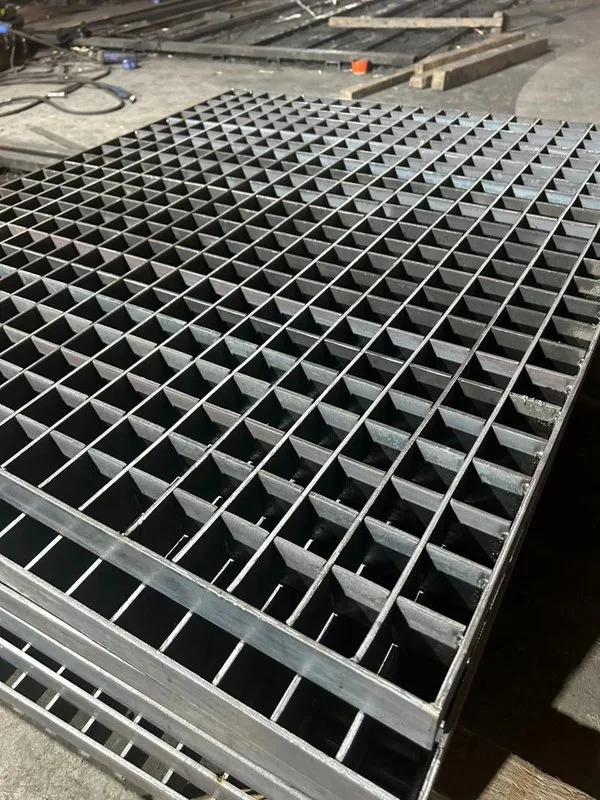
▲ Welded steel grating - every intersection of bearing bars and cross bars is fixed by pressure resistance welding
After installation, a full check is recommended: panel warping, completeness of fixings, and visible height differences between adjacent panels. Such issues with welded and press-locked steel grating are cheapest to fix at the acceptance stage and troublesome to rework after commissioning. Acceptance of steel grating trench covers can follow the same standard.
What Is Press-Locked Steel Grating?
Press-locked steel grating uses a different process: slots are pre-cut in the bearing bars, and the cross bars are pressed in by interference fit, fixed by mechanical interlock without electricity or welding.
Press-locked steel grating features very tight connections at every intersection and a neat appearance, suited to applications with high aesthetic requirements. But its production efficiency is lower than welded grating and the cost is higher.
The installation quality of welded and press-locked steel grating depends largely on preparation: whether the supporting surface is level, whether beam spacing matches the layout, and whether fixings are prepared in advance. With these in place, installation itself is not complicated. If on-site cutting is needed, the cut-edge treatment requirements for trench covers must also be clearly stated.
How to Choose? Look at the Scenario
Selection advice:
Welded steel grating: cost-effective, suited to industrial platforms, walkways, trench covers, and other common scenarios, accounting for over 90% of the market.
Press-locked steel grating: refined appearance, suited to commercial buildings, decorative grilles, and places with high requirements for gap precision.
The standard also notes that steel grating that cannot be made by pressure resistance welding may be made by other methods. This leaves room for press-locking - some special specifications and special-shaped grating cannot be press-welded and must rely on press-locking.
-- Lao Liang @ Anping Steel Grating Factory, July 2026
Different application scenarios emphasize different requirements for welded and press-locked steel grating: pedestrian walkways value anti-slip and comfort; vehicle areas value panel stiffness and fixing reliability; drainage trench covers value water-flow area and anti-theft. Clarify the usage first, then the specifications, to avoid detours - the same thinking applies to trench covers.
Further Reading: Selection Reference for Steel Grating Trench Covers and Trench Covers
If a project uses both steel grating trench covers and trench covers, consider them together on the same layout drawing. The benefit: edging, fixing, and openings at junctions can be handled uniformly, avoiding size conflicts during on-site installation and making later maintenance easier.
- For all product specifications and theoretical weights by series, visit Steel Grating Product Center
- To estimate cost by size and quantity, use Instant Quote PageSubmit Requirements
- To see how similar projects were executed, refer to Project Cases field applications
The above is general guidance. For a specific project, we still recommend submitting span, load class and service environment to our technicians for review. Steel grating is a load-bearing component; rework caused by wrong specification choices costs far more than the time spent on upfront calculation.