







This article focuses on steel grating and introduces, in order, key points of the steel grating overview, common models and sizes, and basic concepts, with practical advice added after each section. If you are comparing options or preparing a purchase, you can check the items one by one in the order given. The parts concerning galvanized steel grating can also be cross-checked against the entries here, and any points that conflict with site conditions should be adjusted accordingly.
Key Points of the Steel Grating Overview
The following aspects most need to be confirmed in advance in actual procurement and use:
Steel Grating
The above points can serve as a pre-purchase checklist; confirm each item before moving to the quotation stage.
In terms of price composition, the cost of steel grating is mainly affected by steel market prices, specification dimensions, surface treatment, and processing difficulty, with zinc layer thickness and special-shape processing having a large impact on unit price. Clarifying these items when requesting a quote makes quotations comparable; the price factors for galvanized steel grating are essentially the same.
Common Models and Sizes of Steel Grating
Common specifications and corresponding parameters are summarized below; confirm each item before ordering:
An open-mesh plate-type steel component made by orthogonally combining flat bearing bars and cross bars at a fixed pitch and fixing them together; by manufacturing method it is divided into welded steel grating and press-locked steel grating.
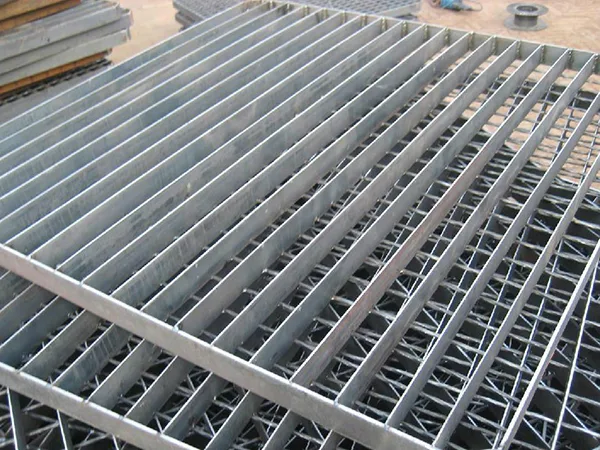
Bearing Bar
The flat bar in the steel grating that bears the load
Cross Bar
The above are common specifications; actual ordered dimensions and tolerance requirements shall be confirmed against the layout drawing.
What is most easily overlooked in spec tables are tolerances and end treatment. Steel grating usually has machining allowance in the length direction; if embedded installation is used on site, edge closing and corner notch requirements must be stated in advance. Hot-dip galvanized steel grating is handled similarly in these details; we recommend marking them clearly on the drawings as well.
Twisted square bars, round bars, or flat bars fixed to the flat bearing bars
Clear Mesh Opening
The diameter of the largest inscribed circle of the open mesh openings of steel grating
Edge Banding
At the ends, sides, or other openings and cut edges of the flat bearing bars of steel grating, flat bars, angle steel, C-section cross bars, or other materials are used as banding plates for fixing.
Decorative Banding
Steel grating edge banding used only to improve appearance, which does not bear or transfer the load of the flat bearing bars
Load-Bearing Banding
Steel grating edge banding at special platform locations where the flat bearing bar ends are unsupported and the banding plate must bear and transfer the load of the flat bearing bars
Toe Plate
A protective baffle fixed around the platform edges or along the cutout openings of steel grating, standing higher than the flat bearing bars
After installation, a full inspection is recommended: check for panel warping, missing fasteners, and noticeable height differences between adjacent panels. Such issues with steel grating are cheapest to fix at the acceptance stage, while rework after commissioning is far more troublesome. The acceptance points for hot-dip galvanized steel grating can follow the same standard.
Further notes: Common combinations of galvanized grating and hot-dip galvanized steel grating
Besides what this article covers, galvanized grating is also common in actual projects. It shares similarities with this article's subject in structure and fabrication; for selection, check span, load and service environment in the same order. If both types of components are used in the same project, we recommend unifying material and surface treatment to avoid later galvanic corrosion or inconsistent appearance.
- For all product specifications and theoretical weights by series, visit Steel Grating Product Center
- To estimate cost by size and quantity, use Instant Quote PageSubmit Requirements
- To see how similar projects were executed, refer to Project Cases field applications
FAQ
Why do different manufacturers quote different weights for the same specifications?
The main difference lies in the actual measured thickness and tolerance control of the bearing bars. When bars are supplied at the lower tolerance limit, weight per unit area falls below the theoretical value, and load capacity drops accordingly. We recommend specifying thickness tolerance clearly when purchasing.
How to choose between hot-dip galvanizing and cold galvanizing?
The two anti-corrosion mechanisms differ: hot-dip galvanizing immerses steel in molten zinc to form a metallurgically bonded coating, thick and long-lasting, suitable for outdoor and humid environments; cold galvanizing is electrochemical deposition with a thinner, more uniform appearance, suitable for dry indoor environments or applications requiring high dimensional precision.
What maintenance is required during daily use?
Maintenance mainly involves periodically checking whether fasteners are loose, whether touch-up paint has peeled off, and whether the panel surface shows obvious deformation or rust. Issues found should be dealt with promptly; overall maintenance is minimal.
The above is for sizing and construction reference. To verify specific parameters or request a quotation, please visitInstant Quote Page, or contact our technical staff.
If you already have drawings or site dimensions, submit them directly and we will help verify specifications and layout, avoiding on-site cutting and rework caused by mismatched models. Without drawings, site photos and approximate dimensions are enough for an estimate.