







This article focuses on steel grating and explains, in turn, its installation and construction points, basic concepts of steel grating, and basic concepts, with practical advice added after each section. If you are comparing options or preparing a purchase, you can check the points in order; the parts concerning hot-dip galvanized steel grating can be confirmed against the entries here, and any mismatch with site conditions can be adjusted accordingly.
Steel Grating Installation and Construction Key Points
On-site construction generally follows the steps and technical requirements below; complete the technical disclosure before starting work:
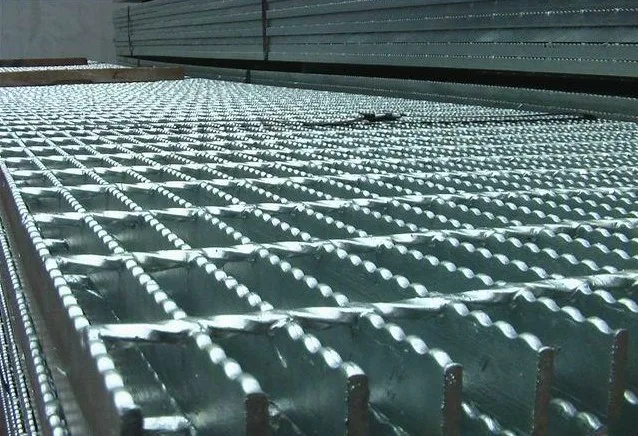
Steel grating fixing methods: welding or fixing with installation clips can be used. Welding gives permanent fixing that will not loosen; installation clips do not damage the hot-dip galvanized layer and are easy to remove. The safest method is to omit the lower clip and weld the screw head directly upside down onto the beam, ensuring the steel grating cannot slip off the beam if a clip loosens
After installation, check each panel's fixing points and flatness; put into use only after confirming no warping or looseness.
Regarding corrosion protection, one thing is easily overlooked: on-site cutting and welding damage the original coating, and these areas need zinc touch-up after construction, otherwise rust often starts from the cut edges. Hot-dip galvanized steel grating has the same issue; it is best to include this in the technical requirements at the construction disclosure.
Basic Concepts of Steel Grating
This section first clarifies the basic concepts, structural forms and common names, laying the groundwork for what follows.
The anti-slip layer of the steel grating is adhered to the surface of the metal plate through a primer layer, and the anti-slip layer is a sand grain layer. Sand is a widely available material, and using it as the anti-slip material can greatly reduce production cost; at the same time, the anti-slip layer coats many sand grains on the metal plate surface to increase surface roughness, using the difference in grain size between sand grains to achieve the anti-slip function, so the anti-slip effect is good. The sand layer is made of 60-120 mesh quartz sand. Quartz sand is a hard, wear-resistant, chemically stable silicate mineral that can greatly improve the anti-slip effect of steel grating. Quartz sand in this particle size range has good anti-slip performance and feels fairly comfortable underfoot; the uniform grain size also improves the appearance of the steel grating surface.
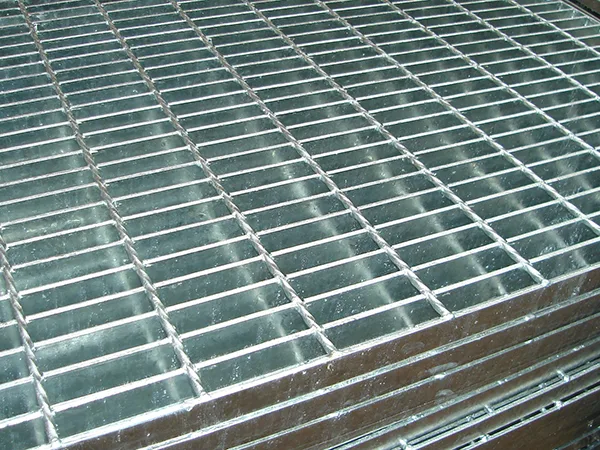
If steel grating is exposed to air or submerged for a long time without effective protection, its surface will rust. Especially due to water level changes, grating often sits in alternating wet-dry environments, and various chemical media in air or water further promote electrochemical action. Meanwhile, as water is the corrosive medium, corrosion accelerates with higher flow velocity and temperature. Thus the working environment of the grating makes its rusting more severe. Damage from metal corrosion degrades the component material in appearance, color and performance, affecting normal use.
Once you grasp these basic concepts, the specifications and sizing recommendations that follow will be much easier to understand.
One reminder: price is not the only consideration. Later maintenance cost, replacement difficulty and service life of steel grating all affect the total cost, and a low-price option may not pay off in these respects. When budgeting, factor in the full life-cycle cost of galvanized steel grating as well.
Further notes: Common combinations of hot-dip galvanized steel grating and galvanized grating
Hot-dip galvanized steel grating and galvanized grating are different specification forms within the same product system. The selection logic is the same as described in this article: first the usage type, then span and load to determine specifications, and finally the environment to determine surface treatment. Their corrosion protection and anti-slip requirements may differ; state them separately when ordering rather than writing one general technical requirement.
- For all product specifications and theoretical weights by series, visit Steel Grating Product Center
- To estimate cost by size and quantity, use Instant Quote PageSubmit Requirements
- To see how similar projects were executed, refer to Project Cases field applications
FAQ
Why do different manufacturers quote different weights for the same specifications?
The main difference lies in the actual measured thickness and tolerance control of the bearing bars. When bars are supplied at the lower tolerance limit, weight per unit area falls below the theoretical value, and load capacity drops accordingly. We recommend specifying thickness tolerance clearly when purchasing.
What maintenance is required during daily use?
Maintenance mainly involves periodically checking whether fasteners are loose, whether touch-up paint has peeled off, and whether the panel surface shows obvious deformation or rust. Issues found should be dealt with promptly; overall maintenance is minimal.
How to choose between hot-dip galvanizing and cold galvanizing?
The two anti-corrosion mechanisms differ: hot-dip galvanizing immerses steel in molten zinc to form a metallurgically bonded coating, thick and long-lasting, suitable for outdoor and humid environments; cold galvanizing is electrochemical deposition with a thinner, more uniform appearance, suitable for dry indoor environments or applications requiring high dimensional precision.
The above is for sizing and construction reference. To verify specific parameters or request a quotation, please visitInstant Quote Page, or contact our technical staff.
Note that this article presents sizing approaches and general practice, and does not constitute a strength commitment for any specific project. For load-bearing safety-critical areas, the design drawings and on-site calculations shall prevail; contact our technical staff if in doubt.