







This article introduces steel grating trench covers in the order of the performance of their process features, commonly used process features, and basic concepts. Each section tries to give actionable ways of judging; if you only need a quick conclusion, start with the key points at the beginning of each section. The same approach applies to hot-dip galvanized steel grating.
Performance Features of the Process Features of Steel Grating Trench Covers
Main features can be summarized as follows:
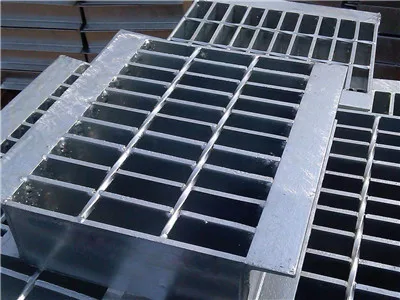
Steel grating trench cover features: attractive appearance with simple lines, a silver finish, and a modern look. Best drainage: water leakage area of 83.3%, twice that of cast iron. Hot-dip galvanizing: rust prevention, easy maintenance and replacement. Anti-theft design: the cover and frame are hinged for safety and easy opening.
Overall, selection should weigh span, load and service environment together.
Material and surface treatment determine the on-site durability of steel grating trench covers. For the same steel grating, the treatment differs greatly between a dry indoor environment and a coastal or chemical environment, so the service environment should be raised as the primary condition during selection. This judgment also holds for hot-dip galvanized steel grating.
Common Models and Sizes of the Process Features of Steel Grating Trench Covers
Main specification comparison is as follows:
Investment savings: large span, heavy load, lower cost than cast iron, saving the cost of theft and breakage. High strength and toughness far exceed cast iron, suitable for large-span, heavy-load environments such as docks and airports. More specifications: meeting different requirements for environment, load, span, size, and shape.
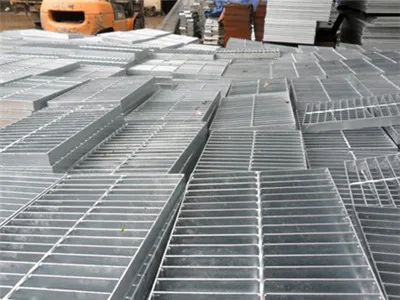
Steel grating trench cover process: according to the different sites where customers use them, our company can provide trench (well) covers in various specifications, with surfaces hot-dip galvanized, cold galvanized (electroplated), or left untreated, and the cover size can be selected.
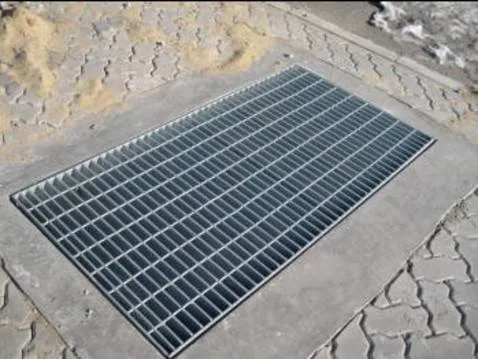
The flat bar direction is the bearing (support) direction, and the flat bar length L is fixed according to the trench (well) width. Along the length of the trench, the standard panel width is 995 mm with a 5 mm gap between panels; where the trench length is less than 1 m, the remaining part is a fixed size, and the steel grating type is selected according to the trench width and load requirements. Standard sizes are recommended for design and construction. Our company can design and produce various sizes or other functions to user requirements.
The above are common specifications; actual ordered dimensions and tolerance requirements shall be confirmed against the layout drawing.
Bigger specifications are not always better. Steel grating trench cover selection should be as economical as possible while meeting load requirements; excessive thickness adds dead weight and cost and makes installation harder. The product page has a fuller comparison for hot-dip galvanized steel grating, which can be consulted before deciding.
Further notes: Common combinations of hot-dip galvanized steel grating and hot-dip galvanized steel grating
If a project uses both hot-dip galvanized steel grating and hot-dip galvanized steel grating, we recommend planning them on the same layout drawing. This way edge closing, fixing and cutouts at junctions can be handled uniformly, avoiding dimension conflicts during installation and making later maintenance easier.
- For all product specifications and theoretical weights by series, visit Steel Grating Product Center
- To estimate cost by size and quantity, use Instant Quote PageSubmit Requirements
- To see how similar projects were executed, refer to Project Cases field applications
FAQ
What maintenance is required during daily use?
Maintenance mainly involves periodically checking whether fasteners are loose, whether touch-up paint has peeled off, and whether the panel surface shows obvious deformation or rust. Issues found should be dealt with promptly; overall maintenance is minimal.
What is most often overlooked during installation and acceptance?
First, bearing bars installed in the wrong direction reduce load capacity; second, insufficient fixing points or missing zinc touch-up paint; third, support beam spacing inconsistent with the layout drawing. These three items are most often overlooked on site.
How to choose between hot-dip galvanizing and cold galvanizing?
The two anti-corrosion mechanisms differ: hot-dip galvanizing immerses steel in molten zinc to form a metallurgically bonded coating, thick and long-lasting, suitable for outdoor and humid environments; cold galvanizing is electrochemical deposition with a thinner, more uniform appearance, suitable for dry indoor environments or applications requiring high dimensional precision.
The above is for sizing and construction reference. To verify specific parameters or request a quotation, please visitInstant Quote Page, or contact our technical staff.
If you already have drawings or site dimensions, submit them directly and we will help verify specifications and layout, avoiding on-site cutting and rework caused by mismatched models. Without drawings, site photos and approximate dimensions are enough for an estimate.