







This article focuses on stair treads, covering three parts in turn - features of steel stair treads, typical application scenarios, and the conditions to confirm during selection - with practical advice added after each part. If you are comparing schemes or preparing procurement, check through in the order given; the parts involving galvanized grating can also be confirmed against this article, and adjusted to the actual site conditions where they differ.
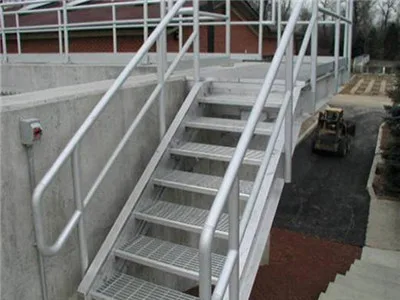
Steel stair treads are one of many types of plate materials, long favored by customers for their strong corrosion resistance and high strength. Steel stair treads are extremely widely used: on platforms and walkways of power plants, waterworks and other factories, in municipal and sanitation engineering, and as floor platforms of theaters, viewing platforms, parking lots and other large venues.
- Treads and stair handrails are in constant contact with people, which means these parts have a shorter life than other components and therefore need frequent protection with special wax or floor wax. In addition, the wear of some tread coatings, such as light-cured coatings, is relative - they also have a certain service life. To protect wooden treads after a period of use, a carpet can be laid over the center of the stair corridor, with the color chosen by the owner according to local wear; this not only protects the stairs but also decorates the space to some extent. Wooden stairs are easily affected by moisture and prone to deformation, cracking, peeling paint and other problems. Metal stairs with wooden components should not be assumed rust-free: metal rusts when damp. In fact, in daily life stairs do not need heavy water scrubbing - simply spray a spray-type cleaner on the surface and wipe with a soft cloth.
- Galvanized treads are produced as this steel grating, which itself cannot withstand strong sunlight or large temperature differences; if produced under unsuitable conditions, the stair treads are affected. Stair treads should therefore avoid long exposure to strong sunlight or drastic room-temperature swings, as these may cause premature aging of the tread coating.
- If a tread is accidentally soaked in water, it should be wiped dry as soon as possible and allowed to dry naturally, without using electric heaters, drying machines or direct sunlight. We inspect the treads regularly and check the joints of all components to prevent loosening or insect decay. When stairs are installed, although the engineers have fastened them tightly into a whole, all components may shift slightly under changes of temperature and humidity. Components of wooden stairs, metal or other materials are usually damaged by wear, collapse, insect attack or mold - these of course require professional repair. More important, however, is preventive maintenance: proper care can greatly extend the life of the stair treads.
Features of Steel Stair Treads
Its overall performance focuses on the following aspects; we suggest comparing item by item in actual selection:
- . Attractive appearance with a bright, glossy surface.
- . Strong corrosion resistance, with a service life of 30-50 years.
- . Steel stair treads have high strength and a light structure.
- . Steel stair treads are easy to install, disassemble and so on.
- . Good ventilation, daylighting, heat dissipation, slip resistance and explosion-proof performance.
- . No accumulation of dirt, rain, snow or water; self-cleaning and easy to maintain.
Overall, selection should weigh span, load and service environment together.
Regarding corrosion protection, one thing is easily overlooked: on-site cutting and welding damage the original coating, and these areas need zinc touch-up after construction, otherwise rust often starts from the cut edges. Hot-dip galvanized steel grating has the same issue; it is best to include this in the technical requirements at the construction disclosure.
Typical Applications
Main applications are as follows:
- Industrial Platforms & Maintenance Walkways: equipment platforms and inspection passages in power plants, chemical plants and steel-structure workshops;
- Municipal & Landscape: road drainage trench covers, rainwater grates, tree grates, park boardwalks;
- Transportation & Ports: wharf trestles, multi-story parking garage lanes, railway bridge walkways;
- Environmental & Water Treatment: walkways in wastewater treatment plants, tank platforms, screening machine platforms;
- Others: elevated tower platforms, stair treads, fences and railings, etc.
If your working conditions fall outside the above range, you can provide site photos and dimensions, and our technicians will help assess them.
To judge quickly whether stair treads suit a given site, three angles suffice: whether there are corrosive media, whether the traffic is pedestrians or vehicles, and roughly what span is involved. With these three points clear, the required specifications and surface treatment of the hot-dip galvanized steel grating can basically be determined.
Key Conditions to Confirm During Selection
We recommend confirming the following factors in order according to service conditions during selection:
- First clarify the span and support beam spacing to determine the required series;
- Then check load requirements by usage type (pedestrian, maintenance, vehicular);
- Finally, determine the surface treatment by service environment (dry indoor, outdoor, coastal, chemical).
Placing the order after confirming these items effectively avoids specification mismatch and on-site rework.
Actual parameters of the same model may differ slightly between manufacturers; acceptance is based on measured values. Key dimensions of the stair treads should be spot-checked, especially for batch deliveries. The corresponding parameters of hot-dip galvanized steel grating can be checked in the same way; communicate promptly if deviations are found.
Further reading: Sizing reference for galvanized grating and hot-dip galvanized steel grating
If a project uses both galvanized grating and hot-dip galvanized steel grating, we recommend planning them on the same layout drawing. This way edge closing, fixing and cutouts at junctions can be handled uniformly, avoiding dimension conflicts during installation and making later maintenance easier.
- For all product specifications and theoretical weights by series, visit Steel Grating Product Center
- To estimate cost by size and quantity, use Instant Quote PageSubmit Requirements
- To see how similar projects were executed, refer to Project Cases field applications
FAQ
What information is needed for custom sizes?
Usually you need to provide the panel dimensions (length x width), bearing bar specs and direction, center-to-center pitch of bearing bars and cross bars, surface treatment, and special requirements such as cutouts, corner notches and banding. Site photos or sketches are even better.
How to choose between hot-dip galvanizing and cold galvanizing?
The two anti-corrosion mechanisms differ: hot-dip galvanizing immerses steel in molten zinc to form a metallurgically bonded coating, thick and long-lasting, suitable for outdoor and humid environments; cold galvanizing is electrochemical deposition with a thinner, more uniform appearance, suitable for dry indoor environments or applications requiring high dimensional precision.
Can the values in the article be applied directly?
Values in this article come from relevant standard clauses or common industry practice. For actual selection, recalculate based on site span, load class and service environment; direct copying is not recommended.
The above is for sizing and construction reference. To verify specific parameters or request a quotation, please visitInstant Quote Page, or contact our technical staff.
Note that this article presents sizing approaches and general practice, and does not constitute a strength commitment for any specific project. For load-bearing safety-critical areas, the design drawings and on-site calculations shall prevail; contact our technical staff if in doubt.