







Many projects focus only on price when purchasing heavy-duty steel grating, overlooking specification matching and anti-corrosion requirements, which often leads to rework. This article lists the conditions to confirm in the order of specifications, application range and engineering fields, and basic concepts, and explains trade-offs under common conditions; the sections on hot-dip galvanized steel grating can be used as a reference for technical disclosure.
Specifications of Heavy-Duty Steel Grating
Main specification comparison is as follows:
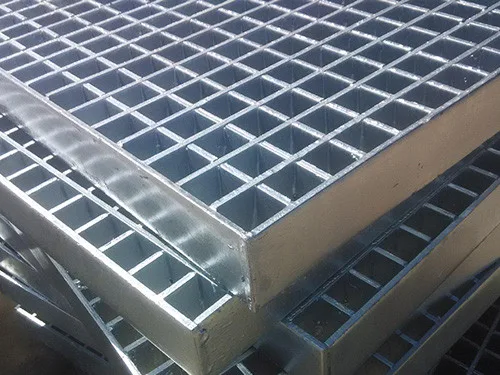
Steel grating is an open steel component made of bearing flat bars and cross bars combined orthogonally at set pitches and fixed by welding or press-locking; cross bars are usually twisted square bars, and round bars or flat bars can also be used.
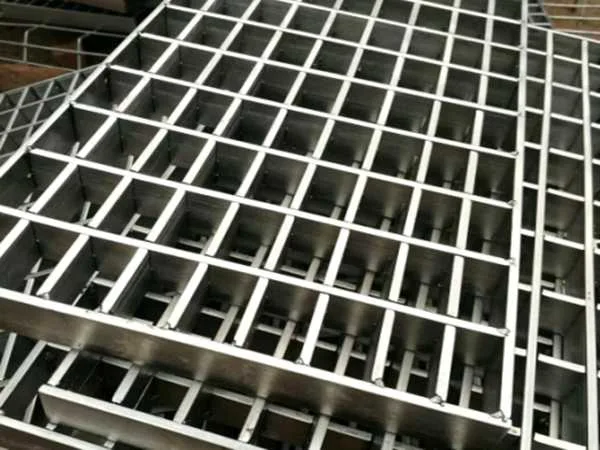
The above are common specifications; actual ordered dimensions and tolerance requirements shall be confirmed against the layout drawing.
Bigger specifications are not always better. Heavy-duty steel grating should be selected economically while meeting load requirements; excessive thickening increases self-weight and cost and complicates installation. The product page offers a fuller comparison for hot-dip galvanized steel grating panels - refer to it before deciding.
Scope of Application & Engineering Fields
Main applications are as follows:
Steel grating has been widely applied in all industries at home and abroad, mainly as industrial platforms, stair treads, handrails, walkway flooring, railway bridge walkways, elevated tower platforms, drainage trench covers, manhole covers, road grilles, multi-story parking, and fences for institutions, factories, enterprises, sports grounds and garden villas.
If your working conditions fall outside the above range, you can provide site photos and dimensions, and our technicians will help assess them.
Different scenarios emphasize different requirements for heavy-duty steel grating: pedestrian walkways value slip resistance and comfort; vehicle areas value panel stiffness and fixing reliability; trench covers value open area and anti-theft. Clarify the usage first, then the specification, to avoid detours - the same applies to hot-dip galvanized steel grating.
What Is Heavy-Duty Steel Grating
Hot-dip galvanizing, also called hot galvanizing, is an effective metal anti-corrosion method, mainly used for metal structures across industries. Derusted steel parts are immersed in molten zinc at about 500°C so that a zinc layer adheres to the steel surface, achieving corrosion protection.
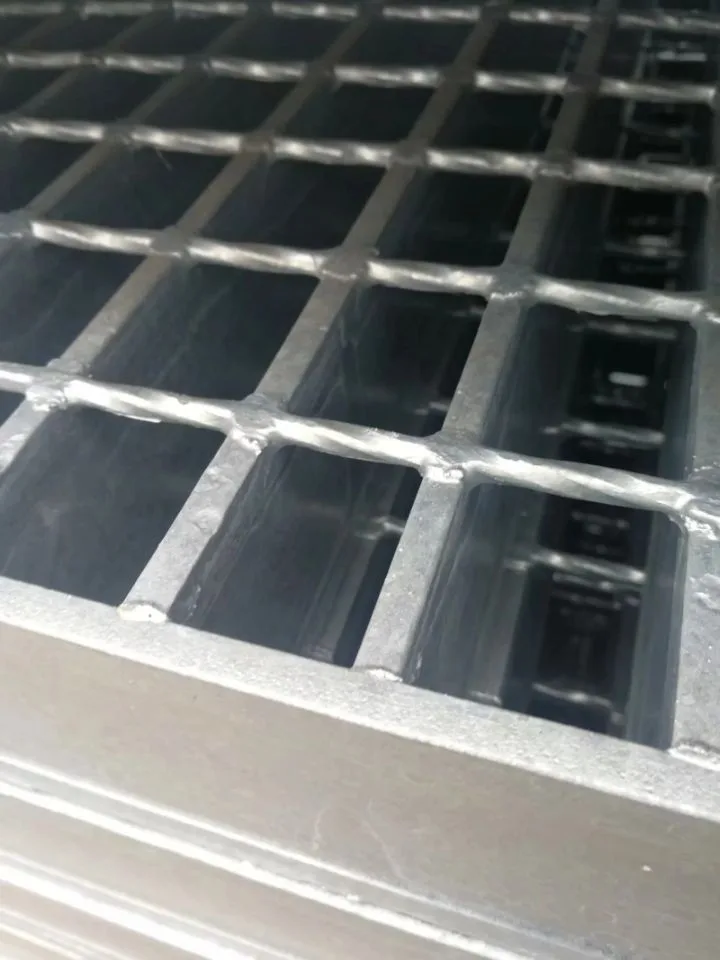
Regarding corrosion protection, one thing is easily overlooked: on-site cutting and welding damage the original coating, and these areas need zinc touch-up after construction, otherwise rust often starts from the cut edges. Hot-dip galvanized steel grating has the same issue; it is best to include this in the technical requirements at the construction disclosure.
Material and Anti-Corrosion Requirements
Hot-dip galvanizing is one of the most widely used and cost-effective steel surface treatment methods in the world today. It plays an immeasurable and irreplaceable role in extending the anti-corrosion life of steel and saving energy and materials. Hot-dip galvanized coatings are generally above 35μm, even up to 200μm, with good coverage, dense coating and no organic inclusions. As is well known, zinc protects against atmospheric corrosion both mechanically and electrochemically; under atmospheric corrosion, protective films of ZnO, Zn(OH)2 and basic zinc carbonate form on the zinc surface, slowing corrosion to a degree, and when this film (also called white rust) is damaged, a new film forms again.
Choosing a surface treatment is essentially a trade-off between initial investment and later maintenance. Requirements can be relaxed for heavy-duty steel grating in dry indoor environments and should be raised for outdoor or humid environments. Hot-dip galvanized steel grating can be selected following the same logic.
Further reading: Selection points for hot-dip galvanized steel grating and hot-dip galvanized steel grating
Hot-dip galvanized steel grating and hot-dip galvanized steel grating are different specification forms within the same product system. The selection logic is the same as described in this article: first the usage type, then span and load to determine specifications, and finally the environment to determine surface treatment. Their corrosion protection and anti-slip requirements may differ; state them separately when ordering rather than writing one general technical requirement.
- For all product specifications and theoretical weights by series, visit Steel Grating Product Center
- To estimate cost by size and quantity, use Instant Quote PageSubmit Requirements
- To see how similar projects were executed, refer to Project Cases field applications
FAQ
How to choose between hot-dip galvanizing and cold galvanizing?
The two anti-corrosion mechanisms differ: hot-dip galvanizing immerses steel in molten zinc to form a metallurgically bonded coating, thick and long-lasting, suitable for outdoor and humid environments; cold galvanizing is electrochemical deposition with a thinner, more uniform appearance, suitable for dry indoor environments or applications requiring high dimensional precision.
Can the values in the article be applied directly?
Values in this article come from relevant standard clauses or common industry practice. For actual selection, recalculate based on site span, load class and service environment; direct copying is not recommended.
What information is needed for custom sizes?
Usually you need to provide the panel dimensions (length x width), bearing bar specs and direction, center-to-center pitch of bearing bars and cross bars, surface treatment, and special requirements such as cutouts, corner notches and banding. Site photos or sketches are even better.
The above is for sizing and construction reference. To verify specific parameters or request a quotation, please visitInstant Quote Page, or contact our technical staff.
Note that this article presents sizing approaches and general practice, and does not constitute a strength commitment for any specific project. For load-bearing safety-critical areas, the design drawings and on-site calculations shall prevail; contact our technical staff if in doubt.