




The core of steel grating selection is three things: span, load and environment. Span determines the series, load determines the bar size and spacing, and environment determines the surface treatment. This page unfolds in that order and explains common pairings of steel grating series in actual projects, giving you a complete judgment framework once read.
Items to Confirm for Steel Grating Selection
This page does not list a fixed specification table, as such products are usually custom-fabricated to site conditions. We recommend confirming each item in the table above before inquiry: once mismatched with actual site conditions, refabrication is often required later.ProductsCommon specifications are organized by series for reference.
| Items to Confirm | What Needs to Be Clarified | Common Practices |
|---|---|---|
| Material Requirements | Carbon steel or stainless steel, grade requirements | Determine by corrosion grade of service environment |
| Surface Treatment | Hot-dip galvanized, painted, or untreated | Hot-dip galvanizing recommended for outdoor and humid environments |
| Dimensions | Panel length and width, whether openings or notches are needed | Custom fabrication per layout drawing |
| End Treatment | Whether banding or end plates are needed | Banding recommended for open edges |
| Acceptance Requirements | Acceptance Criteria for Flatness, Tolerances and Appearance | Recommended to specify in the technical agreement |
| Packaging & Shipping | Whether packing and moisture protection are needed | Packing and cushioning recommended for long-distance shipping |
Steel Grating
From a practical application perspective, the key points of steel grating are further explained below:
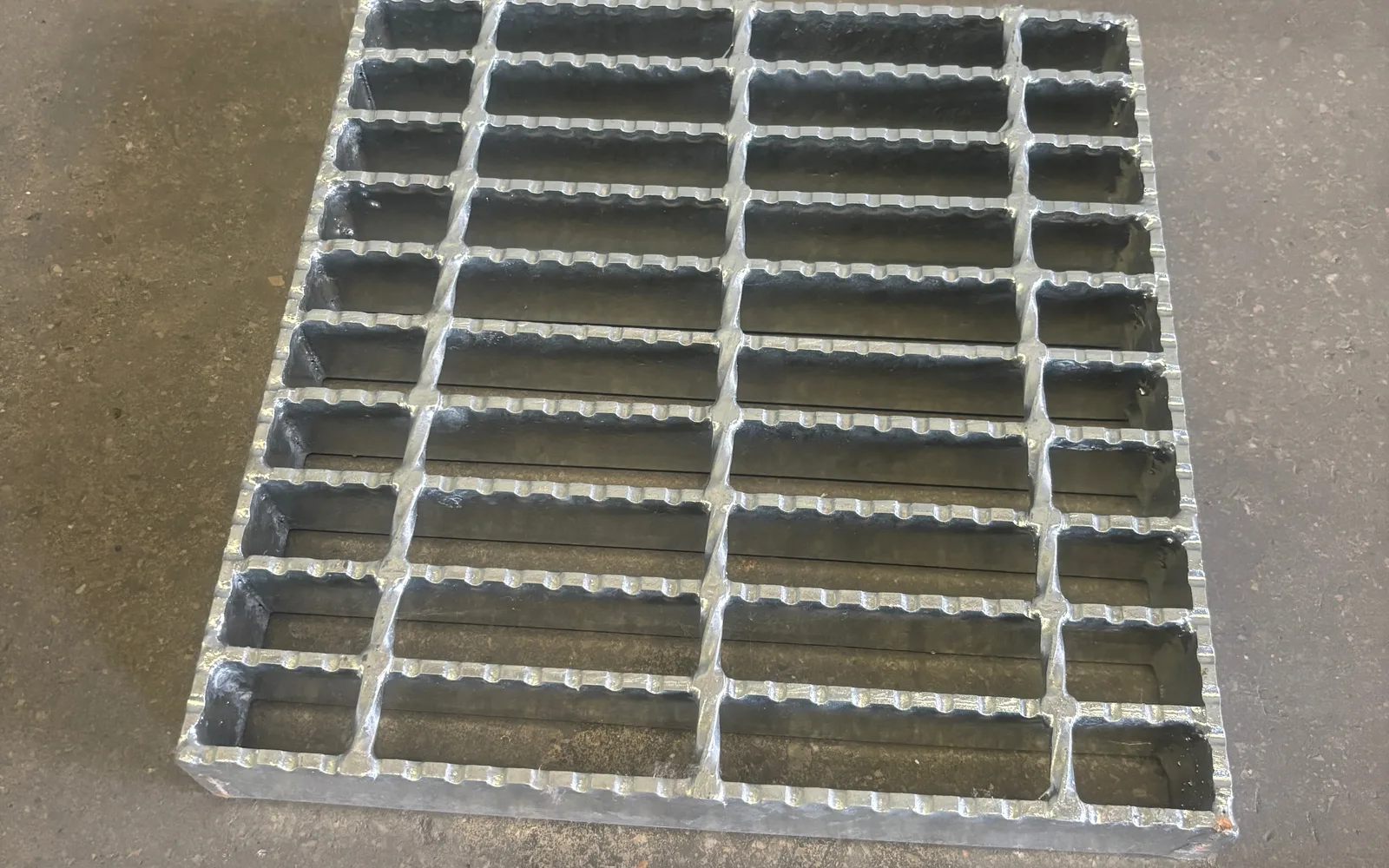
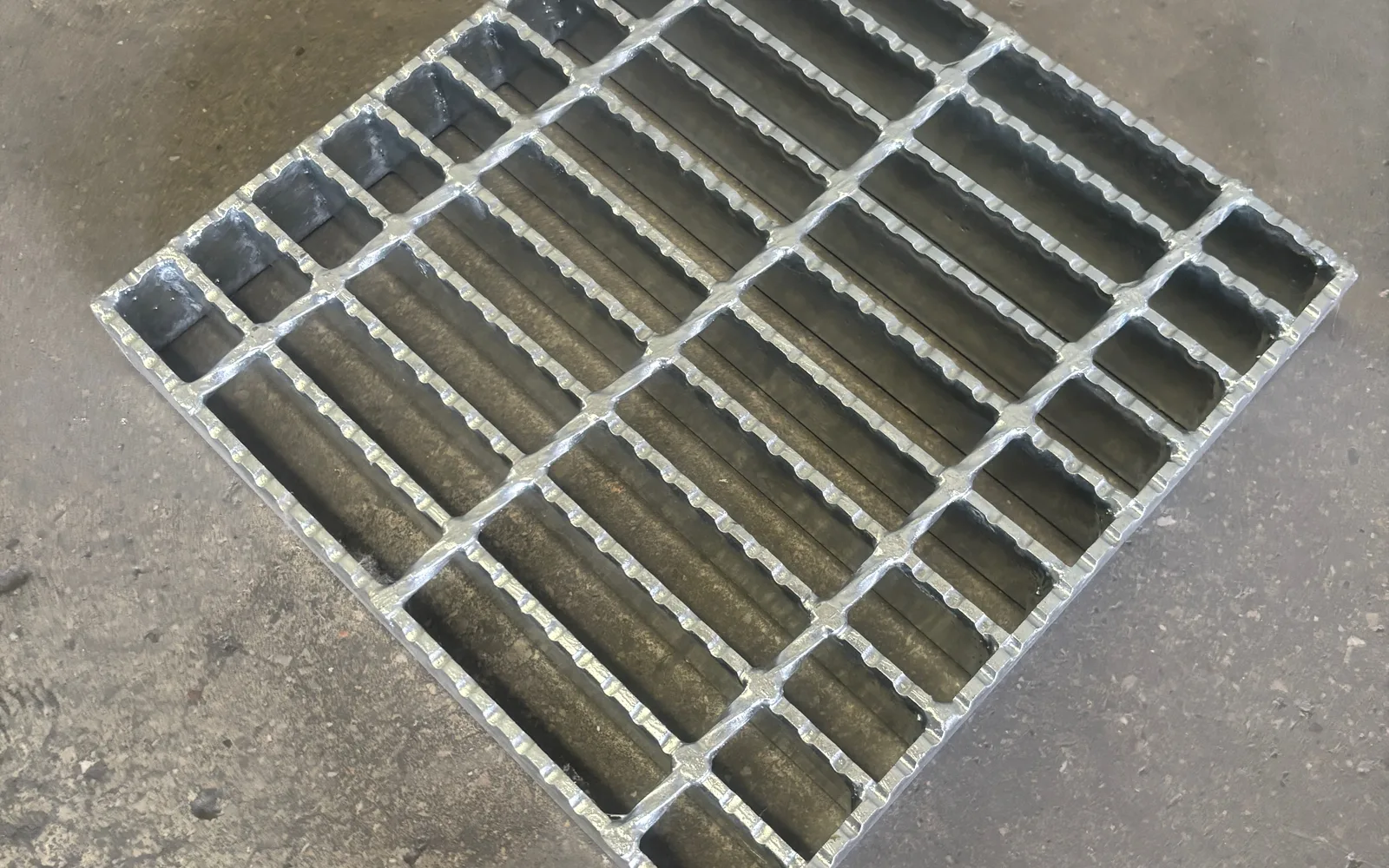
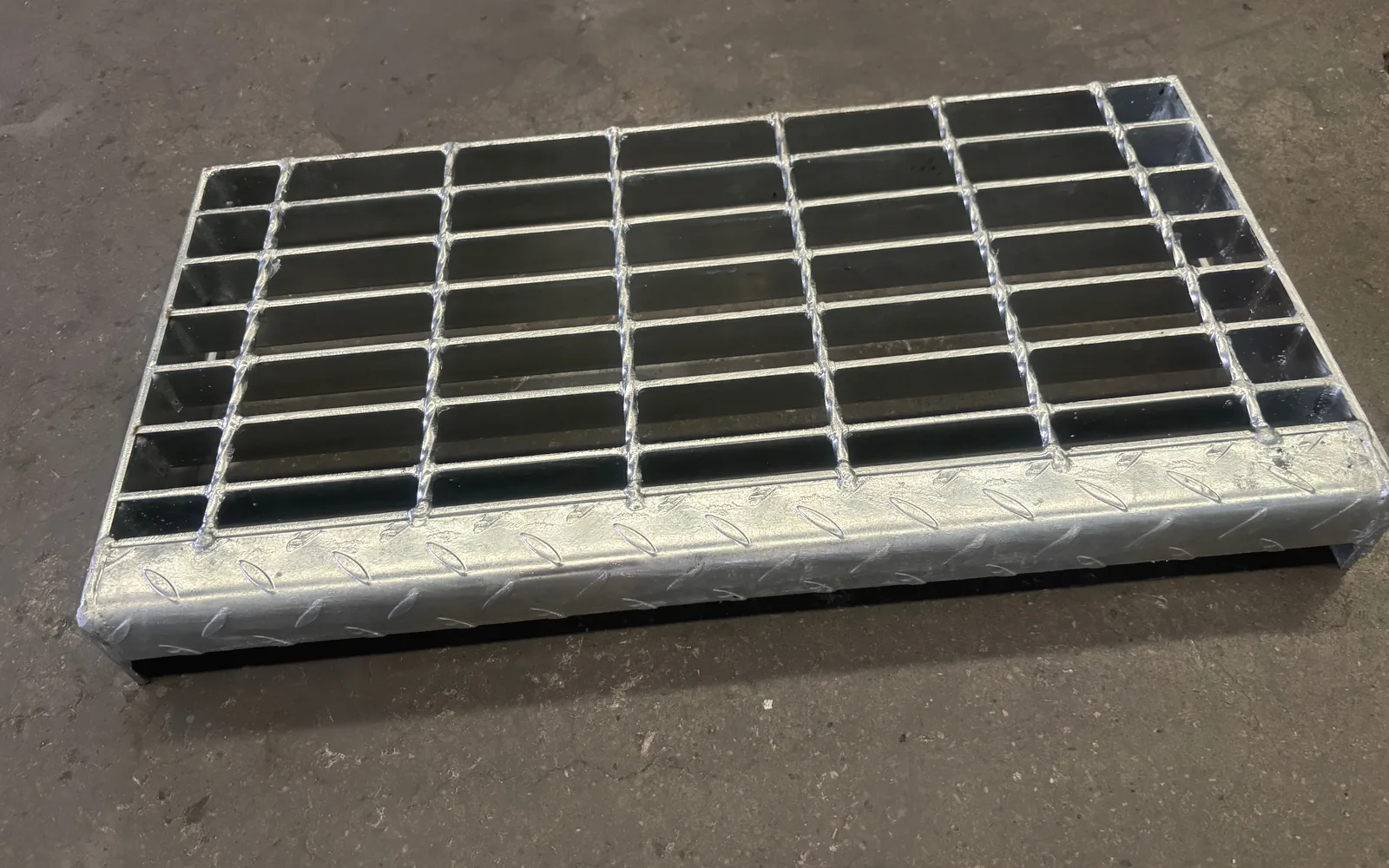
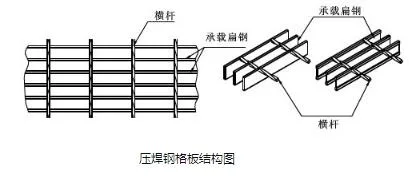
Steel grating is a steel product made by arranging flat bars at a certain pitch with cross bars in a crossing pattern and welding them into a grid with square openings. It is generally made of carbon steel with a hot-dip galvanized surface to prevent oxidation. It is widely used in alloys, building materials, power stations, boilers, shipbuilding, petrochemicals, chemical industries, general industrial plants, municipal construction and other sectors, with advantages such as ventilation and light transmission, slip resistance, strong load capacity, attractive appearance and durability, easy cleaning and simple installation.
The above points can serve as a pre-purchase checklist; confirm each item before moving to the quotation stage.
Steel Grating Model Notation
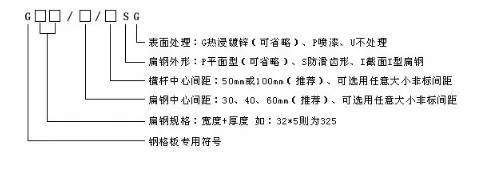
The specification parameters of steel grating mainly consist of the bearing bar size, bearing bar center spacing, cross bar spacing and overall dimensions. Each item should be confirmed before ordering; the comparison of common parameters is as follows:
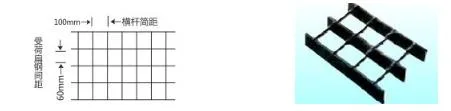
The models of steel grating form various specifications according to the bearing bar size, the combination spacing of bearing bars and cross bars, the structural form, the bearing bar shape and the surface treatment state; the model notation is shown in the figure.
The above are common specifications; actual ordered dimensions and tolerance requirements shall be confirmed against the layout drawing.
Steel Grating Product Series
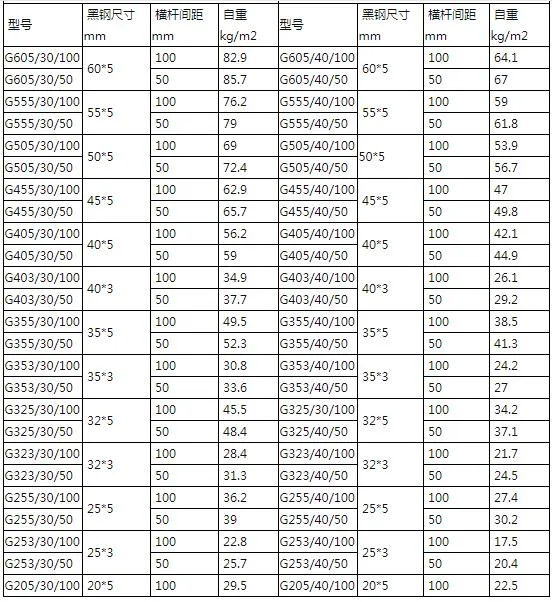
Different specifications correspond to different load capacities and theoretical weights; the common specification parameters of steel grating are shown in the table below. Actual ordered dimensions and tolerance requirements are subject to confirmation by the layout drawing:
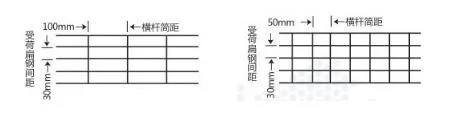
Series 1: the bearing bar center spacing of this series is 30mm Since the load capacity of steel grating is determined by the bearing bars, this series has the smallest spacing and the strongest capacity, and is the most widely used. As shown in the figure
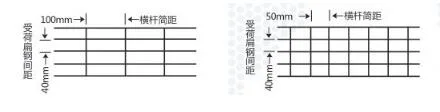
Series 2: the bearing bar center spacing of this series is 40mm It uses less material and is lighter than Series 1, with high cost performance; mainly for smaller spans, it is the ideal type. As shown in the figure
Series 3: the bearing bar center spacing of this series is 60mm Best suited to the mining industry and other engineering needs; when using this series, select grating with a cross bar spacing of no more than 100mm. As shown in the figure
The above are common specifications; actual ordered dimensions and tolerance requirements shall be confirmed against the layout drawing.
Characteristics of Steel Grating
Compared with traditional approaches, steel grating differs markedly in weight, strength, anti-corrosion life and later maintenance cost. In actual selection, the following performance items are most worth comparing first:
uMaterial savings: the most material-efficient way to carry a given load, which correspondingly reduces the material of the supporting structure.
uReduced investment: saves material, labor and construction time; no cleaning or maintenance required.
uEasy construction: fixed with bolted clips or welding on pre-installed supports; one person can complete it.
uTime savings: no on-site reworking needed; installation is very fast.
uDurability: hot-dip galvanized anti-corrosion treatment before delivery; strong resistance to impact and heavy pressure.
uModern look: attractive appearance, standardized design, ventilation and light transmission, giving a smooth modern impression.
uLight structure: less material, light structure, easy hoisting.
uNo dirt accumulation: no retention of rainwater, snow, ice or dust.
uReduced wind load: good ventilation means low wind resistance in strong winds, reducing wind damage.
uSimple design: no secondary beams needed, simple structure and simplified design; no detailed grating drawings required - just specify the model, and the manufacturer can design the layout for customers.
Overall, selection should weigh span, load and service environment together.
Steel Grating Weight Calculation Formula
Different specifications correspond to different load capacities and theoretical weights; the common specification parameters of steel grating are shown in the table below. Actual ordered dimensions and tolerance requirements are subject to confirmation by the layout drawing:
The weight of steel grating refers to the theoretical weight after banding and surface treatment (except for products without surface treatment). Due to differences in banding, openings and cuts, the actual weight may differ from the theoretical weight. In self-weight calculation of industrial platform grating and in delivery settlement of steel grating, the theoretical weight is uniformly used as the calculation basis. For grating shorter than 1 meter, such as trench covers, or grating requiring special banding, the weight increases due to the added banding bars. When banding with flat bars and the grating length is not less than 1 meter, the theoretical weight is calculated by the following formula:
Wt=(b1t1N1+b2t2N2+2b3t3)ρµ×10-6..................
Where: Wt - weight of the steel grating, in kilograms per square meter (kg/m2); t1 - width of the bearing bar, in millimeters (mm); b1 - thickness of the bearing bar, in millimeters (mm); N1 - number of bearing bars per meter of grating; t2 - width of the cross bar, in millimeters (mm); b2 - thickness of the cross bar, in millimeters (mm); N2 - number of cross bars per meter of grating; t3 - width of the banding bar, in millimeters (mm); b3 - thickness of the banding bar, in millimeters (mm); ρ - material density, in kilograms per cubic meter (kg/m3); steel density is calculated as 7850kg/m3; &μ - surface treatment weight gain coefficient; the hot-dip galvanizing weight gain is calculated as 1.06
The above are common specifications; actual ordered dimensions and tolerance requirements shall be confirmed against the layout drawing.
Area Calculation of Steel Grating
For more details on steel grating, refer to the following items and compare them against site conditions one by one:
- When processed to user-specified sizes without drawings, the area is the number of delivered panels multiplied by the sum of width and length, including the openings and cutouts.
- When drawings are provided for user design, the area is calculated from the overall external dimensions on the drawing, including the openings and cutouts.
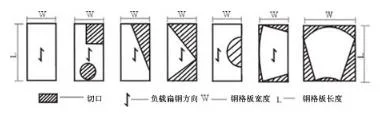
- For irregular steel grating, as shown in the figure, the area is width (W) x length (L), without deducting the cutouts.
The above points can serve as a pre-purchase checklist; confirm each item before moving to the quotation stage.
Weight Table of Common Steel Grating Models
Steel Grating Selection Essentials
Confirm each item in the order below during selection to avoid most later rework. Record the conclusion of each step and submit it with your inquiry:
- Step 1 · Define Span and Support Conditions: First measure the clear span between support beams, then confirm the support surface width is sufficient; these two items determine the usable series range.
- Step 2 · Verify Service Load: Check separately for pedestrian, maintenance or vehicular traffic; maintenance and vehicular use differ greatly in bearing bar requirements.
- Step 3 · Determine Material and Surface Treatment: Ordinary carbon steel works for dry indoor environments; hot-dip galvanizing is recommended for outdoor or humid environments; chemical and coastal environments need separate confirmation.
- Step 4 · Confirm Shape and Fixing Method: Including whether cutouts, corner notches and banding are needed, and whether to use welded fixing or special clips.
Once the above conditions are confirmed, proceed to Instant Quote PageEstimate quantities by dimensions, or send the condition list to customer service for model recommendations from our technicians.
Application Conditions Comparison for Steel Grating
The same specifications last very differently in different environments. The table below gives recommended practices by common service environment for your selection reference:
| Operating Environment | Recommended Practices | Note: |
|---|---|---|
| Indoor Dry Environments | Made of standard carbon steel with surface treatment as required | Focus on span and load; environmental impact is minimal |
| Humid or Water Treatment Environments | Use a higher corrosion protection grade with matching fasteners | Regularly inspect fixing points and surface corrosion |
| Chemical or Coastal Environments | Confirm material and anti-corrosion scheme per medium | Avoid galvanic corrosion from direct contact between different metals |
| High-Temperature or Large Temperature-Difference Environments | Select material and connection method by temperature | Watch for loosening caused by thermal expansion and contraction |
| Clean Rooms and Food & Pharmaceutical | Prioritize surface treatment and cleaning convenience | Avoid dust-collecting structures and cleaning dead corners |
| Temporary or Short-Term Use | Can be configured with the light-duty series | For short schedules, prioritize easy disassembly and turnover |
Custom Fabrication & Quotation
Before ordering, we recommend providing site photos, trench or platform dimensions and traffic requirements together, so we can give the model and layout plan in one go and reduce on-site cutting and rework. Common specifications are usually in stock; lead times for shaped parts and bulk orders depend on specification and quantity. For reference on similar projects, seeProject Cases; for a quotation, go directly to Instant Quote Page.
FAQ
How Is the Price of Steel Grating Calculated?
Usually calculated as the theoretical weight for the model times the material unit price, plus hot-dip galvanizing or other surface treatment costs, and fluctuating with steel and zinc prices. You canInstant Quote PageEnter specifications and dimensions for a quick estimate.
Can it be custom-made to site dimensions?
Yes. Bearing bar specs, pitch, panel dimensions and banding forms can all be custom-made to drawings; cutouts, corner notches and shaped cutting are also supported. For bulk orders, a layout drawing can be confirmed before production.
What mistakes are easy to make during installation?
Three main points: first, bearing bars installed in the wrong direction so loads are carried by cross bars; second, insufficient or missing fixing points; third, welding slag not removed and zinc-rich paint not reapplied after welding. These three cause the most on-site problems.
The above covers the main specifications and selection essentials of steel grating. To determine a specific model based on site span and load, you canInstant Quote PageQuick estimation, or contact customer service directly for sizing advice and layout drawings.