







Regarding steel grating, this article explains in turn what steel grating is, supplementary notes, and basic concepts, providing actionable criteria rather than theory alone. If you have drawings or site dimensions on hand, check each point against them; the same order applies to hot-dip galvanized steel grating.
What Is Steel Grating
This section first clarifies the basic concepts, structural forms and common names, laying the groundwork for what follows.
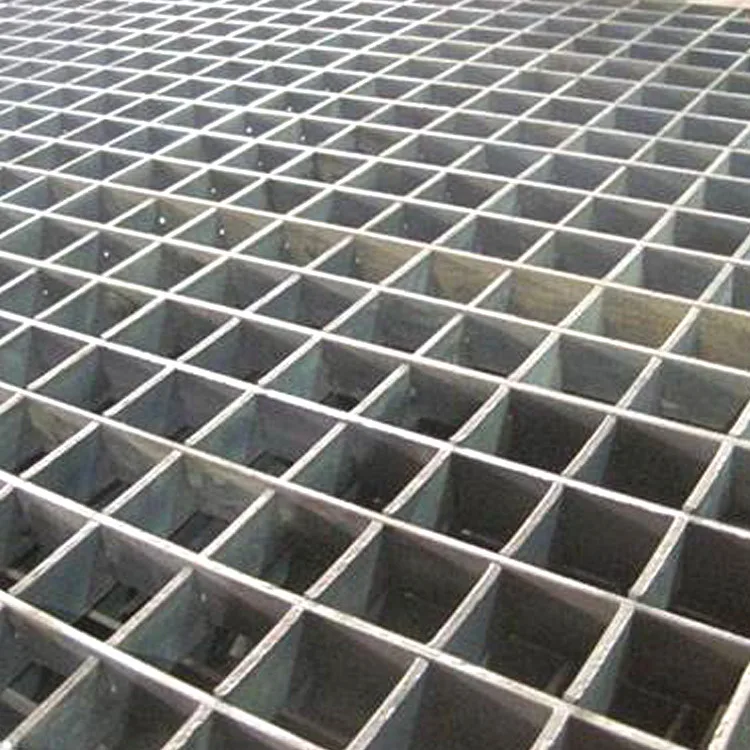
Steel grating is an open panel-type steel member composed of bearing bars and cross bars orthogonally combined at set pitch and fixed by welding or press-locking.
Once you grasp these basic concepts, the specifications and sizing recommendations that follow will be much easier to understand.
A practical tip for specification confirmation: write bearing bar specs, bearing bar pitch, cross bar pitch and overall dimensions into the purchase list at the same time; specifying only one or two often leads to mismatched deliveries. The specification marking system is fully cross-referenced on the product page; number and check each panel against the layout drawing before ordering. The same applies to galvanized grating.
Steel Grating Supplementary Notes
The following aspects most need to be confirmed in advance in actual procurement and use:
By manufacturing method, it is mainly divided into welded steel grating and press-locked steel grating.
The above points can serve as a pre-purchase checklist; confirm each item before moving to the quotation stage.
Quotations for the same specification may fluctuate with the steel market between batches - normal for steel products like steel grating. If the procurement schedule allows, lock in prices early; the procurement of galvanized grating can be planned on the same rhythm.
Basic Concepts of Steel Grating
This section first clarifies the basic concepts, structural forms and common names, laying the groundwork for what follows.
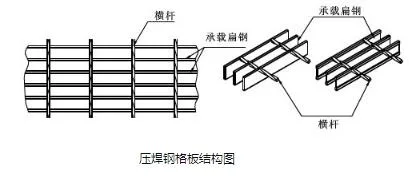
Welded steel grating: steel grating fixed by pressure resistance welding at every intersection of bearing bar and cross bar is called welded steel grating. The cross bars of welded steel grating are usually twisted square bars. As shown in the figure:
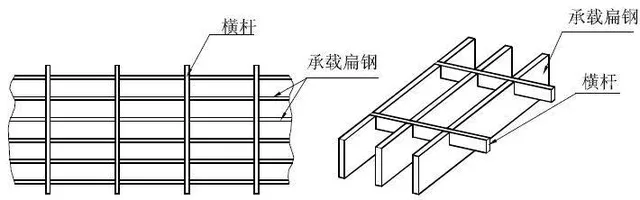
Press-locked steel grating: steel grating fixed at every intersection of bearing bar and cross bar by pressing the cross bar into the bearing bar or into slotted bearing bars is called press-locked steel grating. The cross bars of press-locked steel grating are usually flat bars. As shown in the figure:
Once you grasp these basic concepts, the specifications and sizing recommendations that follow will be much easier to understand.
The installation quality of steel grating largely depends on preparation: whether the bearing surface is flat, whether beam spacing matches the layout, and whether fasteners are prepared in advance. Once these are in place, installation itself is not complicated. If cutting is required on site, the cut-edge treatment requirements for galvanized grating should also be clarified.
Models and designations
Main specification comparison is as follows:
Based on bearing bar size, the combined pitch of bearing bars and cross bars, structural form, bearing bar profile, and surface treatment, steel grating comes in many specifications. The designation method is as follows:
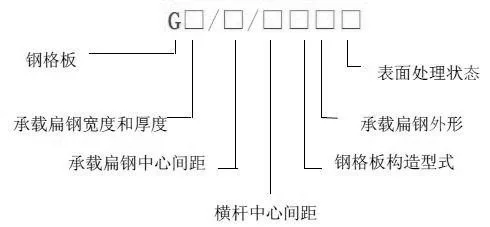
The above are common specifications; actual ordered dimensions and tolerance requirements shall be confirmed against the layout drawing.
Bigger is not always better. Steel grating selection should be as economical as possible while meeting load requirements; over-thickening increases self-weight and cost and complicates installation. The product page offers a fuller comparison for galvanized grating; refer to it before deciding.
Structural forms of steel grating, for example:
Additional key points are as follows:
W - welded steel grating (may be omitted in the designation);
L - press-locked steel grating.
2. Bearing bar center pitch, in millimeters (mm).
3. Cross bar center pitch, in millimeters (mm).
The above points can serve as a pre-purchase checklist; confirm each item before moving to the quotation stage.
What is most easily overlooked in spec tables are tolerances and end treatment. Steel grating usually has machining allowance in the length direction; if embedded installation is used on site, edge closing and corner notch requirements must be stated in advance. Hot-dip galvanized steel grating is handled similarly in these details; we recommend marking them clearly on the drawings as well.
Bearing bar profile designations
F - flat bar (may be omitted in the designation);
I - I-type bar;
S - serrated flat bar.
Bigger is not always better. Steel grating selection should be as economical as possible while meeting load requirements; over-thickening increases self-weight and cost and complicates installation. The product page offers a fuller comparison for hot-dip galvanized steel grating; refer to it before deciding.
Surface treatment designations
G - hot-dip galvanized (may be omitted in the designation);
P - painted;
U - untreated surface.
Designation examples
For steel grating with bearing bar cross-section 32mm x 3mm, bearing bar center pitch 30mm, cross bar center pitch 50mm, welded structural form, and untreated surface, the designation is G323/30/50WU.
For steel grating with bearing bar cross-section 40mm x 5mm, center pitch 40mm, cross bar center pitch 50mm, press-locked structural form, and hot-dip galvanized surface, the designation is G405/40/50L.
Bigger is not always better. Steel grating selection should be as economical as possible while meeting load requirements; over-thickening increases self-weight and cost and complicates installation. The product page offers a fuller comparison for hot-dip galvanized steel grating; refer to it before deciding.
Terms and definitions
Bearing bar: the flat bar that carries the main load.
Cross bar: twisted square bar, round bar, or flat bar fixed to the bearing bars.
Clear opening: the diameter of the largest inscribed circle of the open mesh of steel grating.
Bearing bar center pitch: the center-to-center distance between two adjacent bearing bars.
Cross bar center pitch: the center-to-center distance between two adjacent cross bars.
Banding bar: flat bar or section steel welded to the bearing bars of steel grating or to the edges of openings and cutouts.
Toe plate: a guard plate fixed around the edges of a platform or the edges of cutouts and openings in steel grating.
Steel grating length: the maximum dimension of steel grating parallel to the bearing bars, called the length (L).
Steel grating width: the maximum dimension of steel grating perpendicular to the bearing bars, called the width (W).
Bigger is not always better. Steel grating selection should be as economical as possible while meeting load requirements; over-thickening increases self-weight and cost and complicates installation. The product page offers a fuller comparison for hot-dip galvanized steel grating; refer to it before deciding.
Further reading: Selection points for hot-dip galvanized steel grating and galvanized grating
Besides what this article covers, hot-dip galvanized steel grating is also common in actual projects. It shares similarities with this article's subject in structure and fabrication; for selection, check span, load and service environment in the same order. If both types of components are used in the same project, we recommend unifying material and surface treatment to avoid later galvanic corrosion or inconsistent appearance.
- For all product specifications and theoretical weights by series, visit Steel Grating Product Center
- To estimate cost by size and quantity, use Instant Quote PageSubmit Requirements
- To see how similar projects were executed, refer to Project Cases field applications
FAQ
What information is needed for custom sizes?
Usually you need to provide the panel dimensions (length x width), bearing bar specs and direction, center-to-center pitch of bearing bars and cross bars, surface treatment, and special requirements such as cutouts, corner notches and banding. Site photos or sketches are even better.
Can the values in the article be applied directly?
Values in this article come from relevant standard clauses or common industry practice. For actual selection, recalculate based on site span, load class and service environment; direct copying is not recommended.
Where can I find specific specifications?
our websiteProductsCommon specifications and theoretical weights are organized by series, also available in Instant Quote PageEstimate by size, or contact us directly for sizing advice.
The above is for sizing and construction reference. To verify specific parameters or request a quotation, please visitInstant Quote Page, or contact our technical staff.
If you already have drawings or site dimensions, submit them directly and we will help verify specifications and layout, avoiding on-site cutting and rework caused by mismatched models. Without drawings, site photos and approximate dimensions are enough for an estimate.