







Many projects purchase galvanized steel grating based on price alone, overlooking specification matching and corrosion protection requirements, which often leads to rework later. This article lists, in order, the key points of rainwater trench covers, their scope of application and engineering fields, and the performance features of rainwater trench covers, and explains how to choose for common working conditions. Content related to hot-dip galvanized steel grating can be used directly as a reference for technical disclosure.
Key Points on Rainwater Trench Covers
Additional key points are as follows:
Galvanized steel grating trench covers can reduce road water accumulation and ease traffic congestion on rainy days. Here is how to handle rainwater trench covers of galvanized steel grating in different environments!
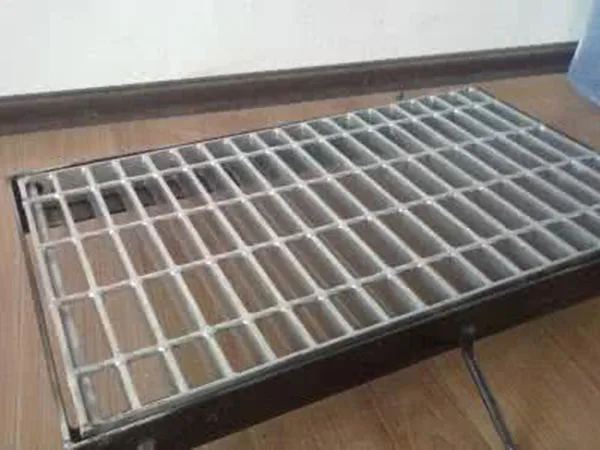
1. Galvanized steel grating trench covers should have rainwater inlets at water connection points, upstream of crosswalks, upstream of the entrances and exits of roadside premises, and at the exits of communities or courtyards close to ground runoff. Additional rainwater inlets should be added as needed at low-lying road sections and areas prone to water accumulation.
2. At at-grade intersections, galvanized steel grating trench cover rainwater inlets should be arranged according to the vertical design, and measures should be taken to prevent rainwater from the road section from entering the intersection.
3. The distance between rainwater outlets of galvanized steel grating trench covers should be 25~50 m, and their positions should be coordinated with the positions of inspection wells. The angle between the connecting pipe and the main pipe should be close to 90 degrees. When the connecting pipe is inclined, it should be arranged facing forward together with the flow direction of the main pipe.
4. The grate surface of the rainwater inlet of an at-grade galvanized steel grating trench cover should be 3~5 cm lower than the nearby road surface, and the surrounding road surface should slope toward the rainwater inlet. The bottom of a vertical rainwater inlet should be slightly lower than the nearby road surface, and the depth of the rainwater inlet well should be less than or equal to 1 m. In freezing regions, anti-freeze measures should be taken for the rainwater well and its foundation. In areas with heavy sediment, sediment tanks can be provided as needed.
The above points can serve as a pre-purchase checklist; confirm each item before moving to the quotation stage.
Regarding corrosion protection, one thing is easily overlooked: on-site cutting and welding damage the original coating, and these areas need zinc touch-up after construction, otherwise rust often starts from the cut edges. Hot-dip galvanized steel grating has the same issue; it is best to include this in the technical requirements at the construction disclosure.
Scope of Application & Engineering Fields
Main applications are as follows:
5. The relatively small pipe diameter of the rainwater inlet connecting pipe is 200 mm; the slope of the connecting pipe should be greater than or equal to 10%, the length less than or equal to 25 m, and the depth of buried soil greater than or equal to 0.7 m. If necessary, rainwater inlets can be connected in series; the number of rainwater inlets connected in series should not exceed 3, and the pipe diameter of the outlet connecting pipe should be increased. However, the pipe support of the rainwater inlet connecting pipe is the same as that of the rainwater pipe. How long steel stair treads last cannot be simply stated; depending on the application environment and different processing methods, welding quality allows use for different numbers of years.
If your working conditions fall outside the above range, you can provide site photos and dimensions, and our technicians will help assess them.
To quickly judge whether galvanized steel grating is suitable for a site, consider three angles: whether there are corrosive media, whether the traffic is pedestrians or vehicles, and roughly what the span range is. Once these three points are clear, the required specifications and surface treatment of the hot-dip galvanized steel grating can basically be determined.
Performance Features of Rainwater Trench Covers
Main features can be summarized as follows:
6. The drainage capacity of the rainwater vents of galvanized steel grating trench covers: flat grate rainwater vents are about 20 l/s, and combined rainwater vents are 30 l/s. The drainage capacity of rainwater vents that are easily blocked by debris in heavy rain should be multiplied by a coefficient of 0.5~0.7. The drainage capacity of multi-grate rainwater vents and vertical rainwater vents should be determined by calculation.
Overall, selection should weigh span, load and service environment together.
Choosing a surface treatment is essentially a trade-off between initial investment and later maintenance. For galvanized steel grating used in dry indoor environments, the requirements can be relaxed appropriately, while for outdoor or humid environments they should be raised accordingly. The selection of hot-dip galvanized steel grating can also be judged with this approach.
Further notes: Common combinations of hot-dip galvanized steel grating and hot-dip galvanized steel grating
In engineering, hot-dip galvanized steel grating is often used together with the components mentioned in this article. The two differ in load carrying and installation practices; when combining them, pay special attention to the connection of support conditions and fixing methods, as junction treatment is often where problems arise. For unified drawings, submit dimensions of both types and our technicians will process them under the same layout logic.
- For all product specifications and theoretical weights by series, visit Steel Grating Product Center
- To estimate cost by size and quantity, use Instant Quote PageSubmit Requirements
- To see how similar projects were executed, refer to Project Cases field applications
FAQ
How to choose between hot-dip galvanizing and cold galvanizing?
The two anti-corrosion mechanisms differ: hot-dip galvanizing immerses steel in molten zinc to form a metallurgically bonded coating, thick and long-lasting, suitable for outdoor and humid environments; cold galvanizing is electrochemical deposition with a thinner, more uniform appearance, suitable for dry indoor environments or applications requiring high dimensional precision.
What maintenance is required during daily use?
Maintenance mainly involves periodically checking whether fasteners are loose, whether touch-up paint has peeled off, and whether the panel surface shows obvious deformation or rust. Issues found should be dealt with promptly; overall maintenance is minimal.
Can the values in the article be applied directly?
Values in this article come from relevant standard clauses or common industry practice. For actual selection, recalculate based on site span, load class and service environment; direct copying is not recommended.
The above is for sizing and construction reference. To verify specific parameters or request a quotation, please visitInstant Quote Page, or contact our technical staff.
If you already have drawings or site dimensions, submit them directly and we will help verify specifications and layout, avoiding on-site cutting and rework caused by mismatched models. Without drawings, site photos and approximate dimensions are enough for an estimate.