







Regarding steel grating, this article explains item by item, in order: the design of ball-joint stanchion protective railings, design loads of protective railings, and the selection of ball-joint stanchion protective railings, giving directly applicable judgment methods rather than just principles. If you have drawings or site dimensions on hand, check each point in the text against them; steel stair treads can follow the same sequence of judgment.
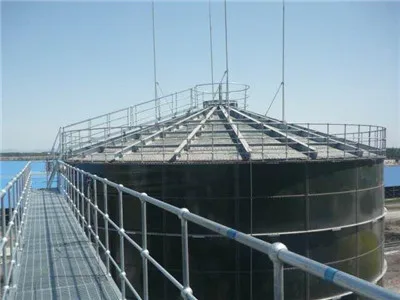
Although protective railings on both sides of walkway platforms do not affect the load-bearing performance of the main structure, they are critical components for user safety. Railing failures causing injuries occur from time to time, so railing safety deserves serious attention.
Design of Ball-Joint Stanchion Protective Railings
The following aspects most need to be confirmed in advance in actual procurement and use:
- Protective railings cover most situations in a factory, mainly in the following areas:
- Open edges of main floor levels
- Open edges of each maintenance steel platform
- Around stairways and stair openings
- Open edges of pits, holes and similar openings.
2. Common practice in current design: for industrial buildings, the current design philosophy prioritizes safety and practicality, with insufficient attention to aesthetics. Protective railing designs usually directly adopt the detail drawings of the latest national standard atlas.
The above points can serve as a pre-purchase checklist; confirm each item before moving to the quotation stage.
Regular maintenance can significantly extend the service life of steel grating. It is recommended to inspect it together with equipment overhauls, focusing on fasteners and damaged coating areas, and repair rust promptly. Steel stair treads can follow the same maintenance schedule.
Design Loads of Protective Railings
Additional key points are as follows:
Comparison of design load values for protective railings in different codes involves numerous atlases and codes with considerable differences in values. There are mainly four types:
- National standard atlas 02J401, Steel Ladders. The characteristic value of the horizontal concentrated live load on the top of handrails and railings is taken as 1.0 kN/m.
- National standard GB 50577-2010, Code for Design of Occupational Safety and Health in Cement Plants. Guards shall have sufficient stiffness and strength: this code does not specify explicit design load values, but sets requirements for safety in use.
- National standard GB 50009-2012, Load Code for the Design of Building Structures. The characteristic value of live load on railings of stairs, stands, balconies and accessible roofs shall not be less than the following: (1) For residences, dormitories, offices, hotels, hospitals, nurseries and kindergartens, the horizontal load at the top of railings shall be 1.0 kN/m. (2) For schools, canteens, theaters, cinemas, stations, auditoriums, exhibition halls or stadiums, the horizontal load at the top of railings shall be 1.0 kN/m and the vertical load 1.2 kN/m, with horizontal and vertical loads considered separately.
- National standard GB 4053.3-2009, Safety Requirements for Fixed Steel Ladders and Platforms. Handrails of inclined steel stairs shall withstand a concentrated load of not less than 890 N applied in any direction except upward, with maximum bending deflection between adjacent posts not greater than 1/250 of the span. Intermediate rails shall withstand a horizontal concentrated load of not less than 700 N applied at the midpoint of their circumference, with maximum deflection not greater than 75 mm. End or terminal posts shall withstand a concentrated load of 890 N applied at the top of the post in any direction. These loads shall not be superimposed. After installation, the top rail of a protective railing shall withstand a concentrated load of not less than 890 N in the horizontal and vertical downward directions and a uniform load of not less than 700 N/m, with maximum deflection between adjacent posts not greater than 1/250 of the span. Horizontal and vertical loads, and concentrated and uniform loads, shall not be superimposed. Load requirements for intermediate rails and end or terminal posts are the same as those for inclined steel stair handrails.
The above points can serve as a pre-purchase checklist; confirm each item before moving to the quotation stage.
This part on steel grating may seem basic, but it is often the source of later disputes. In communication, specifying the structure type, material and surface treatment in writing is far more reliable than agreeing on a name alone. The same breakdown approach applies to the selection of steel stair treads.
Selection of Ball-Joint Stanchion Protective Railings
We recommend confirming the following factors in order according to service conditions during selection:
- In the conventional design of steel grating platforms, railings generally follow the national standard atlas 02(
- J401, Steel Ladders, type LG2-12. Steel stair railings have corresponding stair types according to different slopes and stair widths, and railings correspond to the stair types. Protective railings mainly comprise four types of components:
- Handrail (also called top rail)
- Intermediate rail
- Post
- Toe plate.
- Component details of LG2-12:
- Handrail: steel tube Φ60×3.0
- Intermediate rails: two flat bars -30×4
- Post: steel tube Φ60×3.5
- Toe plate: one flat bar -100×3.
Placing the order after confirming these items effectively avoids specification mismatch and on-site rework.
When making a selection decision on steel grating, the thing to avoid most is choosing a type "from experience" alone. If any of the three factors - span, load or service environment - changes, the conclusion may differ. Listing the conditions clearly before comparing with standard practice for steel stair treads is far more efficient.
Steel Stair Railing Selection
We recommend confirming the following factors in order according to service conditions during selection:
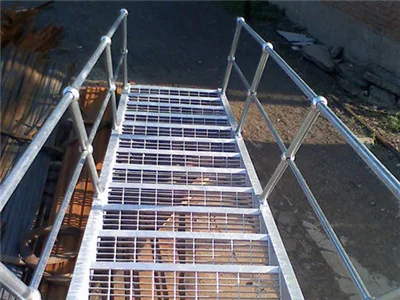
- When the stair slope is ≤ 45°, the detail closest in style to railing LG2-12 is detail (6) on page 72 of [3]. Component details:
- Handrail: steel tube Φ60×3.0
- Intermediate rails: three reinforcing bars Φ20
- Post: steel tube Φ50×2.5
- Toe plate: none.
- When the stair slope is > 45°, this case is used only in special areas. Component details:
- Handrail: steel tube Φ50×2.5
- Intermediate rails: none
- Post: steel tube Φ33.5×3.25
- Toe plate: none.
Placing the order after confirming these items effectively avoids specification mismatch and on-site rework.
It is recommended to fix the selection sequence as: first determine the span and support conditions, then the load requirements, and finally the surface treatment. Following this sequence, the specifications of steel grating can basically be determined; choosing a type first and then fitting the conditions tends to lead to repeated revisions. The same sequence applies to steel stair treads.
Classified Design of Protective Railings by Component
Main types are classified as follows:
- Appearance consideration: uniform styling of all protective railings within the same building or plant area creates a sense of aesthetics. Therefore it is necessary to standardize the style of protective railings. Taking LG2-12 as the prototype, adjustments and optimizations are made:
- Handrail: round steel tube
- Intermediate rails: two flat bars -30×4
- Post: round steel tube
- Toe plate (where required): one flat bar -100×3.
2) Component optimization. Differences in component sections are mainly found in the handrails and posts of protective railings; see Table 1 for comparison.
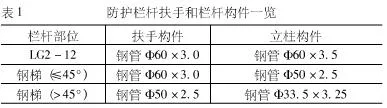
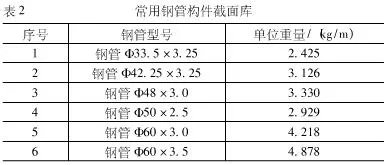
For the convenience and comfort of people going up and down steel stairs, GB 50295-2008 specifies that the angle of steel stairs should not exceed 45° [2], so steel stairs with a slope > 45° are rarely used. Most protective railing handrails have a diameter of 60 mm, and handrails of this diameter are inconvenient to grip; a hand cannot hold such a handrail firmly. Meanwhile, relevant codes also require: handrails should preferably be steel tubes with an outer diameter of not less than 30 mm and not more than 50 mm. Based on steel tubes commonly used and easily available on the market, a section library of tubes with diameters in the range of 30-50 mm is established, with the selected sections listed in the same table for comparison, as shown in Table 2.
Since all codes and atlases stipulate that post spacing shall not exceed 1 m, we take 1 m as the calculation unit.
Determine the category first and then the specific model; this saves detours and makes comparison with other materials easier.
This part on steel grating may seem basic, but it is often the source of later disputes. In communication, specifying the structure type, material and surface treatment in writing is far more reliable than agreeing on a name alone. The same breakdown approach applies to the selection of steel stair treads.
Design verification using steel tube sections selected from the section library
Main specification comparison is as follows:
(1) Handrail: considering edge-span factors, simplified as a simply supported beam with a span of 1.0 m under a concentrated load of 0.89 kN at mid-span and a uniform load of 1.0 kN/m;
(2) Post: calculated as a cantilever member with a height of 1.2 m under a concentrated load of 1.0 kN at the top. Deflection limits: handrail 1/250 of the span, i.e. not more than 4 mm; post 1/100 of its height [9], i.e. not more than 12 mm. Calculation results are summarized in Table 3.
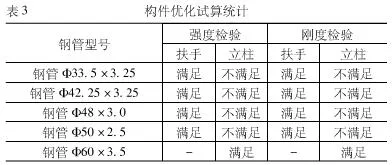
From the design of platform protective railings, steel tubes with diameters in the range of 30-50 mm all fail to meet the strength and stiffness requirements for posts. If a steel tube Φ48×3.0 or Φ50×2.5 is used as a post, trial calculations show that the post spacing must be adjusted to about 500 mm to meet the requirements. The safety focus of protective railings lies in the posts, which play a decisive role. The post sections selected in the national standard atlas [4] meet the strength and stiffness requirements of relevant codes, and their calculated deflection is also close to 1/100 of the railing height.
The above are common specifications; actual ordered dimensions and tolerance requirements shall be confirmed against the layout drawing.
Actual parameters of the same type may vary slightly between manufacturers; acceptance should be based on measured values. Key dimensions of steel grating should be spot-checked, especially for bulk deliveries. Corresponding parameters of steel stair treads can be checked in the same way, and any deviation should be communicated promptly.
Further Notes: How to Match Steel Stair Treads with Grating Stair Treads
Steel stair treads and grating stair treads are different specification forms within the same product system, and the selection logic is the same as described in this article: first consider the use, then determine the specification by span and load, and finally determine the surface treatment by environment. The two may differ in anti-corrosion and anti-slip requirements; it is advisable to specify them separately when ordering rather than writing a single general technical requirement.
- For all product specifications and theoretical weights by series, visit Steel Grating Product Center
- To estimate cost by size and quantity, use Instant Quote PageSubmit Requirements
- To see how similar projects were executed, refer to Project Cases field applications
FAQ
What is most often overlooked during installation and acceptance?
First, bearing bars installed in the wrong direction reduce load capacity; second, insufficient fixing points or missing zinc touch-up paint; third, support beam spacing inconsistent with the layout drawing. These three items are most often overlooked on site.
Where can I find specific specifications?
our websiteProductsCommon specifications and theoretical weights are organized by series, also available in Instant Quote PageEstimate by size, or contact us directly for sizing advice.
What maintenance is required during daily use?
Maintenance mainly involves periodically checking whether fasteners are loose, whether touch-up paint has peeled off, and whether the panel surface shows obvious deformation or rust. Issues found should be dealt with promptly; overall maintenance is minimal.
The above is for sizing and construction reference. To verify specific parameters or request a quotation, please visitInstant Quote Page, or contact our technical staff.
The above is general guidance. For a specific project, we still recommend submitting span, load class and service environment to our technicians for review. Steel grating is a load-bearing component; rework caused by wrong specification choices costs far more than the time spent on upfront calculation.