







Many projects focus only on price when purchasing galvanized steel grating, ignoring specification matching and anti-corrosion requirements, which often leads to rework later. This article lists the conditions to confirm one by one - following the order of what galvanized steel grating fence applications are, supplementary notes and basic concepts - and explains how to make trade-offs under common working conditions. Content relating to hot-dip galvanized steel grating can be used directly as a reference for technical briefings.
What Are the Applications of Galvanized Steel Grating Fences
This section first clarifies the basic concepts, structural forms and common names, laying the groundwork for what follows.
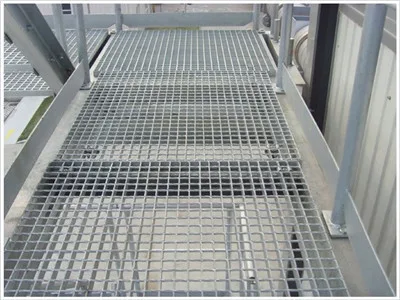
Steel grating, also called grating, steel grid plate or grid plate, consists of flat steel and twisted steel. Compared with other products, steel grating is more durable and more economical. It is mainly used for power station platforms, parking platforms, maintenance platforms, trench covers, treads and the like. Thanks to these advantages, it is widely used in environmental protection equipment and sewage treatment.
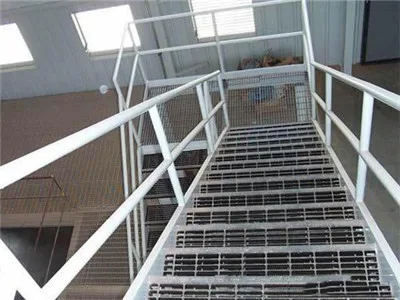
Once you grasp these basic concepts, the specifications and sizing recommendations that follow will be much easier to understand.
For material selection, do not simply chase high grades. The material of galvanized steel grating should match the load requirements and service environment; over-specifying causes unnecessary cost increases. The corresponding treatment for galvanized grating can be found on the product page, chosen against actual conditions.
Supplementary Notes on Applications of Galvanized Steel Grating Fences
Additional key points are as follows:
The gap width between grating bars can be set according to the dust removal method and pump requirements. Grating gaps are generally 16 - 25 mm; sedimentation tanks generally use 15-30mm and 40mm, with three types of mechanical cleaning equipment: chain-type, mobile and wire-rope traction grating machines.
The above points can serve as a pre-purchase checklist; confirm each item before moving to the quotation stage.
Materials and surface treatment determine the field durability of galvanized steel grating. The same steel grating requires very different treatments in dry indoor conditions versus coastal or chemical environments, so the service environment should be raised as the primary condition during selection. The same applies to galvanized grating.
Specification Parameters for Applications of Galvanized Steel Grating Fences
By bar spacing, steel grating is divided into coarse, medium and fine gratings. By cleaning method, there are three types: manual grating, mechanical grating and hydraulic gap grating. By structural features, it can be rake-type, ring-type, arc-type, rotary-type, drum-type, tooth-type or ladder-type.
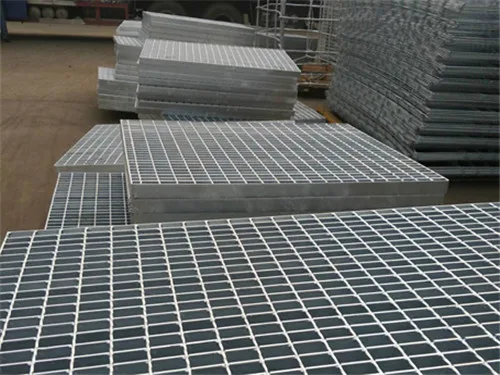
Actual parameters of the same model may vary slightly between manufacturers; acceptance shall be based on measured values. We recommend sampling key dimensions of galvanized steel grating, especially for bulk deliveries. Corresponding parameters of hot-dip galvanized steel grating can be checked the same way; communicate promptly if deviations are found.
Scope of Application & Engineering Fields
Grating equipment is generally used at sewage treatment inlets and pump station collecting tank inlets. Its main function is to remove larger suspended or floating matter from wastewater, reduce the load on downstream treatment, and protect pumps, pipes and instruments. When the retained screenings exceed 0.2m3/d, mechanical cleaning is generally used; when grating screenings are below 0.2m3/d, manual or mechanical removal can be used.
The scope of application of galvanized steel grating is actually broader than many people think, from industrial platforms to municipal landscaping. The difference: industrial scenarios focus more on load capacity and corrosion protection, while municipal scenarios also consider appearance, theft prevention and pedestrian safety. Common practice for galvanized grating in these scenarios can be found on the case page.
Further reading: Sizing reference for hot-dip galvanized steel grating and galvanized grating
In engineering, galvanized grating is often used together with the components mentioned in this article. The two differ in load carrying and installation practices; when combining them, pay special attention to the connection of support conditions and fixing methods, as junction treatment is often where problems arise. For unified drawings, submit dimensions of both types and our technicians will process them under the same layout logic.
- For all product specifications and theoretical weights by series, visit Steel Grating Product Center
- To estimate cost by size and quantity, use Instant Quote PageSubmit Requirements
- To see how similar projects were executed, refer to Project Cases field applications
FAQ
What information is needed for custom sizes?
Usually you need to provide the panel dimensions (length x width), bearing bar specs and direction, center-to-center pitch of bearing bars and cross bars, surface treatment, and special requirements such as cutouts, corner notches and banding. Site photos or sketches are even better.
What is most often overlooked during installation and acceptance?
First, bearing bars installed in the wrong direction reduce load capacity; second, insufficient fixing points or missing zinc touch-up paint; third, support beam spacing inconsistent with the layout drawing. These three items are most often overlooked on site.
Why do different manufacturers quote different weights for the same specifications?
The main difference lies in the actual measured thickness and tolerance control of the bearing bars. When bars are supplied at the lower tolerance limit, weight per unit area falls below the theoretical value, and load capacity drops accordingly. We recommend specifying thickness tolerance clearly when purchasing.
The above is for sizing and construction reference. To verify specific parameters or request a quotation, please visitInstant Quote Page, or contact our technical staff.
The above is general guidance. For a specific project, we still recommend submitting span, load class and service environment to our technicians for review. Steel grating is a load-bearing component; rework caused by wrong specification choices costs far more than the time spent on upfront calculation.