







Many projects focus only on price when purchasing anti-slip steel grating, ignoring specification matching and anti-corrosion requirements, which often leads to rework later. This article lists the conditions to confirm in order - advantages, materials and specifications - and explains how to choose for common working conditions. The parts relating to hot-dip galvanized steel grating can be used directly as a technical briefing reference.
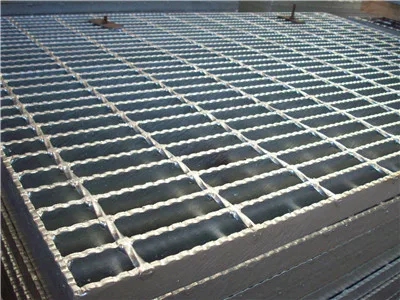
Anti-slip steel grating is welded from flat bearing bars with one serrated edge and twisted square cross bars. In addition to all the features and uses of standard anti-slip grating, it provides much stronger slip resistance, especially for stairs, damp and greasy areas, regions with long periods of snow and ice cover, and offshore oil platforms.
Advantages of Anti-Slip Steel Grating
Its overall performance focuses on the following aspects; we suggest comparing item by item in actual selection:
- Made of flat bars serrated on one side, it has the features and uses of ordinary steel grating plus stronger anti-slip ability, especially suitable for wet, slippery places such as offshore oil platforms.
- With hot-dip galvanized surface treatment, it has strong rust resistance and is maintenance- and replacement-free for 30 years. The product can be used as a trench cover hinged to the frame - theft-proof, safe and easy to open.
- Made of high-strength carbon steel for very high strength: strength and toughness far exceed cast iron; suitable for docks, airports and other large-span, heavy-load environments.
- Large mesh openings give the best drainage: open area reaches 83.3%, more than twice that of cast iron.
- Attractive appearance: clean lines, silver finish, modern look. Saves material and investment: for long spans and heavy loads it costs less than cast iron, and avoids the replacement costs of cast iron covers lost to theft or crushing.
Serrated steel grating is hot-dip galvanized for very strong corrosion resistance.
Overall, selection should weigh span, load and service environment together.
Regarding corrosion protection, one thing is easily overlooked: on-site cutting and welding damage the original coating, and these areas need zinc touch-up after construction, otherwise rust often starts from the cut edges. Galvanized grating has the same issue; it is best to include this in the technical requirements at the construction disclosure.
Materials of Anti-Slip Steel Grating
Common materials and surface treatments are as follows:
Plain bearing bar: generally Q235, with common models 203 253 255 303 305 323 325 403 404 405 503 505 605 705 and similar specs. Serrated bearing bar: same models as plain bars, except that one side has an uneven serrated groove cut into it, mainly for slip resistance.
Serrated steel grating is marked with the letter "S".
Once material and surface treatment are decided, we recommend writing zinc coating thickness and appearance requirements into the technical agreement.
A practical tip for confirming specifications: put the bearing bar size, bearing bar pitch, cross bar pitch and overall dimensions in the purchase list together - listing only one or two often leads to a delivery mismatch. The full specification notation for anti-slip steel grating is on the product page; before ordering, number each panel against the layout drawing. The same applies to galvanized bar grating.
Specifications of Anti-Slip Steel Grating
Main specification comparison is as follows:
- Bearing bar height (or width) and thickness of anti-slip steel grating: bar heights are usually 20mm, 25mm, 30mm, 32mm, 35mm, 40mm, 45mm, 50mm and so on; bar thicknesses are 3mm, 4mm and 5mm.
- Surface treatments for anti-slip steel grating: hot-dip galvanizing, cold galvanizing, electroplating, spray-painted, anti-rust oil dipping, PVC-dip coated, or untreated.
- Bearing bar pitch of anti-slip steel grating: the center-to-center distance between two adjacent bearing bars, commonly 30mm or 40mm, sometimes 60mm.
- Cross bar pitch of anti-slip steel grating: the center-to-center distance between two adjacent cross bars is usually 50mm or 100mm, and can be produced to customer requirements.
The above are common specifications; actual ordered dimensions and tolerance requirements shall be confirmed against the layout drawing.
Actual parameters for the same model may vary slightly between manufacturers, so acceptance should be based on measured values. Spot-check the key dimensions of anti-slip steel grating, especially on bulk deliveries. The corresponding parameters of hot-dip galvanized steel grating can be verified the same way; report any deviation promptly.
Further notes: Common combinations of hot-dip galvanized steel grating and galvanized grating
If a project uses both hot-dip galvanized steel grating and galvanized grating, we recommend planning them on the same layout drawing. This way edge closing, fixing and cutouts at junctions can be handled uniformly, avoiding dimension conflicts during installation and making later maintenance easier.
- For all product specifications and theoretical weights by series, visit Steel Grating Product Center
- To estimate cost by size and quantity, use Instant Quote PageSubmit Requirements
- To see how similar projects were executed, refer to Project Cases field applications
FAQ
What is most often overlooked during installation and acceptance?
First, bearing bars installed in the wrong direction reduce load capacity; second, insufficient fixing points or missing zinc touch-up paint; third, support beam spacing inconsistent with the layout drawing. These three items are most often overlooked on site.
What information is needed for custom sizes?
Usually you need to provide the panel dimensions (length x width), bearing bar specs and direction, center-to-center pitch of bearing bars and cross bars, surface treatment, and special requirements such as cutouts, corner notches and banding. Site photos or sketches are even better.
What maintenance is required during daily use?
Maintenance mainly involves periodically checking whether fasteners are loose, whether touch-up paint has peeled off, and whether the panel surface shows obvious deformation or rust. Issues found should be dealt with promptly; overall maintenance is minimal.
The above is for sizing and construction reference. To verify specific parameters or request a quotation, please visitInstant Quote Page, or contact our technical staff.
If you already have drawings or site dimensions, submit them directly and we will help verify specifications and layout, avoiding on-site cutting and rework caused by mismatched models. Without drawings, site photos and approximate dimensions are enough for an estimate.