







Applications of steel stair treads in actual projects are not complicated; the difficulty lies in matching specifications, material, and service environment. This article covers the types of stair treads, typical application scenarios, and basic concepts in turn; after reading, you will have a complete judgment framework for galvanized steel grating.
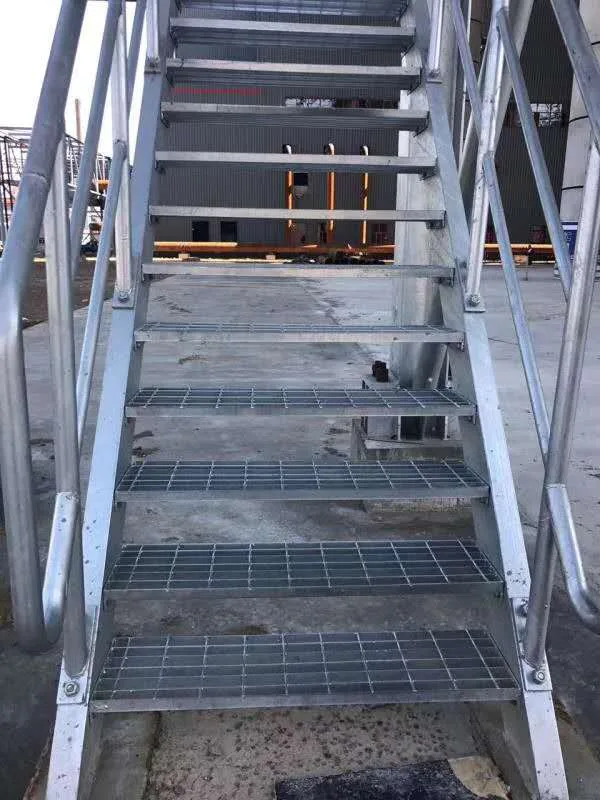
Stair treads are also known as grating stair treads, Stair treads are made from steel grating (steel grating is a steel product made by cross-arranging flat bearing bars at a fixed pitch with cross bars and welding them into a panel with square openings). The surface is generally treated by hot-dip galvanizing or electro-galvanizing.
Types of Stair Treads
Common classification methods are as follows:
(1) By installation method, stair treads are divided into welded fixed treads and bolted fixed treads. Bolted fixed treads require 65X5mm flat bars added as side plates.
(2) By anti-slip requirements, stair treads fall into two types: with nosing plate (checkered plate or strip steel) and without nosing plate.
T325/30/100 (for tread widths over 215mm and up to 305mm) T255/30/100 (for tread widths over 215mm and up to 305mm). For safety reasons, customers are advised to use stair treads with nosing plates.
Uses of stair treads: steel stair grating is mainly used for industrial platforms, stair treads, handrails, walkway flooring, railway bridge walkways, elevated tower platforms, drainage trench covers, manhole covers, road grilles, multi-story parking lots, and fencing for institutions, schools, factories, enterprises, sports fields, gardens and villas; it can also be used for residential exterior windows, balcony railings, and highway and railway guardrails.
Determine the category first and then the specific model; this saves detours and makes comparison with other materials easier.
After installation, a full check is recommended: panel warping, completeness of fixings, and visible height differences between adjacent panels. Such issues with steel stair treads are cheapest to fix at the acceptance stage and troublesome to rework after commissioning. Acceptance of hot-dip galvanized steel grating can follow the same standard.
Typical Applications
Typical applications mainly include the following categories, which can help you judge suitability for your project:
- Industrial Platforms & Maintenance Walkways: equipment platforms and inspection passages in power plants, chemical plants and steel-structure workshops;
- Municipal & Landscape: road drainage trench covers, rainwater grates, tree grates, park boardwalks;
- Transportation & Ports: wharf trestles, multi-story parking garage lanes, railway bridge walkways;
- Environmental & Water Treatment: walkways in wastewater treatment plants, tank platforms, screening machine platforms;
- Others: elevated tower platforms, stair treads, fences and railings, etc.
If your working conditions fall outside the above range, you can provide site photos and dimensions, and our technicians will help assess them.
Different parts of the same scenario often have different requirements. Take steel stair treads as an example: main walkways vs. edge areas, frequently used vs. occasional maintenance areas can have different specifications. Galvanized steel grating used in combination should also be considered zone by zone, balancing safety and cost.
Key Conditions to Confirm During Selection
- First clarify the span and support beam spacing to determine the required series;
- Then check load requirements by usage type (pedestrian, maintenance, vehicular);
- Finally, determine the surface treatment by service environment (dry indoor, outdoor, coastal, chemical).
What is easiest to overlook in spec sheets are tolerances and end treatment. Stair treads usually leave machining allowance along the length; if field installation is recessed, state the edge banding and corner-notching requirements in advance. Galvanized steel grating is handled similarly in these details; mark them clearly on the drawings.
Further notes: Common combinations of galvanized grating and hot-dip galvanized steel grating
Besides what this article covers, galvanized grating is also common in actual projects. It shares similarities with this article's subject in structure and fabrication; for selection, check span, load and service environment in the same order. If both types of components are used in the same project, we recommend unifying material and surface treatment to avoid later galvanic corrosion or inconsistent appearance.
- For all product specifications and theoretical weights by series, visit Steel Grating Product Center
- To estimate cost by size and quantity, use Instant Quote PageSubmit Requirements
- To see how similar projects were executed, refer to Project Cases field applications
FAQ
Can the values in the article be applied directly?
Values in this article come from relevant standard clauses or common industry practice. For actual selection, recalculate based on site span, load class and service environment; direct copying is not recommended.
How to choose between hot-dip galvanizing and cold galvanizing?
The two anti-corrosion mechanisms differ: hot-dip galvanizing immerses steel in molten zinc to form a metallurgically bonded coating, thick and long-lasting, suitable for outdoor and humid environments; cold galvanizing is electrochemical deposition with a thinner, more uniform appearance, suitable for dry indoor environments or applications requiring high dimensional precision.
Where can I find specific specifications?
our websiteProductsCommon specifications and theoretical weights are organized by series, also available in Instant Quote PageEstimate by size, or contact us directly for sizing advice.
The above is for sizing and construction reference. To verify specific parameters or request a quotation, please visitInstant Quote Page, or contact our technical staff.
The above is general guidance. For a specific project, we still recommend submitting span, load class and service environment to our technicians for review. Steel grating is a load-bearing component; rework caused by wrong specification choices costs far more than the time spent on upfront calculation.