







On steel grating, this article covers the standard and acceptance requirements, common models and sizes, and basic concepts in turn, giving actionable criteria rather than theory alone. Those with drawings or site dimensions can check against the key points; hot-dip galvanized steel grating can follow the same order.
Steel Grating Standards and Acceptance Requirements
The main standard clauses and acceptance requirements involved are as follows:
The current national standard YB/T 4001.1 specifies the dimensional tolerances of steel grating; the main indicators are as follows:
| Item | Tolerances | Remarks |
|---|---|---|
| Item | Permissible Deviation | Description |
| Length | +0 / −5 mm | No positive deviation allowed |
| Width | ±5 mm | All four sides |
| Bearing Bar Pitch | ±3 mm | Adjacent center pitch |
| Diagonals | ≤5 mm | Anti-warping |
| Flatness | ≤4 mm/m | No tripping hazard |
We recommend checking each clause above during acceptance and keeping the factory inspection records.
Actual parameters of the same model may vary slightly between manufacturers; acceptance shall be based on measured values. We recommend sampling key steel grating dimensions, especially for bulk deliveries. Corresponding parameters of hot-dip galvanized steel grating can be checked the same way; communicate promptly if deviations are found.
Common Steel Grating Models and Sizes
Common specifications and corresponding parameters are summarized below; confirm each item before ordering:
In addition, the flat bar width tolerance is +/-0.3mm, thickness +/-0.3mm and cross bar pitch +/-5mm. Check against this table at acceptance; values outside the range can be rejected for rectification. Note: slight deformation after galvanizing is normal, and flatness is judged by the "no tripping hazard" criterion.
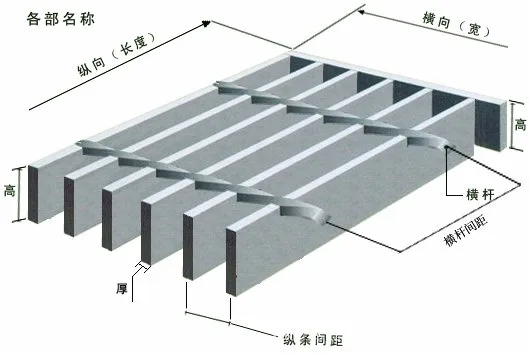
The above are common specifications; actual ordered dimensions and tolerance requirements shall be confirmed against the layout drawing.
What is most easily overlooked in spec tables are tolerances and end treatment. Steel grating usually has machining allowance in the length direction; if embedded installation is used on site, edge closing and corner notch requirements must be stated in advance. Hot-dip galvanized steel grating is handled similarly in these details; we recommend marking them clearly on the drawings as well.
Further notes: Common combinations of hot-dip galvanized steel grating and hot-dip galvanized steel grating
Besides what this article covers, hot-dip galvanized steel grating is also common in actual projects. It shares similarities with this article's subject in structure and fabrication; for selection, check span, load and service environment in the same order. If both types of components are used in the same project, we recommend unifying material and surface treatment to avoid later galvanic corrosion or inconsistent appearance.
- For all product specifications and theoretical weights by series, visit Steel Grating Product Center
- To estimate cost by size and quantity, use Instant Quote PageSubmit Requirements
- To see how similar projects were executed, refer to Project Cases field applications
FAQ
Why do different manufacturers quote different weights for the same specifications?
The main difference lies in the actual measured thickness and tolerance control of the bearing bars. When bars are supplied at the lower tolerance limit, weight per unit area falls below the theoretical value, and load capacity drops accordingly. We recommend specifying thickness tolerance clearly when purchasing.
How to choose between hot-dip galvanizing and cold galvanizing?
The two anti-corrosion mechanisms differ: hot-dip galvanizing immerses steel in molten zinc to form a metallurgically bonded coating, thick and long-lasting, suitable for outdoor and humid environments; cold galvanizing is electrochemical deposition with a thinner, more uniform appearance, suitable for dry indoor environments or applications requiring high dimensional precision.
What information is needed for custom sizes?
Usually you need to provide the panel dimensions (length x width), bearing bar specs and direction, center-to-center pitch of bearing bars and cross bars, surface treatment, and special requirements such as cutouts, corner notches and banding. Site photos or sketches are even better.
The above is for sizing and construction reference. To verify specific parameters or request a quotation, please visitInstant Quote Page, or contact our technical staff.
The above is general guidance. For a specific project, we still recommend submitting span, load class and service environment to our technicians for review. Steel grating is a load-bearing component; rework caused by wrong specification choices costs far more than the time spent on upfront calculation.