







This article introduces steel grating in the order of pressure welding, manual welding and basic concepts. Each part gives practical judgement methods where possible; if you only need a quick conclusion, read the key points at the start of each part. The same method applies to galvanized steel grating.
Pressure Welding (Resistance Welding)
Additional key points are as follows:
Flat bars and twisted square bars are automatically pressed and energised on a large welding machine, producing uniform, strong and neat welds. It suits high-volume standardised production and is the mainstream process.
| Process | Appearance | Efficiency | Scenario |
|---|---|---|---|
| Process | Appearance | Efficiency | Applicable |
| Machine pressure welding | Uniform and neat | High | High-volume standard |
| Manual welding | Slightly uneven | Low | Irregular small batches |
The above points can serve as a pre-purchase checklist; confirm each item before moving to the quotation stage.
To judge whether steel grating suits a given application, check three angles quickly: whether corrosive media are present, whether traffic is pedestrian or vehicular, and roughly what span is involved. Once these are clear, you can basically determine the required specification and surface treatment for galvanized steel grating.
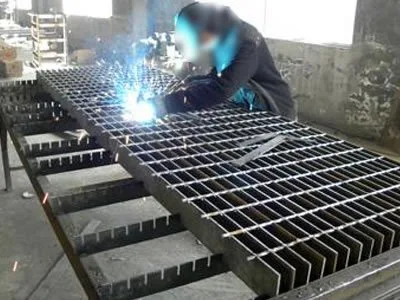
Manual welding
Additional key points are as follows:
Manual arc welding is flexible, but weld sizes vary and the appearance is slightly poorer; it is mostly used for irregular shapes, small batches or repairs. Both methods meet the national standard for load capacity, but pressure welding is more consistent and has a shorter lead time. Prefer pressure welding for standard specifications; use manual welding only to supplement irregular cut-outs and non-standard sizes.
The above points can serve as a pre-purchase checklist; confirm each item before moving to the quotation stage.
What is most easily overlooked in spec tables are tolerances and end treatment. Steel grating usually has machining allowance in the length direction; if embedded installation is used on site, edge closing and corner notch requirements must be stated in advance. Galvanized grating is handled similarly in these details; we recommend marking them clearly on the drawings as well.
Further notes: How to combine galvanized grating and hot-dip galvanized steel grating in use
If a project uses both galvanized grating and hot-dip galvanized steel grating, we recommend planning them on the same layout drawing. This way edge closing, fixing and cutouts at junctions can be handled uniformly, avoiding dimension conflicts during installation and making later maintenance easier.
- For all product specifications and theoretical weights by series, visit Steel Grating Product Center
- To estimate cost by size and quantity, use Instant Quote PageSubmit Requirements
- To see how similar projects were executed, refer to Project Cases field applications
FAQ
What information is needed for custom sizes?
Usually you need to provide the panel dimensions (length x width), bearing bar specs and direction, center-to-center pitch of bearing bars and cross bars, surface treatment, and special requirements such as cutouts, corner notches and banding. Site photos or sketches are even better.
Why do different manufacturers quote different weights for the same specifications?
The main difference lies in the actual measured thickness and tolerance control of the bearing bars. When bars are supplied at the lower tolerance limit, weight per unit area falls below the theoretical value, and load capacity drops accordingly. We recommend specifying thickness tolerance clearly when purchasing.
How to choose between hot-dip galvanizing and cold galvanizing?
The two anti-corrosion mechanisms differ: hot-dip galvanizing immerses steel in molten zinc to form a metallurgically bonded coating, thick and long-lasting, suitable for outdoor and humid environments; cold galvanizing is electrochemical deposition with a thinner, more uniform appearance, suitable for dry indoor environments or applications requiring high dimensional precision.
The above is for sizing and construction reference. To verify specific parameters or request a quotation, please visitInstant Quote Page, or contact our technical staff.
The above is general guidance. For a specific project, we still recommend submitting span, load class and service environment to our technicians for review. Steel grating is a load-bearing component; rework caused by wrong specification choices costs far more than the time spent on upfront calculation.