







Applications of steel grating in actual projects are not complicated; the difficulty lies in matching specifications, material, and service environment. This article covers the foreword, 1. Standards are not just drawings on paper, and 2. The 2019 edition in turn; after reading, you will have a complete judgment framework for galvanized steel grating.
Foreword
My name is Liang Jianguo, and I have spent thirty full years in the steel grating trade. From the small workshops of the 80s and 90s to today's automated production lines; from copying drawings by rote in the early days to today's CNC welding and hot-dip galvanizing lines - I have watched this industry grow with my own eyes. Over the years I have visited hundreds of large and small construction sites across the country and seen plenty of steel grating problems. Today, on our factory's platform, I would like to talk with you about steel grating standards. These are lessons I paid for over the years; I hope they help those who follow avoid some detours.
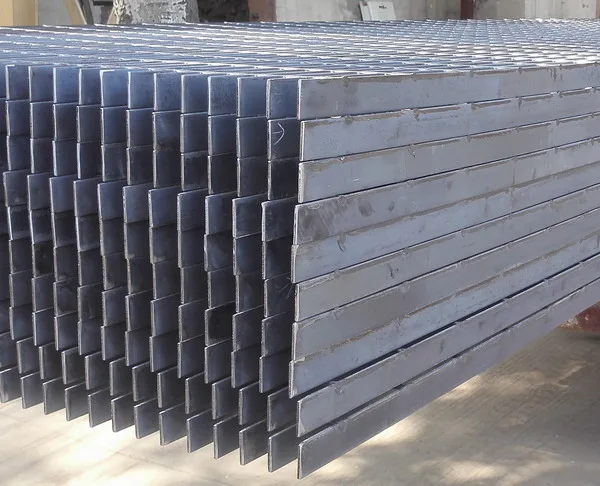
▲ Finished hot-dip galvanized steel grating - good grating depends on care at every step from raw material to finished product
Regarding corrosion protection, one thing is easily overlooked: on-site cutting and welding damage the original coating, and these areas need zinc touch-up after construction, otherwise rust often starts from the cut edges. Hot-dip galvanized steel grating has the same issue; it is best to include this in the technical requirements at the construction disclosure.
1. Standards are not just drawings on paper - they are written in blood
What do those of us in this trade fear most? Accidents. Steel grating looks simple - a few flat bars welded crosswise - but where is it used? Operating platforms in chemical plants, cable trench covers in power plants, walkways in steel mills, offshore drilling platforms... every one of them is a place where lives are at stake.
I clearly remember in the early 2000s a site used steel grating whose flat bar thickness was shaved by a few tenths of a millimeter, and it bent when stepped on. Fortunately it was low-level work and no one was hurt. Since then I have set a rule:All products leaving our factory must have a load capacity at least 20% above the standard value.This is not making a fuss; it is being responsible for human lives.
So the current industry standard for steel grating - YB/T 4001.1-2019 (Steel Grating and Accessories, Part 1: Steel Grating)- is not the red tape some people think it is; it is the safety baseline distilled from decades of lessons learned in our industry.
📌 A word from Old Liang:
Many buyers look only at price and ignore the standard - that is the biggest trap. Steel grating is sold by the ton; with the same specifications, standard-compliant products use full material, while those cutting corners can be 15%-20% cheaper. But after one year of use, the compliant ones are still in service while the corner-cut ones have deformed, lost welds, or rusted through.
This part on steel grating may look basic, but it is often the source of later disputes. When communicating, write the structural form, material, and surface treatment clearly - far more reliable than agreeing on a name only. The same breakdown applies to selecting hot-dip galvanized steel grating.
2. The 2019 edition - I must explain these changes clearly
We used the 2007 edition for over a decade, and honestly it had quite a few problems. The 2019 edition made many improvements; let me walk you through the most critical ones:
When understanding this content, read it together with the later chapters: the subject itself is explained first, followed by specifications and installation. If you only need quick conclusions, start with the key points of this section; for procurement, the related requirements for galvanized steel grating should also be written into the technical agreement.
2.1 Bearing bar direction requirement - the most easily overlooked, potentially fatal detail
The new standard clearly states:The bearing bars should be laid perpendicular to the length direction of the steel grating.It sounds simple, but half of the on-site problems come from getting the direction wrong.
Let me give an example: for a 1000mm×1000mm steel grating panel, whether the bearing bars run along the 1000mm direction or across it can change the load capacity by a factor of two or three! Some installation crews do not understand this and think "it is the same size, just lay it turned" - and the panel wobbles as soon as someone walks on it. The new standard states this more clearly, which I think is excellent.
| Item | 2007 edition | 2019 edition | Key changes |
|---|---|---|---|
| Bearing bar direction | Required but not explicit | Explicitly required to be perpendicular to the length direction | Stricter and clearer |
| Anti-slip requirements | General description | Serrated, I-type, and other anti-slip measures detailed | Serrated steel grating content added |
| Packaging and marking | Simple requirements | Steel strapping, model and standard number marked, traceability codes | Traceability greatly improved |
| Referenced standards | Older national standards referenced | GB/T 706, GB/T 13912, etc. updated | Aligned with current national standards |
Installation most affects the later user experience. When laying steel grating, the direction must not be reversed: the bearing bars should align with the main load direction - the point most easily overlooked on site. The number of fixings should also match the layout drawing; a missing one can cause local loosening. The same requirement applies to hot-dip galvanized steel grating.
2.2 Hot-dip galvanizing requirements - never underestimate this layer of skin
The quality of steel grating is 30% welding and 70% galvanizing. I have seen too much grating beautifully welded but with a zinc coating as thin as rice paper, rusted badly in less than two years.
The new standard explicitly references GB/T 13912 (Metallic coatings - Hot dip galvanized coatings on fabricated iron and steel articles - Specifications and test methods). This standard specifies: for steel with a thickness of 6mm or more, the average coating thickness must be no less than 85μm and the local minimum no less than 70μm. Our factory actually performs to a higher standard - an average of over 100μm. Why? Because chemical and marine environments are highly corrosive; a bit more zinc thickness means several more years of service life.
💡 Old Liang's practical method - how to quickly judge galvanizing quality?
First, look at the color: good hot-dip galvanizing is silvery white with a light gray tinge; a dull or blackish surface means the galvanizing temperature was wrong or the zinc bath was impure. Second, look at the surface: some zinc icicles and dross are normal, but peeling or blistering is absolutely unacceptable. Third, look at the cut surfaces: weld points between cross bars and bearing bars and cut ends are most prone to missed plating - shine a flashlight on them; bright is good, dull or yellowish means problems.
Material and surface treatment determine the durability of steel grating on site. The same grating is treated very differently for dry indoor use versus coastal or chemical environments; the service environment should be stated as the first condition during selection. The same judgment applies to galvanized steel grating.
3. A few heartfelt words for buyers and contractors
I have been in this trade thirty years and dealt with plenty of buyers. Some things must be said:
First, don't compare prices only.Steel grating is sold by weight; if someone quotes lower, they must have saved on material. Where? Thinner flat bars, thinner cross bars, thinner zinc coating. You cannot tell at the time, but a year later you will.
Second, always write the standard into the contract.Be sure to state in the contract that "the product complies with the YB/T 4001.1-2019 standard" and that hot-dip galvanizing complies with "GB/T 13912". Put it in black and white, and you have grounds for acceptance.
Third, inspect on delivery.Do not just pile it up at the site. Use calipers to measure flat bar thickness, a coating thickness gauge to measure the zinc layer, and a tape measure to check overall dimensions. Raise problems on the spot; rework after installation is far more costly.
Fourth, don't get the installation direction wrong.Let me say it again: bearing bars perpendicular to the length direction! Check the drawings at the site first and confirm the direction before laying. Wrong direction greatly reduces load capacity - that is playing with safety.
A practical tip for confirming specifications: write all four items - flat bar specs, bearing bar pitch, cross bar pitch, and overall dimensions - into the purchase list together; specifying only one or two often leads to mismatched deliveries. The complete specification marking of steel grating is on the product page; number and check panel by panel against the layout drawing before ordering, and the same applies to galvanized steel grating.
4. A word on international standards
Many projects now require export standards, commonly American ANSI/NAAMM MBG531, British BS 4592, and Australian AS 1657. In principle, our YB/T 4001.1 is aligned with international standards on the main technical requirements, but details differ between countries. For example, the American standard is more detailed on weld strength, and the British standard has dedicated test methods for anti-slip performance.
If you have export needs, communicate clearly with the manufacturer in advance about which standard to produce to; otherwise, having goods turned away at a foreign port is no joke.
Note that specific practices for steel grating vary with project conditions; this article offers general guidance, not fixed answers. In practice, first confirm the site span, support conditions, and traffic requirements, then implement item by item against this section; the same logic applies to galvanized steel grating, and a final review before ordering is still recommended.
Conclusion
After all this, it comes down to one sentence:In the steel grating trade, standards are the baseline and conscience is the ceiling.Standards ensure a product is usable, but making it good and durable depends on the manufacturer's own scale of conscience.
We at Anping Steel Grating Factory have worked in this trade for many years; we dare not claim to be the best, but every panel goes through every required step from raw material entering the factory to finished product leaving it, and no material is skimped. Because we know we are not making a steel plate - we are making the safety beneath someone's feet.
That's all for today. If you have questions about steel grating standards, selection, or acceptance, feel free to call us anytime 13323188871, and Old Liang will tell you all he knows.
-- Lao Liang @ Anping Steel Grating Factory, July 2026
Process choice directly determines the performance of finished steel grating. Welding and press-locking each suit different situations; neither is simply better - it depends on load requirements and service environment. The same logic applies to galvanized steel grating.
Further notes: How to combine galvanized grating and hot-dip galvanized steel grating in use
Galvanized grating and hot-dip galvanized steel grating are different specification forms within the same product system. The selection logic is the same as described in this article: first the usage type, then span and load to determine specifications, and finally the environment to determine surface treatment. Their corrosion protection and anti-slip requirements may differ; state them separately when ordering rather than writing one general technical requirement.
- For all product specifications and theoretical weights by series, visit Steel Grating Product Center
- To estimate cost by size and quantity, use Instant Quote PageSubmit Requirements
- To see how similar projects were executed, refer to Project Cases field applications
Note that this article presents sizing approaches and general practice, and does not constitute a strength commitment for any specific project. For load-bearing safety-critical areas, the design drawings and on-site calculations shall prevail; contact our technical staff if in doubt.