







In actual engineering, applying composite grating panels is not complicated; the difficulty lies in matching specifications, material and service environment. This article covers testing and analysis of composite grating panels, main advantages, scope of application and engineering fields in turn; after reading you will have a complete way of judging hot-dip galvanized steel grating.
Application scenarios of testing and analysis of composite grating panels
Main applications are as follows:
Owing to their light weight, high strength, corrosion resistance and strong designability, composite materials have been widely used in aerospace, defense and infrastructure. Fiber-reinforced composite grating panels use unsaturated polyester resin as the matrix material and glass fiber as reinforcement, molded into shape. As a special structural form, composite grating panels can meet load requirements well and exhibit certain ductile failure characteristics, making them especially suitable for corrosive environments such as chemical plant platform floors, walkway floors and maintenance passages.
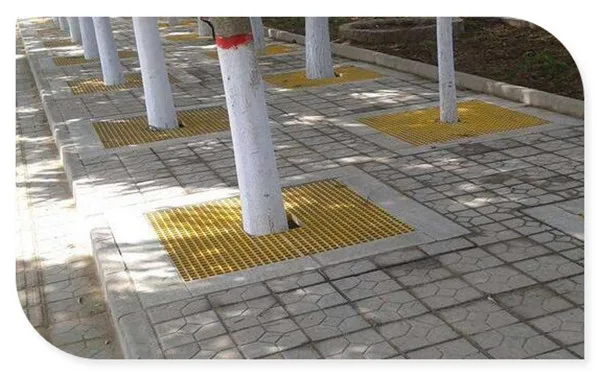
If your working conditions fall outside the above range, you can provide site photos and dimensions, and our technicians will help assess them.
Different parts of the same site often have different requirements. Taking composite grating panels as an example, main passages and corner areas, frequently used areas and occasional maintenance areas can have different specifications; it is also advisable to combine steel grating specifications by zone, balancing safety and cost.
Key Advantages
Main features can be summarized as follows:
The overall structure of a grating panel consists of rib grids and skins. Geometrically, the grating structure has good topology optimization; at equal weight it offers a larger section moment of inertia and better bending performance than other structural forms, and the ribs have high normal stiffness, yielding higher structural efficiency. Moreover, the ribs are relatively independent; under impact loads, cracks do not easily propagate after damage, so overall performance remains good.
Overall, selection should weigh span, load and service environment together.
The concepts in this section are the basis for everything that follows. If you remember only one point, let it be this: the performance of composite grating panels is determined by the structural form, not by thickness or weight alone. When in doubt, describe the site conditions clearly and judge against common practice for steel grating specifications.
Scope of Application & Engineering Fields
Main applications are as follows:
Stability analysis models for stiffened composite grating structures mainly include the discrete stiffener model, the finite element model and the smeared stiffener model. The discrete stiffener model applies only to specific stiffened structures; the finite element model requires extensive repeated analysis for optimization design; the smeared stiffener model, based on homogenization assumptions and considering the overall buckling capacity of the structure, is more applicable. In short, the load transfer paths of composite grating structures are complex, and failure involves multiple damage modes such as rib fiber fracture, skin fiber fracture and rib-skin debonding, posing considerable difficulties for related research.
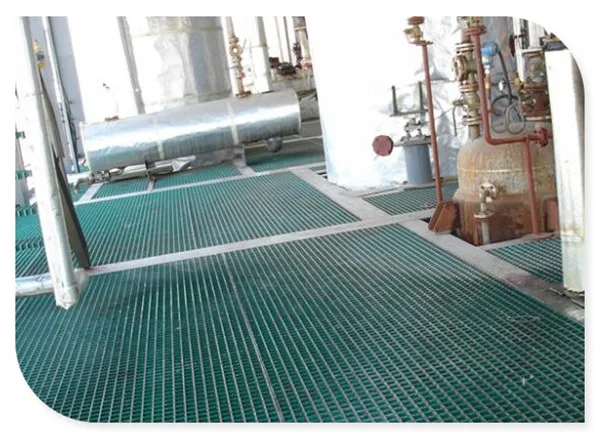
If your working conditions fall outside the above range, you can provide site photos and dimensions, and our technicians will help assess them.
The scope of application of composite grating panels is actually broader than many people think, from industrial platforms to municipal landscaping. The difference: industrial scenarios focus more on load capacity and corrosion protection, while municipal scenarios also consider appearance, theft prevention and pedestrian safety. Common practices for hot-dip galvanized steel grating in these scenarios can be viewed on the case pages.
Supplementary notes on testing and analysis of composite grating panels
Additional key points are as follows:
This article takes composite grating panels as the research object and conducts systematic bending tests and numerical analysis on composite pure grating panels without skins, composite grating stiffened panels with an upper or lower skin, and composite grating sandwich panels with double-sided skins. Pure grating panels consist entirely of rib grids; stiffened panels consist of rib grids plus an upper or lower skin, bearing bending and shear loads together; sandwich panels consist of rib grids plus upper and lower skins, where the skins mainly bear bending loads, the rib grids mainly bear shear loads and partly bending loads, and support the upper and lower skins.
Specifically: in stiffened panels, the upper or lower skin is rigidly connected with the rib grid, restraining rib buckling and deformation with the single skin, improving overall structural stiffness more effectively than pure grating panels; in sandwich panels, the upper and lower skins are the main load-bearing members, while the ribs provide effective support and connection for the skins, transferring shear stress so that both skins deform consistently, improving the overall stiffness of the member.
Test scheme
The above points can serve as a pre-purchase checklist; confirm each item before moving to the quotation stage.
It should be noted that the specific construction of composite grating panels varies with project conditions; what is given here is a general approach rather than a fixed answer. Before execution, confirm the site span, support conditions and traffic requirements, then implement item by item against this section; for steel grating specifications, the judgment logic is the same, and re-checking before ordering is still recommended.
Performance characteristics of testing and analysis of composite grating panels
Its overall performance focuses on the following aspects; we suggest comparing item by item in actual selection:
The tests refer to the 'Test method for flexural properties of sandwich constructions', with three-point and four-point bending tests on pure grating, stiffened grating and sandwich grating specimens. Loading used a 30t universal testing machine; the bending tests adopted step loading with real-time recording of load and displacement values.
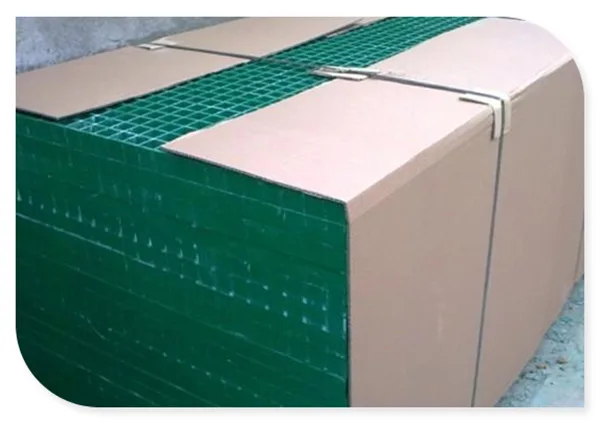
Overall, selection should weigh span, load and service environment together.
When making selection decisions, the biggest pitfall with composite grating panels is 'picking a model by experience'. If any of span, load or service environment changes, the conclusion may differ. Listing the conditions clearly and comparing against common practice for hot-dip galvanized steel grating is far more efficient.
Key points on testing and analysis of composite grating panels
Additional key points are as follows:
The results show
The above points can serve as a pre-purchase checklist; confirm each item before moving to the quotation stage.
In terms of price composition, the cost of composite grating panels is mainly affected by steel market conditions, specifications and dimensions, surface treatment and processing difficulty; zinc coating thickness and special-shaped processing have a large impact on the unit price. Stating these clearly when inquiring makes quotations comparable; the price factors for hot-dip galvanized steel grating are basically the same.
What is testing and analysis of composite grating panels
Before reaching ultimate load capacity, the load-displacement curve of composite grating panels grows linearly; thereafter strength declines in a 'sawtooth staircase' pattern with several small rises and falls: the panel gives dense audible warnings before failure and the failure process lasts a long time; sandwich panels and lower-skin stiffened panels fail similarly, starting from whitening and cracking of the lower skin to skin debonding, with four stages: elastic deformation, debonding instability, core shear failure and residual strength; pure grating panels and upper-skin stiffened panels fail similarly, starting from vertical rib cracking to horizontal fiber rupture leading to specimen failure; sandwich panels show a nearly ductile phase during failure, defined as 'pseudo-ductility'.
This part of composite grating panels may seem basic, but it is often the source of later disputes. Stating structural form, material and surface treatment clearly in communication is far more reliable than agreeing on a name only. The same breakdown applies to selecting hot-dip galvanized steel grating.
Main advantages (continued)
For composite grating panels with the same skin arrangement, ultimate bending capacity and bending stiffness decrease as specimen span increases; taking the upper-skin stiffened panel as an example, when the span decreases from 1000mm to 500mm, ultimate capacity drops 55.7% and mid-span displacement rises 120%. Sandwich panels and upper-skin stiffened panels offer somewhat higher ultimate bending capacity than other types; for a 1000mm-span sandwich panel, ultimate bending capacity is 27.2%, 5.3% and 36.2% higher than that of pure grating panels, upper-skin stiffened panels and lower-skin stiffened panels of the same span, respectively;
According to the finite element analysis of parameters affecting bending performance, increasing upper skin thickness is more effective than increasing lower skin thickness; increasing rib thickness and decreasing rib spacing are also beneficial. When rib height increases from 25mm to 75mm, bending capacity rises 72.7% and bending stiffness 124.1%; increasing rib height most effectively improves the bending capacity and bending stiffness of specimens.
The concepts in this section are the basis for everything that follows. If you remember only one point: the performance of composite grating panels is determined by structural form, not by thickness or weight alone. When in doubt, describe the site conditions clearly and judge against common practice for hot-dip galvanized steel grating.
Further reading: key points for selecting hot-dip galvanized steel grating and steel grating specifications
Hot-dip galvanized steel grating and steel grating specifications belong to the same product system in different specification forms; the selection logic is as described in this article: first the nature of use, then size by span and load, finally surface treatment by environment. The two may differ in corrosion and anti-slip requirements; state them separately before ordering rather than writing one generic technical requirement.
- For all product specifications and theoretical weights by series, visit Steel Grating Product Center
- To estimate cost by size and quantity, use Instant Quote PageSubmit Requirements
- To see how similar projects were executed, refer to Project Cases field applications
FAQ
Where can I find specific specifications?
our websiteProductsCommon specifications and theoretical weights are organized by series, also available in Instant Quote PageEstimate by size, or contact us directly for sizing advice.
Why do different manufacturers quote different weights for the same specifications?
The main difference lies in the actual measured thickness and tolerance control of the bearing bars. When bars are supplied at the lower tolerance limit, weight per unit area falls below the theoretical value, and load capacity drops accordingly. We recommend specifying thickness tolerance clearly when purchasing.
How to choose between hot-dip galvanizing and cold galvanizing?
The two anti-corrosion mechanisms differ: hot-dip galvanizing immerses steel in molten zinc to form a metallurgically bonded coating, thick and long-lasting, suitable for outdoor and humid environments; cold galvanizing is electrochemical deposition with a thinner, more uniform appearance, suitable for dry indoor environments or applications requiring high dimensional precision.
The above is for sizing and construction reference. To verify specific parameters or request a quotation, please visitInstant Quote Page, or contact our technical staff.
If you already have drawings or site dimensions, submit them directly and we will help verify specifications and layout, avoiding on-site cutting and rework caused by mismatched models. Without drawings, site photos and approximate dimensions are enough for an estimate.