







This article covers steel ladder grating treads in three parts - terms and definitions, general requirements, and manufacturing and installation - with practical advice after each. If you are comparing options or preparing procurement, check items in order; cross-check the stair tread entries, and adjust where site conditions differ.
1. Terms and definitions
Below we first briefly explain the relevant concepts and basic construction to make the following parameters and sizing content easier to understand.
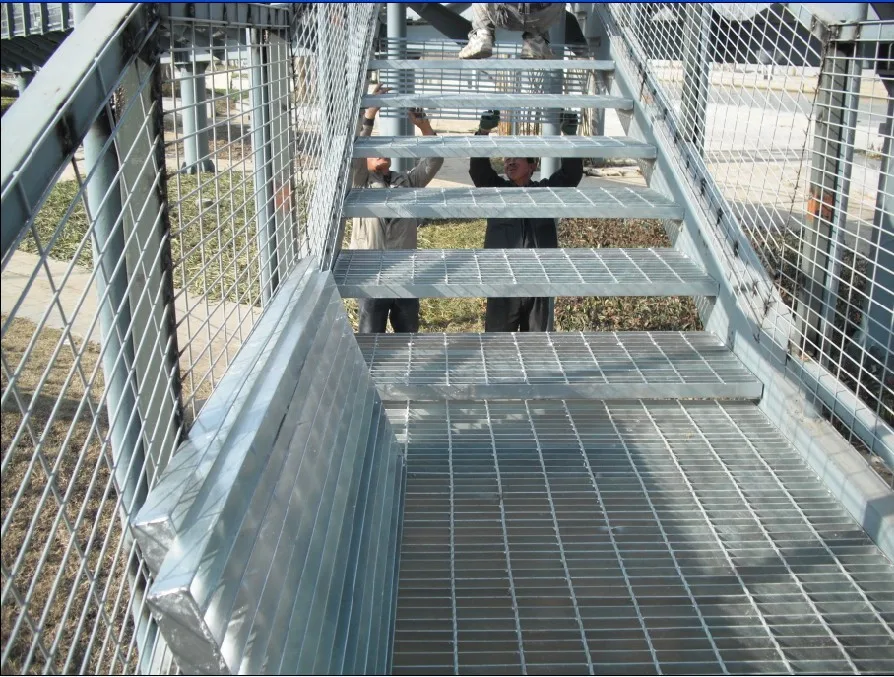
1 Fixed steel inclined ladder
A treaded steel ladder permanently installed on a building or equipment, inclined at 30-75 degrees to the horizontal (see Figure 1).
2 Stair Stringer (Frame) stile(rail)
The side members of a ladder used to mount treads or other transversely load-bearing components.
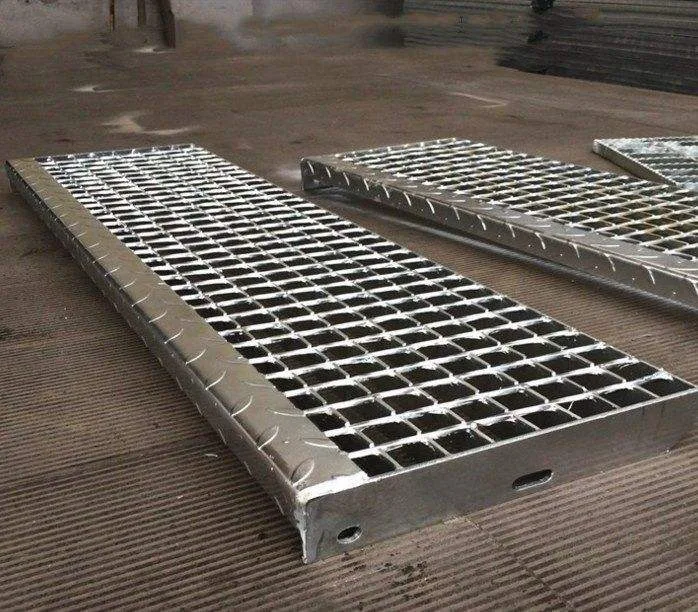
3 Tread tread(step)
The horizontal ladder component stepped on when going up and down, with a front-to-back depth of no less than 80 mm.
4 Tread height rise
The vertical distance between two adjacent treads.
5 Tread width going
The horizontal distance between the noses of two adjacent treads.
6 Clear width inside
The distance measured parallel to the treads between the inner sides of the two stringers, referred to as ladder width.
7 Ladder height
The vertical distance between the upper and lower datum planes of the stringer, referred to as ladder height.
8 Inclination angle of pitch
The angle between the plane containing the two stringer centerlines and the horizontal.
1 - tread;
2 - stringer;
3 - intermediate rail;
4 - post;
5 - handrail;
H - stair height;
L - stair span;
h1 - railing height;
h2 - handrail height;
α - ladder inclination angle;
r - tread rise;
g - tread width.
Once you grasp these basic concepts, the specifications and sizing recommendations that follow will be much easier to understand.
Bigger is not always better. Selection of steel ladder grating treads should be as economical as possible while meeting load requirements; excessive thickness increases weight and cost and complicates installation. The product page provides fuller cross-references for steel stair treads - review them together before deciding.
2. General requirements
The standards and inspection items to check are as follows:
1 Material
The steel used for inclined steel ladders shall have mechanical properties not lower than Q235-B, with guaranteed carbon content.
2 Inclination of Steel Stairway
1 The inclination of a fixed steel inclined ladder to the horizontal shall be within 30°~75°, preferably 30°~35°. The maximum inclination for occasional access should be 42°; for frequent two-way traffic, 38°.
2 Within a flight, the combination of riser height and going shall remain consistent and shall meet the requirement of Equation (1):
550≤g+2r≤700 ..........................(1),
Where:
g - tread width, in millimeters (mm);
r - tread rise, in millimeters (mm).
3 For examples of common ladder inclinations and the corresponding riser height r and going g combinations (g+2r=600), see Table 1; other inclinations may be determined by linear interpolation.
4 For examples of common ladder inclinations and height-to-span ratios (H:L), see Table 2.
3. Design loads
1 The design load of a fixed steel inclined ladder shall be determined by actual service requirements but shall not be less than the values specified in this part.
2 A fixed steel inclined ladder shall withstand 5 times the specified live load standard value, and no less than a 4.4kN concentrated load applied at any point. The uniformly distributed live load standard value on the horizontal projection of the ladder shall be no less than 3.5kN/m2.
3 The concentrated live load at the midpoint of a tread shall be no less than 1.5kN, and the uniformly distributed load over the clear width inside the ladder no less than 2.2kN/m.
4 Ladder handrails shall withstand a concentrated load of no less than 890 N applied in any direction except vertically upward, with maximum deflection between adjacent posts no greater than 1/250 of the span. Intermediate rails shall withstand a horizontal concentrated load of no less than 700 N applied at the midpoint of their circumference, with maximum deflection no greater than 75 mm. End or terminal posts shall withstand a concentrated load of 890 N applied at the top of the post in any direction. These loads are not superimposed.
We recommend checking each clause above during acceptance and keeping the factory inspection records.
On anti-corrosion, one point is easily overlooked: cutting and welding on site damage the original coating, and these areas need zinc repair after construction, or rust will start from the cuts. Steel ladder treads have the same issue; it is best written into technical requirements during disclosure.
4. Manufacturing and installation
On-site construction generally follows the steps and technical requirements below; complete the technical disclosure before starting work:
1 Inclined steel ladders shall use welded connections; welding shall comply with GB 50205. Where other connection methods are used, connection strength shall be no lower than welding. Installed ladders shall be free of skew, twist, deformation and other defects.
2 Manufacturing and installation processes shall ensure the ladder and all its components have smooth surfaces, free of sharp edges, corners, burrs or other external defects that could injure users or hinder passage.
3 Where an inclined steel ladder connects to a platform beam attached to equipment, bolted connections with slotted holes are preferred at the joint.
After installation, check each panel's fixing points and flatness; put into use only after confirming no warping or looseness.
Installation most affects later user experience. When laying steel ladder grating treads, the direction must not be reversed: the bearing bars should align with the main load direction - the most overlooked point on site. Fixings must be complete per the layout drawing; a missing one can cause local loosening. The same applies to steel stair treads.
5. Rust and corrosion prevention
Common materials and surface treatments are as follows:
1 Fixed steel inclined ladders shall be designed to minimize trapped moisture to reduce rusting and corrosion.
2 According to the ladder's service occasion and environmental conditions, suitable anti-rust and anti-corrosion coating shall be applied.
3 After installation, the inclined steel ladder shall be given at least one coat of primer and one (or more) topcoat(s), or an equivalent anti-rust, anti-corrosion coating.
6. Grounding
For lightning protection of outdoor inclined steel ladders and their connections, connection and grounding accessories shall comply with GB 50057.
Once material and surface treatment are decided, we recommend writing zinc coating thickness and appearance requirements into the technical agreement.
Choosing a surface treatment is essentially balancing initial investment against later maintenance. Requirements can be relaxed for steel ladder grating treads in indoor dry environments and raised for outdoor or humid environments. Steel stair tread selection follows the same logic.
7. Structural requirements
The standards and inspection items to check are as follows:
Stair Height
1 Ladder height should not exceed 5 m; above 5 m, an intermediate platform (rest platform) should be provided and the ladder divided into sections.
2 The ladder height of a single flight should not exceed 6 m, and the number of steps should not exceed 16.
Clear Inside Width
1 For the clear width inside the ladder: the clear width for one-way traffic should be 600 mm; for frequent one-way and occasional two-way traffic, 800 mm; for frequent two-way traffic, 1000 mm.
2 The clear width inside the ladder shall be no less than 450 mm and should not exceed 1100 mm.
8. Treads
1 The front-to-back depth of treads shall be no less than 80 mm; the overlap of adjacent treads in the front-to-back direction shall be no less than 10 mm and no more than 35 mm.
2 All treads within a flight shall be equally spaced; the tread spacing should be 225 mm~255 mm.
3 The top surface of the top tread shall be level with the platform surface, with no gap between the tread and the platform.
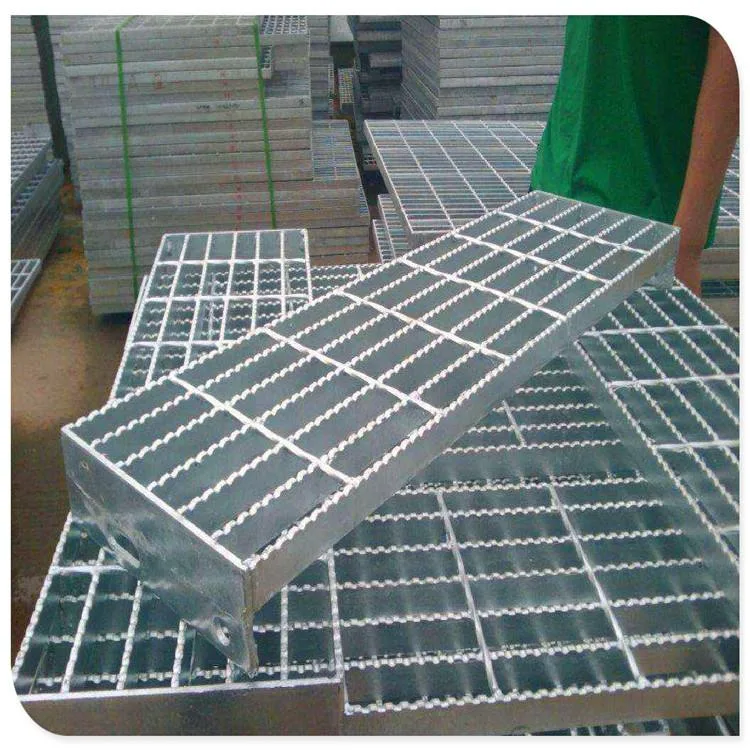
4 Treads shall use anti-slip materials or have anti-slip nosings at least 25 mm wide. Checkered steel plate no less than 4 mm thick, or anti-slip treated plain steel plate, or grating welded from 25 mm x 4 mm flat bars and small angle steel, or other equivalent structures, shall be used.
9. Stringers
Stringers must be sufficiently stiff to minimize lateral flexural deformation and must project forward from the front edge of the bottom tread by at least 50mm.
X. Ladder Clearance Space
1 Above the ladder user, the vertical distance measured along the stringer centerline from the front edge of the tread nosing to the overhead obstruction shall be no less than 1200 mm.
2. Above the ladder user, the vertical distance from the front edge of the tread to any overhead obstruction must be at least 2000mm.
We recommend checking each clause above during acceptance and keeping the factory inspection records.
Note that the specific practice for steel ladder grating treads varies with project conditions; this article offers a general approach, not fixed answers. In practice, first confirm site span, support conditions and traffic requirements, then implement this section item by item; the same logic applies to steel stair treads, and a final check before ordering is recommended.
Further reading: selection reference for steel stair treads and steel ladder treads
Besides the content of this article, real projects often involve steel stair treads. They share structural forms and processing with the topic here; when selecting, check span, load and environment in turn. If both are used together in one project, unify material and surface treatment to avoid galvanic corrosion or inconsistent appearance.
- For all product specifications and theoretical weights by series, visit Steel Grating Product Center
- To estimate cost by size and quantity, use Instant Quote PageSubmit Requirements
- To see how similar projects were executed, refer to Project Cases field applications
FAQ
What information is needed for custom sizes?
Usually you need to provide the panel dimensions (length x width), bearing bar specs and direction, center-to-center pitch of bearing bars and cross bars, surface treatment, and special requirements such as cutouts, corner notches and banding. Site photos or sketches are even better.
Can the values in the article be applied directly?
Values in this article come from relevant standard clauses or common industry practice. For actual selection, recalculate based on site span, load class and service environment; direct copying is not recommended.
What maintenance is required during daily use?
Maintenance mainly involves periodically checking whether fasteners are loose, whether touch-up paint has peeled off, and whether the panel surface shows obvious deformation or rust. Issues found should be dealt with promptly; overall maintenance is minimal.
The above is for sizing and construction reference. To verify specific parameters or request a quotation, please visitInstant Quote Page, or contact our technical staff.
The above is general guidance. For a specific project, we still recommend submitting span, load class and service environment to our technicians for review. Steel grating is a load-bearing component; rework caused by wrong specification choices costs far more than the time spent on upfront calculation.