







This article presents the stainless steel grating production process in order - material, bearing bar punching and cutting, and basic concepts - with actionable checks in each part. If you only need a quick answer, read the opening point of each section; the same method applies to galvanized bar grating.
Material and Surface Treatment in the Stainless Steel Grating Production Process
Material and surface treatment are key to service life. Common practices and suitable environments are as follows:
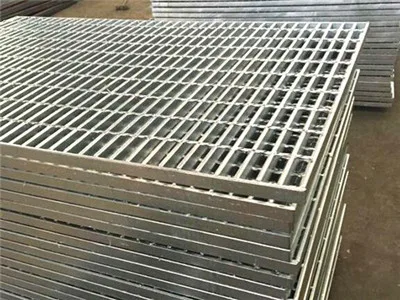
The biggest difference between stainless steel grating and galvanized steel grating is that stainless steel grating uses flat bearing bars made of stainless steel. Stainless steel has unique advantages, outperforming the material of galvanized grating in corrosion and rust resistance, acid and alkali resistance and high-temperature resistance, so it is often used for base platform construction in chemical plants - mainly because strong acid and alkali chemicals may occasionally splash
onto the base platform. So what does the production process of this stainless steel grating look like?
Once material and surface treatment are decided, we recommend writing zinc coating thickness and appearance requirements into the technical agreement.
Material and surface treatment determine how stainless steel grating performs on site. For the same grating, the treatment used in a dry interior differs greatly from that used in coastal or chemical environments, so the service environment should be stated as the primary condition during selection. The same holds for hot-dip galvanized steel grating.
Bearing Bar Punching and Cutting
The following aspects most need to be confirmed in advance in actual procurement and use:
The above points can serve as a pre-purchase checklist; confirm each item before moving to the quotation stage.
It is worth noting that price is not the only consideration. Maintenance costs, replacement difficulty and service life all affect the total cost of stainless steel grating, so the cheapest option is not always the most economical. Include the full life-cycle cost of hot-dip galvanized steel grating in your budget.
Mold Layout
This part of stainless steel grating production may look basic, but it is often the source of later disputes. It is far more reliable to state the structural form, material and surface treatment clearly than to agree on a name alone. The same breakdown works when selecting galvanized bar grating.
Welding
The process choice directly determines the performance of finished stainless steel grating. Welding and press-locking each have their place; neither is simply better, and the choice depends on load requirements and service environment. The same logic applies to galvanized bar grating.
Grinding
It should be noted that the exact detailing of stainless steel grating varies with project conditions; what is given here is a general approach, not a fixed answer. In practice, confirm the site span, support conditions and traffic requirements first, then work through this section point by point. Where galvanized bar grating is involved, the same logic applies, and a re-check before ordering is still recommended.
Polishing
This part of stainless steel grating production may look basic, but it is often the source of later disputes. It is far more reliable to state the structural form, material and surface treatment clearly than to agree on a name alone. The same breakdown works when selecting galvanized bar grating.
Further notes: How to combine galvanized grating and hot-dip galvanized steel grating in use
Besides what this article covers, galvanized grating is also common in actual projects. It shares similarities with this article's subject in structure and fabrication; for selection, check span, load and service environment in the same order. If both types of components are used in the same project, we recommend unifying material and surface treatment to avoid later galvanic corrosion or inconsistent appearance.
- For all product specifications and theoretical weights by series, visit Steel Grating Product Center
- To estimate cost by size and quantity, use Instant Quote PageSubmit Requirements
- To see how similar projects were executed, refer to Project Cases field applications
FAQ
What maintenance is required during daily use?
Maintenance mainly involves periodically checking whether fasteners are loose, whether touch-up paint has peeled off, and whether the panel surface shows obvious deformation or rust. Issues found should be dealt with promptly; overall maintenance is minimal.
Can the values in the article be applied directly?
Values in this article come from relevant standard clauses or common industry practice. For actual selection, recalculate based on site span, load class and service environment; direct copying is not recommended.
What information is needed for custom sizes?
Usually you need to provide the panel dimensions (length x width), bearing bar specs and direction, center-to-center pitch of bearing bars and cross bars, surface treatment, and special requirements such as cutouts, corner notches and banding. Site photos or sketches are even better.
The above is for sizing and construction reference. To verify specific parameters or request a quotation, please visitInstant Quote Page, or contact our technical staff.
The above is general guidance. For a specific project, we still recommend submitting span, load class and service environment to our technicians for review. Steel grating is a load-bearing component; rework caused by wrong specification choices costs far more than the time spent on upfront calculation.