







Steel grating is not complicated to apply in real projects; the difficulty lies in matching specifications, material and service environment. This article explains the advantages of serrated steel grating, typical applications and basic concepts in turn, giving you a complete framework for judging galvanized steel grating.
Plain flat steel grating becomes very slippery when exposed to water, oil or ice. The solution is to pressserrations (teeth) into the bearing edge of the flat bars, creating a micro-grip that markedly raises the friction coefficient. In model designations,SS indicates the serrated type (e.g. G303/30/100S).
| Type | Anti-Slip | Foot feel | Scenario |
|---|---|---|---|
| Type | Slip resistance | Foot feel | Applicable |
| Flat type (P) | Average | Comfortable | Dry indoor areas |
| Serrated (S) | Excellent | Slightly hard underfoot | Wet or outdoor areas |
| I-type serration | Superior | Medium | Heavy-load anti-slip |
Advantages of Serrated Steel Grating
Main features can be summarized as follows:
(1) Reliable slip resistance on wet, oily or icy surfaces; (2) strength equal to flat type; (3) only slightly higher cost. Drawbacks: tooth tips collect dust and feel slightly hard underfoot. Suitable platforms: wastewater treatment plants, ship decks, mine walkways, outdoor stairs, etc. Flat type is sufficient for ordinary dry indoor walkways.
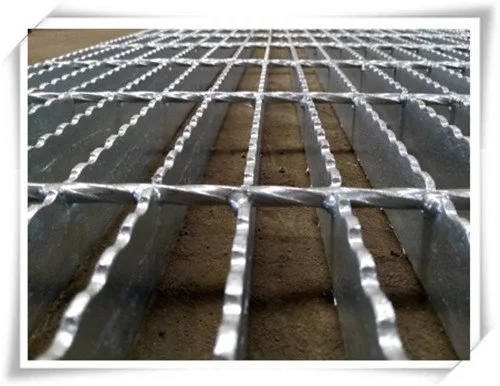
Overall, selection should weigh span, load and service environment together.
Different areas of the same site often have different requirements. Take steel grating: main passages and corner areas, frequently used areas and occasional maintenance areas can be specified separately; the combination with galvanized grating should also be considered by zone, balancing safety and cost.
Typical Applications
Typical applications mainly include the following categories, which can help you judge suitability for your project:
- Industrial Platforms & Maintenance Walkways: equipment platforms and inspection passages in power plants, chemical plants and steel-structure workshops;
- Municipal & Landscape: road drainage trench covers, rainwater grates, tree grates, park boardwalks;
- Transportation & Ports: wharf trestles, multi-story parking garage lanes, railway bridge walkways;
- Environmental & Water Treatment: walkways in wastewater treatment plants, tank platforms, screening machine platforms;
- Others: elevated tower platforms, stair treads, fences and railings, etc.
If your working conditions fall outside the above range, you can provide site photos and dimensions, and our technicians will help assess them.
Different applications have different priorities for steel grating: pedestrian walkways value anti-slip and comfort, vehicle areas value panel stiffness and fixing reliability, and drainage trench covers value open area and theft resistance. Clarify the usage type before looking at specifications to save detours; the same applies to galvanized grating.
Key Conditions to Confirm During Selection
- First clarify the span and support beam spacing to determine the required series;
- Then check load requirements by usage type (pedestrian, maintenance, vehicular);
- Finally, determine the surface treatment by service environment (dry indoor, outdoor, coastal, chemical).
What is most easily overlooked in spec tables are tolerances and end treatment. Steel grating usually has machining allowance in the length direction; if embedded installation is used on site, edge closing and corner notch requirements must be stated in advance. Galvanized grating is handled similarly in these details; we recommend marking them clearly on the drawings as well.
Further notes: How to combine galvanized grating and hot-dip galvanized steel grating in use
If a project uses both galvanized grating and hot-dip galvanized steel grating, we recommend planning them on the same layout drawing. This way edge closing, fixing and cutouts at junctions can be handled uniformly, avoiding dimension conflicts during installation and making later maintenance easier.
- For all product specifications and theoretical weights by series, visit Steel Grating Product Center
- To estimate cost by size and quantity, use Instant Quote PageSubmit Requirements
- To see how similar projects were executed, refer to Project Cases field applications
FAQ
Why do different manufacturers quote different weights for the same specifications?
The main difference lies in the actual measured thickness and tolerance control of the bearing bars. When bars are supplied at the lower tolerance limit, weight per unit area falls below the theoretical value, and load capacity drops accordingly. We recommend specifying thickness tolerance clearly when purchasing.
How to choose between hot-dip galvanizing and cold galvanizing?
The two anti-corrosion mechanisms differ: hot-dip galvanizing immerses steel in molten zinc to form a metallurgically bonded coating, thick and long-lasting, suitable for outdoor and humid environments; cold galvanizing is electrochemical deposition with a thinner, more uniform appearance, suitable for dry indoor environments or applications requiring high dimensional precision.
Where can I find specific specifications?
our websiteProductsCommon specifications and theoretical weights are organized by series, also available in Instant Quote PageEstimate by size, or contact us directly for sizing advice.
The above is for sizing and construction reference. To verify specific parameters or request a quotation, please visitInstant Quote Page, or contact our technical staff.
The above is general guidance. For a specific project, we still recommend submitting span, load class and service environment to our technicians for review. Steel grating is a load-bearing component; rework caused by wrong specification choices costs far more than the time spent on upfront calculation.