







Steel stair treads are not complicated in practical engineering; the difficulty lies in matching specifications, material and service environment. This article covers, in order, what steel stair treads are, their scope of application and engineering fields, and how to choose them, giving you a complete approach to evaluating hot-dip galvanized steel grating.
What Are Steel Stair Treads and How to Choose Them
Below we first briefly explain the relevant concepts and basic construction to make the following parameters and sizing content easier to understand.
Steel stair treads can be screw-fixed or welded. Bolt fixing requires a drilled rear side plate, while direct welding requires no thickened side plate. Treads are usually hot-dip galvanized or spray-painted; painted treads should be sprayed with anti-rust primer before the topcoat to achieve long-term corrosion protection.
Galvanized steel grating treads are stairs where grating is used for platforms. By installation method, there are two main types: welded fixing and bolt fixing. Those welded directly to the stringer beams need no side plates, which is relatively economical and durable but not easy to disassemble.
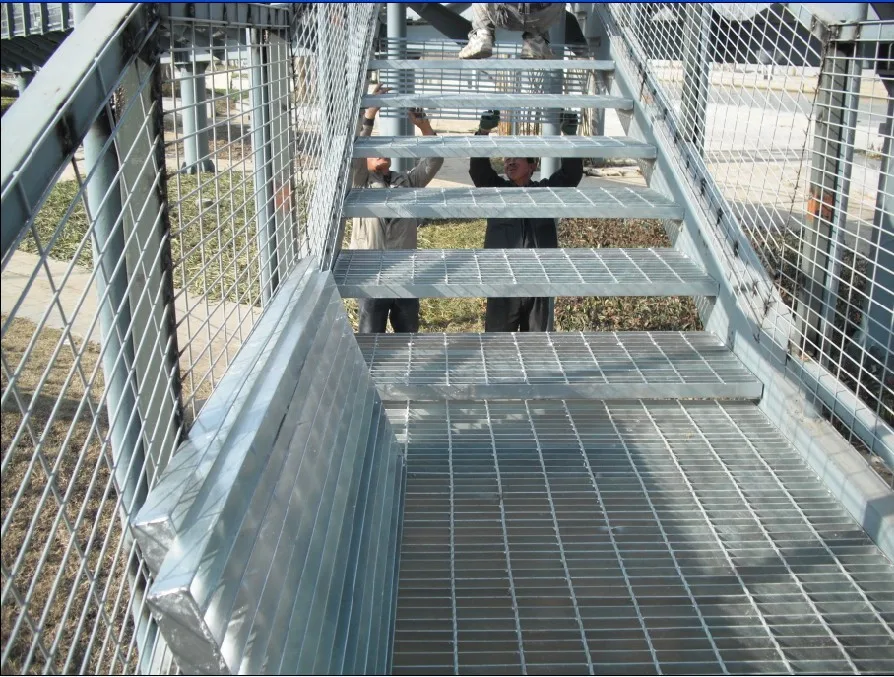
Once you grasp these basic concepts, the specifications and sizing recommendations that follow will be much easier to understand.
Bigger specifications are not always better. The selection of steel stair treads should be as economical as possible while meeting load requirements; excessive thickening increases self-weight and cost and complicates installation. The product page provides more complete reference for hot-dip galvanized steel grating; refer to it before making a decision.
Scope of Application & Engineering Fields
Typical applications mainly include the following categories, which can help you judge suitability for your project:
Steel stair treads are classified by tread function and service environment. If you have drawings, strictly follow the engineering designer's drawings. For stairs with heavy foot traffic, treads with nosing plates should be used; otherwise nosing plates can be omitted to reduce cost.
If your working conditions fall outside the above range, you can provide site photos and dimensions, and our technicians will help assess them.
Different parts of the same scene often have different requirements. Take steel stair treads as an example: specifications for main passages and corner areas, frequently used areas and occasional maintenance areas can be set separately; the combined use of galvanized grating is also recommended on a zoned basis, balancing safety and cost.
Installation and Construction Points of Steel Stair Treads
On-site construction generally follows the steps and technical requirements below; complete the technical disclosure before starting work:
Bolt-fixed treads need thickened side plates on both sides, drilled and fixed directly with bolts during installation, allowing repeated recovery and reuse. Customers can customize with any type of steel grating made into various sizes to match the corresponding stairs. From an economic point of view, we recommend using our recommended sizes as much as possible.
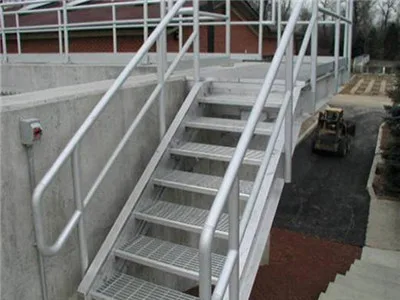
After installation, check each panel's fixing points and flatness; put into use only after confirming no warping or looseness.
A practical tip for specification confirmation: write all four items - bearing bar specs, bearing bar center pitch, cross bar pitch and overall dimensions - into the purchase list; specifying only one or two often leads to mismatched deliveries. The specification notation of steel stair treads is fully mapped on the product page; number and check each panel against the layout drawing before ordering, and the same applies to hot-dip galvanized steel grating.
Supplementary Notes on Choosing Steel Stair Treads
Widths are 700mm, 800mm and 900mm; the minimum width is 600mm and the maximum width should not exceed 1200mm. For stairs used by a single person, the width between the two stringers or guardrails should be no less than 600mm. When stairs frequently carry several people crossing or serve as evacuation routes, the stair width should be increased to 1200mm.
This section covers common practice for steel stair treads in most projects. If your site conditions are special - corrosive media, large temperature differences or frequent disassembly - the treatment should be adjusted accordingly. Galvanized grating under such conditions also needs separate confirmation; consult with site photos before deciding.
Application Scenarios of Steel Stair Treads
The protruding edge of stair treads should withstand a 1.5KN load; when the width is not greater than 1200mm, the load acts on a 100mm×100mm area; when the width is greater than 1200mm, apply 1.5KN every 600mm. The deflection of stair treads shall not exceed 1/500 of the stair span.
Different application scenarios have different priorities for steel stair treads: pedestrian walkways emphasize anti-slip and comfort, vehicle areas emphasize panel stiffness and fixing reliability, and drainage trench covers emphasize open area and anti-theft. Clarify the use first, then the specifications, to avoid detours; the same applies to hot-dip galvanized steel grating.
Further reading: Sizing reference for hot-dip galvanized steel grating and galvanized grating
Hot-dip galvanized steel grating and galvanized grating are different specification forms within the same product system. The selection logic is the same as described in this article: first the usage type, then span and load to determine specifications, and finally the environment to determine surface treatment. Their corrosion protection and anti-slip requirements may differ; state them separately when ordering rather than writing one general technical requirement.
- For all product specifications and theoretical weights by series, visit Steel Grating Product Center
- To estimate cost by size and quantity, use Instant Quote PageSubmit Requirements
- To see how similar projects were executed, refer to Project Cases field applications
FAQ
What maintenance is required during daily use?
Maintenance mainly involves periodically checking whether fasteners are loose, whether touch-up paint has peeled off, and whether the panel surface shows obvious deformation or rust. Issues found should be dealt with promptly; overall maintenance is minimal.
How to choose between hot-dip galvanizing and cold galvanizing?
The two anti-corrosion mechanisms differ: hot-dip galvanizing immerses steel in molten zinc to form a metallurgically bonded coating, thick and long-lasting, suitable for outdoor and humid environments; cold galvanizing is electrochemical deposition with a thinner, more uniform appearance, suitable for dry indoor environments or applications requiring high dimensional precision.
Can the values in the article be applied directly?
Values in this article come from relevant standard clauses or common industry practice. For actual selection, recalculate based on site span, load class and service environment; direct copying is not recommended.
The above is for sizing and construction reference. To verify specific parameters or request a quotation, please visitInstant Quote Page, or contact our technical staff.
If you already have drawings or site dimensions, submit them directly and we will help verify specifications and layout, avoiding on-site cutting and rework caused by mismatched models. Without drawings, site photos and approximate dimensions are enough for an estimate.