







The application of steel grating for different uses in actual projects is not complicated; the difficulty lies in matching specifications, material, and service environment. This article covers key points about steel grating, material and anti-corrosion requirements, and performance characteristics, giving you a complete framework for judging galvanized grating as well.
Key Points on Steel Grating Explained
The following aspects most need to be confirmed in advance in actual procurement and use:
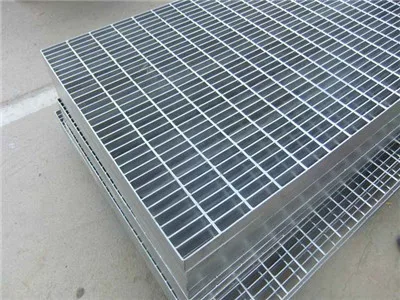
Steel grating (steel grating panels)
The above points can serve as a pre-purchase checklist; confirm each item before moving to the quotation stage.
Quotations for the same specification may fluctuate with the steel market across batches, which is normal for steel products such as grating for different uses. If the procurement schedule allows, lock in prices early; plan galvanized grating purchasing on the same rhythm.
Material and Anti-Corrosion Requirements
Material and surface treatment are key to service life. Common practices and suitable environments are as follows:
1. It is generally made of carbon steel, with the surface mostly treated by hot-dip or cold galvanizing. Galvanizing prevents oxidation and improves anti-corrosion performance. It can also be made of stainless steel.
Once material and surface treatment are decided, we recommend writing zinc coating thickness and appearance requirements into the technical agreement.
Material and surface treatment determine the durability of steel grating for different uses on site. For the same steel grating, the treatment differs greatly between dry indoor use and coastal or chemical environments, so the service environment should be stated as the primary condition when selecting. The same applies to galvanized grating.
Performance characteristics of steel grating
Main features can be summarized as follows:
2. Steel grating offers ventilation, daylighting, heat dissipation, anti-slip, and explosion-proof performance. Its surface can be serrated (serrated steel grating) to enhance anti-slip performance. Bearing bars can also be I-type or flat-type.
Overall, selection should weigh span, load and service environment together.
Process choice directly determines the final performance of steel grating for different uses. Welding and press-locking each suit different situations; neither is simply better - the load requirements and service environment decide. The same logic applies to hot-dip galvanized steel grating.
Steel grating specifications for different uses
Series 1 (30mm pitch) is the most commonly used type, found in products across all industrial fields.This series has a bearing bar center pitch of 30mm, conforming to US standards,and within the entire steel grating series it offers the strongest resistance to surface impact. It is widelyused in power plants, refineries, sewage treatment plants, grain silos, chemical plants, highways, airports,and docks, for platforms, walkways, drainage trench covers, stair treads, and more. Serrated steel gratingcan be used in damp, slippery places, especially offshore oil platforms.
Series 2 (40mm pitch) steel grating is the most economical and lightweight type, conforming to British standardsfor fixed platforms, walkways, and stairs. For short spans, it is the idealproduct, even under loads such as transport equipment walkways, and it can also be used forwarehouse shelving, mezzanine flooring, trestle bridges, protective fencing, sun shades, and more.
Series 3 (60mm pitch) steel grating was developed especially for the mining industry,solving the problem of mineral spillage on the panel surface. This series has nominalopenings of 50*60mm, allowing most spilled material to fall through and keeping the panelclean and safe. This product is often specified for panel surfaces in crushing systems,walkways on conveyor lines, ball mills, processing plants, and transfer stations.
Bigger is not always better. The selection of steel grating for different uses should be as economical as possible while meeting load requirements; over-thickening increases self-weight and cost and complicates installation. The products page offers a more complete comparison of galvanized grating; refer to it before deciding.
Further reading: Selection points for galvanized grating and hot-dip galvanized steel grating
If a project uses both galvanized grating and hot-dip galvanized steel grating, we recommend planning them on the same layout drawing. This way edge closing, fixing and cutouts at junctions can be handled uniformly, avoiding dimension conflicts during installation and making later maintenance easier.
- For all product specifications and theoretical weights by series, visit Steel Grating Product Center
- To estimate cost by size and quantity, use Instant Quote PageSubmit Requirements
- To see how similar projects were executed, refer to Project Cases field applications
FAQ
How to choose between hot-dip galvanizing and cold galvanizing?
The two anti-corrosion mechanisms differ: hot-dip galvanizing immerses steel in molten zinc to form a metallurgically bonded coating, thick and long-lasting, suitable for outdoor and humid environments; cold galvanizing is electrochemical deposition with a thinner, more uniform appearance, suitable for dry indoor environments or applications requiring high dimensional precision.
Can the values in the article be applied directly?
Values in this article come from relevant standard clauses or common industry practice. For actual selection, recalculate based on site span, load class and service environment; direct copying is not recommended.
Why do different manufacturers quote different weights for the same specifications?
The main difference lies in the actual measured thickness and tolerance control of the bearing bars. When bars are supplied at the lower tolerance limit, weight per unit area falls below the theoretical value, and load capacity drops accordingly. We recommend specifying thickness tolerance clearly when purchasing.
The above is for sizing and construction reference. To verify specific parameters or request a quotation, please visitInstant Quote Page, or contact our technical staff.
The above is general guidance. For a specific project, we still recommend submitting span, load class and service environment to our technicians for review. Steel grating is a load-bearing component; rework caused by wrong specification choices costs far more than the time spent on upfront calculation.