







Using guardrail steel grating in real projects is not complicated; the difficulty lies in matching specifications, material and service environment. This article explains application scenarios, basic concepts of guardrail grating and general concepts in turn, giving you a complete basis for judging hot-dip galvanized steel grating.
Application Scenarios of Guardrail Steel Grating
Typical applications mainly include the following categories, which can help you judge suitability for your project:
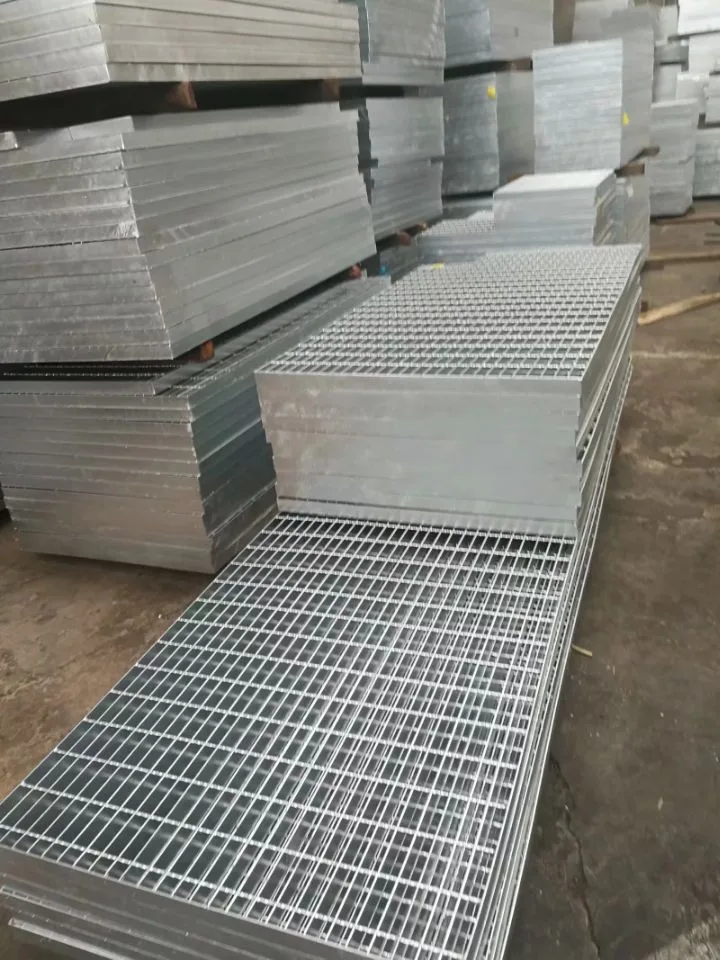
Guardrail steel grating has a very wide range of uses: walkways, ventilation screens, mooring docks, trestles, machine frames and frames, pedestrian bridges, drilling platforms, conveyor gallery trestles, bridge edge walkways, trench covers, ventilation windows, railway crossing walkways, manhole covers, security doors and windows, airport lighting guards, trash racks, perimeter fences, spray booths, warehouse racking, equipment walkways, billboards, livestock pens, equipment safety guards, pipe rack trestles, scaffolding, marine landing treads, washing racks, truck top walkways, platforms, filter screens, sunshade boxes, stair treads, offshore work vessels and stacker walkways.
If your working conditions fall outside the above range, you can provide site photos and dimensions, and our technicians will help assess them.
Guardrail steel grating is actually used more widely than many people think, from industrial platforms to municipal landscaping. The difference is that industrial applications focus on load capacity and corrosion protection, while municipal ones also consider appearance, theft prevention and pedestrian safety. Common practices for hot-dip galvanized steel grating in these scenarios can be seen on the case pages.
Basic Concepts of Guardrail Steel Grating
Below we first briefly explain the relevant concepts and basic construction to make the following parameters and sizing content easier to understand.
Guardrail steel grating can also be used for workshop partitioning, generally known as steel grating isolation fencing.
Once you grasp these basic concepts, the specifications and sizing recommendations that follow will be much easier to understand.
A practical tip for confirming specifications: write the bearing bar size, bearing bar centre pitch, cross bar pitch and overall dimensions into the purchase list together; listing only one or two of them easily leads to a mismatch on delivery. The full specification notation for guardrail steel grating is given on the product page; before ordering, number and check each panel against the layout drawing. The same applies to hot-dip galvanized steel grating.
Further notes: How to combine hot-dip galvanized steel grating and hot-dip galvanized steel grating in use
If a project uses both hot-dip galvanized steel grating and hot-dip galvanized steel grating, we recommend planning them on the same layout drawing. This way edge closing, fixing and cutouts at junctions can be handled uniformly, avoiding dimension conflicts during installation and making later maintenance easier.
- For all product specifications and theoretical weights by series, visit Steel Grating Product Center
- To estimate cost by size and quantity, use Instant Quote PageSubmit Requirements
- To see how similar projects were executed, refer to Project Cases field applications
FAQ
What maintenance is required during daily use?
Maintenance mainly involves periodically checking whether fasteners are loose, whether touch-up paint has peeled off, and whether the panel surface shows obvious deformation or rust. Issues found should be dealt with promptly; overall maintenance is minimal.
What information is needed for custom sizes?
Usually you need to provide the panel dimensions (length x width), bearing bar specs and direction, center-to-center pitch of bearing bars and cross bars, surface treatment, and special requirements such as cutouts, corner notches and banding. Site photos or sketches are even better.
Can the values in the article be applied directly?
Values in this article come from relevant standard clauses or common industry practice. For actual selection, recalculate based on site span, load class and service environment; direct copying is not recommended.
The above is for sizing and construction reference. To verify specific parameters or request a quotation, please visitInstant Quote Page, or contact our technical staff.
Note that this article presents sizing approaches and general practice, and does not constitute a strength commitment for any specific project. For load-bearing safety-critical areas, the design drawings and on-site calculations shall prevail; contact our technical staff if in doubt.