







Many projects focus only on price when purchasing hot-dip galvanized steel grating, ignoring specification matching and anti-corrosion requirements, which often leads to rework later. This article lists the conditions to confirm one by one - following the order of specification parameters, material and anti-corrosion requirements, and basic concepts - and explains how to make trade-offs under common working conditions. Content relating to hot-dip galvanized steel grating can be used directly as a reference for technical briefings.
Specification Parameters of Hot-Dip Galvanized Steel Grating
Main specification comparison is as follows:
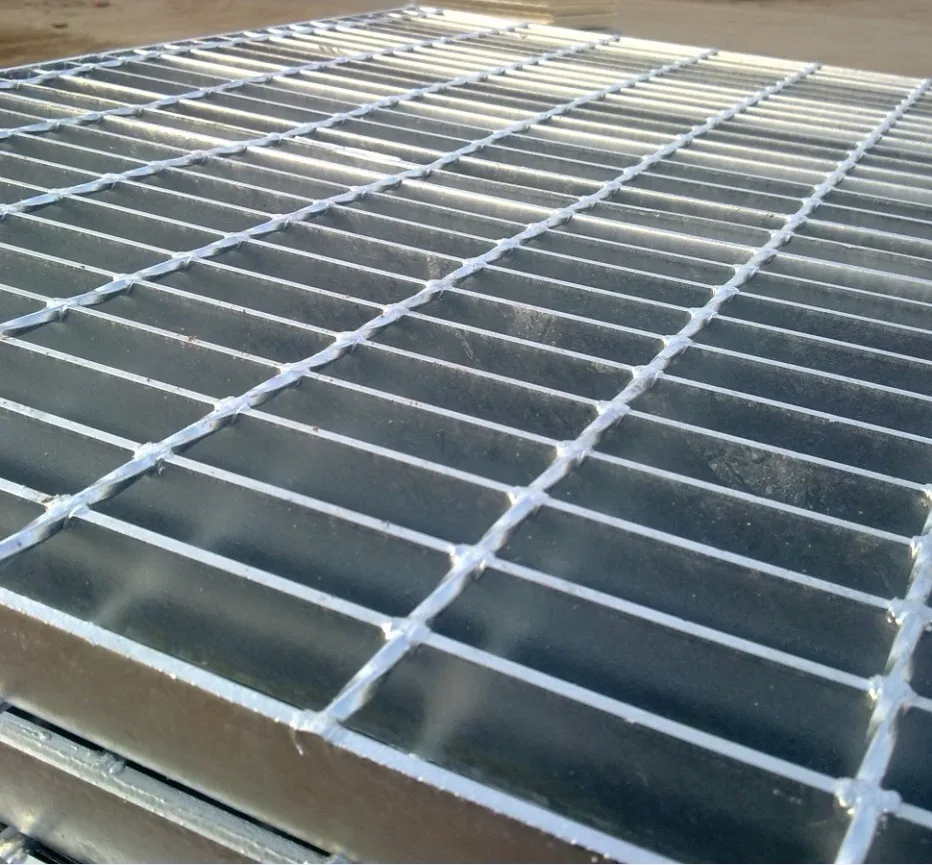
Manufacturing requirements: steel grating shall be made by pressure resistance welding, with cross bars pressed into the load-bearing flat bars by a press. Banding plates running in the same direction as the bearing bars shall be welded to every cross bar. The end edge plate of steel stair treads shall be fully welded on one side. At the ends of the bearing bars, banding is generally done with flat bars or sections of the same specification as the bearing bars. If a stair tread has a front nosing guard plate, it shall run the full length of the tread.
What technical requirements does the petrochemical industry have for galvanized steel grating? Material requirements: bearing bars, cross bars and banding plates generally use carbon structural steel or stainless steel. The mechanical properties and chemical composition of carbon structural steel shall comply with the relevant rules for Q-A in GB/T700-988;
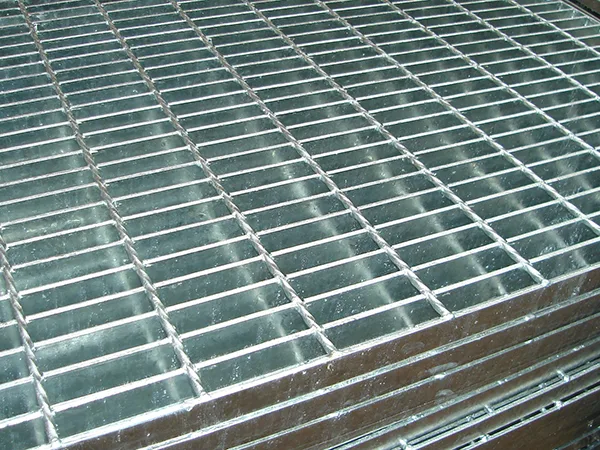
The above are common specifications; actual ordered dimensions and tolerance requirements shall be confirmed against the layout drawing.
Bigger specifications are not always better. The selection of hot-dip galvanized steel grating should be as economical as possible while meeting load requirements; over-thickening increases self-weight and cost and complicates installation. The product page has a fuller comparison of hot-dip galvanized steel grating; refer to it before deciding.
Material and Anti-Corrosion Requirements
Common materials and surface treatments are as follows:
The mechanical properties and chemical composition of stainless steel shall satisfy the material rules in GB0-99. Layout requirements: the manufacturer shall plan grating layout based on the drawing of members and openings on the steel structure platform. The manufacturer's layout drawing shall conform to the designer's intent and be approved by the design unit before production.
Once material and surface treatment are decided, we recommend writing zinc coating thickness and appearance requirements into the technical agreement.
Material and surface treatment determine the on-site durability of hot-dip galvanized steel grating. For the same steel grating, the treatment differs greatly between dry indoor use and coastal or chemical environments; service environment should be raised as the primary condition in selection. The same applies to hot-dip galvanized steel grating.
Common Models and Sizes of Hot-Dip Galvanized Steel Grating
Banding shall use a single-side fillet weld with a leg height not less than the bearing bar thickness and a weld length not less than the bearing bar thickness. Where the banding plate carries no load, welding at intervals is allowed, but the spacing shall not exceed 80mm; where the banding plate carries load, it shall be fully welded to the bearing bars, with no skip welding.
What is most easily overlooked in specification tables are tolerances and end treatment. Hot-dip galvanized steel grating usually has machining allowance in the length direction; if recessed installation is used on site, state the banding and corner-cutting requirements in advance. Hot-dip galvanized steel grating is handled similarly in these details, so mark them clearly on the drawing.
Related Reading: Selection Reference for Hot-Dip Galvanized Steel Grating and Hot-Dip Galvanized Steel Grating
Besides what this article covers, hot-dip galvanized steel grating is also common in actual projects. It shares similarities with this article's subject in structure and fabrication; for selection, check span, load and service environment in the same order. If both types of components are used in the same project, we recommend unifying material and surface treatment to avoid later galvanic corrosion or inconsistent appearance.
- For all product specifications and theoretical weights by series, visit Steel Grating Product Center
- To estimate cost by size and quantity, use Instant Quote PageSubmit Requirements
- To see how similar projects were executed, refer to Project Cases field applications
FAQ
What is most often overlooked during installation and acceptance?
First, bearing bars installed in the wrong direction reduce load capacity; second, insufficient fixing points or missing zinc touch-up paint; third, support beam spacing inconsistent with the layout drawing. These three items are most often overlooked on site.
Can the values in the article be applied directly?
Values in this article come from relevant standard clauses or common industry practice. For actual selection, recalculate based on site span, load class and service environment; direct copying is not recommended.
Why do different manufacturers quote different weights for the same specifications?
The main difference lies in the actual measured thickness and tolerance control of the bearing bars. When bars are supplied at the lower tolerance limit, weight per unit area falls below the theoretical value, and load capacity drops accordingly. We recommend specifying thickness tolerance clearly when purchasing.
The above is for sizing and construction reference. To verify specific parameters or request a quotation, please visitInstant Quote Page, or contact our technical staff.
Note that this article presents sizing approaches and general practice, and does not constitute a strength commitment for any specific project. For load-bearing safety-critical areas, the design drawings and on-site calculations shall prevail; contact our technical staff if in doubt.