







The application of anti-slip steel grating in actual projects is not complicated; the difficulty lies in matching specifications, material and service environment. This article covers, in order, the anti-slip function in snowy and rainy weather, material and anti-corrosion requirements, and the advantages of serrated steel grating, giving you a complete approach to evaluating hot-dip galvanized steel grating.
Performance Characteristics of the Anti-Slip Function
Main features can be summarized as follows:
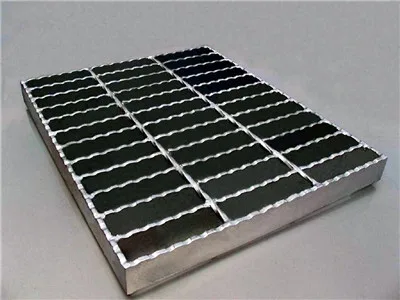
Steel grating has an anti-slip function: flat bars and twisted square cross bars are cross-welded for good slip resistance, and grating welded from serrated flat bars and twisted square cross bars provides better slip resistance than flat grating. It sheds rather than accumulates rain and snow, ventilates well and is highly safe, especially suitable for damp, slippery places such as offshore oil platforms.
Overall, selection should weigh span, load and service environment together.
During processing, dimension control mainly relies on dies and tooling, so consistency in mass production is good, while shaped pieces need separate layout. For on-site secondary processing, the anti-corrosion treatment of cut edges of hot-dip galvanized steel gratings must not be skipped either.
Material and Anti-Corrosion Requirements
Common materials and surface treatments are as follows:
1. Serrated steel grating is welded from tooth-shaped flat bars and has strong slip resistance; it is often called 'sawtooth steel grating' or 'sawtooth anti-slip steel grating', especially suitable for damp, slippery places such as offshore oil platforms. Its price is higher than the flat type, so consider cost when purchasing. With hot-dip galvanized surface treatment, it has strong rust resistance - 30 years maintenance-free and replacement-free. In grating markings, serrated steel grating is denoted by the letter "S"". For example, in G323/30/50SG the "S"means serrated steel grating; the full explanation is hot-dip galvanized serrated steel grating of 323/30/50. Serrated steel grating is also a category of hot-dip galvanized steel grating, based on whether the flat bar surface is serrated.
Once material and surface treatment are decided, we recommend writing zinc coating thickness and appearance requirements into the technical agreement.
Regarding corrosion protection, one thing is easily overlooked: on-site cutting and welding damage the original coating, and these areas need zinc touch-up after construction, otherwise rust often starts from the cut edges. Hot-dip galvanized steel grating has the same issue; it is best to include this in the technical requirements at the construction disclosure.
2. Advantages of serrated steel grating (serrated steel gratings)
Main features can be summarized as follows:
- Serrated steel grating has large mesh openings and the best drainage: the water-drainage area reaches 83.3%, more than twice that of cast iron.
- Attractive product appearance: clean lines, silver surface, modern concept.
- Material savings: for large spans and heavy loads, it costs less than cast iron and saves the replacement costs of cast iron covers stolen or crushed.
- Serrated steel grating has the best slip resistance among grating types, greatly increasing surface friction, preventing accidents from slipping and maximizing production safety.
Overall, selection should weigh span, load and service environment together.
Quotations for the same specification may fluctuate with the steel market between batches - a normal phenomenon for steel products like anti-slip steel grating. If the procurement schedule allows, lock prices in advance; procurement of hot-dip galvanized steel gratings can be planned at the same pace.
3. Specifications of serrated steel grating (serrated steel gratings)
Common specifications and corresponding parameters are summarized below; confirm each item before ordering:
- Flat bar height (or width) and thickness of serrated steel grating: bar height is usually 20mm, 25mm, 30mm, 32mm, 35mm, 40mm, 45mm, 50mm, etc.; grating flat bar thickness includes 3mm, 4mm, 5mm, 6mm, 8mm, etc.
- Surface treatments of serrated steel grating: hot-dip galvanizing, cold galvanizing, electroplating, spray painting, anti-rust oil dipping, PVC-dip coating.
- Bearing bar pitch of serrated steel grating: the center distance of adjacent bearing flat bars, commonly 30mm and 40mm, sometimes 60mm.
- Cross bar pitch of serrated steel grating: the center distance of adjacent cross bars, usually 50mm and 100mm; special specifications can be produced on request.
The above are common specifications; actual ordered dimensions and tolerance requirements shall be confirmed against the layout drawing.
A practical tip for confirming specifications: write the flat bar size, bearing bar pitch, cross bar pitch and overall dimensions into the purchase list together; writing only one or two often causes delivery mismatches. The specification notation is fully compared on the product pages; before ordering, check panel by panel against the layout drawing by number; the same applies to hot-dip galvanized steel grating.
Further reading: Selection points for hot-dip galvanized steel grating and hot-dip galvanized steel grating
Hot-dip galvanized steel grating and hot-dip galvanized steel grating are different specification forms within the same product system. The selection logic is the same as described in this article: first the usage type, then span and load to determine specifications, and finally the environment to determine surface treatment. Their corrosion protection and anti-slip requirements may differ; state them separately when ordering rather than writing one general technical requirement.
- For all product specifications and theoretical weights by series, visit Steel Grating Product Center
- To estimate cost by size and quantity, use Instant Quote PageSubmit Requirements
- To see how similar projects were executed, refer to Project Cases field applications
FAQ
Why do different manufacturers quote different weights for the same specifications?
The main difference lies in the actual measured thickness and tolerance control of the bearing bars. When bars are supplied at the lower tolerance limit, weight per unit area falls below the theoretical value, and load capacity drops accordingly. We recommend specifying thickness tolerance clearly when purchasing.
What information is needed for custom sizes?
Usually you need to provide the panel dimensions (length x width), bearing bar specs and direction, center-to-center pitch of bearing bars and cross bars, surface treatment, and special requirements such as cutouts, corner notches and banding. Site photos or sketches are even better.
Can the values in the article be applied directly?
Values in this article come from relevant standard clauses or common industry practice. For actual selection, recalculate based on site span, load class and service environment; direct copying is not recommended.
The above is for sizing and construction reference. To verify specific parameters or request a quotation, please visitInstant Quote Page, or contact our technical staff.
Note that this article presents sizing approaches and general practice, and does not constitute a strength commitment for any specific project. For load-bearing safety-critical areas, the design drawings and on-site calculations shall prevail; contact our technical staff if in doubt.