







About steel grating, this article covers, item by item: how to keep gully grates draining smoothly, what gully grate drainage means,"and platform steel grating specifications, trying to give directly executable judgment methods rather than just principles. If you have drawings or site dimensions, check them against the key points; drainage trench covers can follow the same judgment sequence.
Maintenance of gully grates for smooth drainage
Pay attention to the following in daily maintenance:
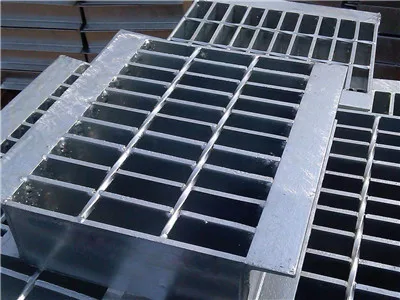
Steel grating gully gratesare often blocked by leaves and garbage, affecting discharge on rainy days. When heavy rain comes, what passes through the gully grate includes not only rainwater but also leaves, paper, plastic bags and other garbage. Once garbage blocks part of the rainwater inlet, the water flow cross-section will be reduced, and the rainwater inlet connecting pipe is easily blocked. Measures to ensure smooth drainage of gully grates: besides strengthening daily cleaning and maintenance, engineering and maintenance technical measures can be taken to reduce the impact of garbage on rainwater inlets.
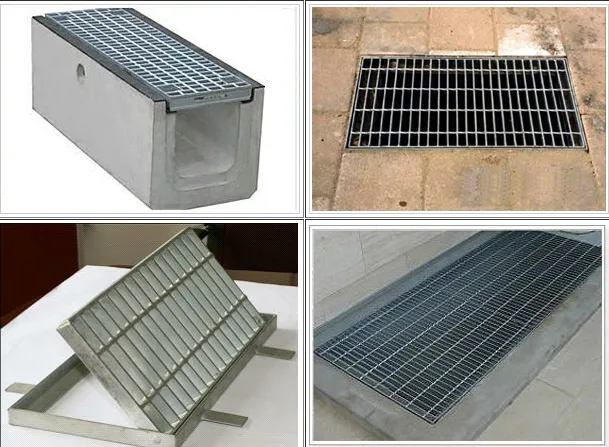
Regular inspection and maintenance as required effectively extends service life and reduces replacement costs.
Regular maintenance can significantly extend the service life of steel grating. It is recommended to check together with equipment maintenance, focusing on fixings and damaged coating; repair rust promptly. The maintenance cycle of drainage trench covers can follow the same arrangement.
Common models and sizes for smooth drainage of gully grates
Common specifications and corresponding parameters are summarized below; confirm each item before ordering:
Select the specification of press-locked steel grating according to the load requirements of the site. The larger the bearing bar specification and the denser the mesh, the greater the load capacity, the heavier the press-locked steel grating, and the higher the price; conversely, lower load capacity means lower price. Press-locked steel grating has a relatively large load capacity and is used in places with high load requirements.
The above are common specifications; actual ordered dimensions and tolerance requirements shall be confirmed against the layout drawing.
The most easily overlooked items in specification tables are tolerances and end treatment. Steel grating usually retains machining allowance along the length; if embedded installation is used on site, edge sealing and corner-cutting requirements should be stated in advance. Hot-dip galvanized trench covers are handled similarly in such details; it is recommended to mark them clearly on the drawings.
What is keeping gully grates draining smoothly
Below we first briefly explain the relevant concepts and basic construction to make the following parameters and sizing content easier to understand.
Choice of connection form: whether the connection between steel grating and beams uses welding or saddle clips should be comprehensively considered based on usage requirements, lateral stability of the supporting beams, and economy.
Once you grasp these basic concepts, the specifications and sizing recommendations that follow will be much easier to understand.
Actual parameters of the same model may differ slightly between manufacturers; acceptance should be based on measured values. Spot-check the key dimensions of steel grating, especially for bulk deliveries. The corresponding parameters of drainage trench covers can be checked the same way; communicate promptly if deviations are found.
"Platform Steel Grating Specifications
Common specifications and corresponding parameters are summarized below; confirm each item before ordering:
- Steel grating with a 30mm bearing bar pitch is the most widely used type in industry; among common steel grating series it offers the strongest resistance to surface impact.
- Steel grating with a 40mm bearing bar pitch is the most economical and lightweight type, and the ideal choice where spans are smallest.
- Steel grating with a 60mm bearing bar pitch and 50mm cross bar pitch was developed specifically for mining applications. It solves the problem of minerals splashing onto the panel surface, and is often specified for processing plants, transfer stations and crushing systems in the mining industry."
" Light weight: its specific gravity is about 1.8, its weight only 1/4 of steel and 2/3 of aluminum.
High strength: its strength is ten times that of rigid PVC, its absolute strength far exceeds aluminum, reaching the level of ordinary steel.
Corrosion resistance: polyester type is a non-metallic material; it does not rust, mildew or rot, needs no painting, and resists corrosion by many gaseous and liquid media, and is maintenance-free; unlike traditional metal gratings, it does not corrode or rust under chemical media and requires no regular inspection or maintenance.
Fatigue resistance: FRP grating has slight elasticity, making people who work on it for long periods feel comfortable. As a working platform, it reduces leg and back fatigue of workers, increases work comfort, thereby improving work efficiency, and is recommended by ergonomists."
The above are common specifications; actual ordered dimensions and tolerance requirements shall be confirmed against the layout drawing.
A practical tip for specification confirmation: write bearing bar specs, bearing bar pitch, cross bar pitch and overall dimensions into the purchase list at the same time; specifying only one or two often leads to mismatched deliveries. The specification marking system is fully cross-referenced on the product page; number and check each panel against the layout drawing before ordering. The same applies to hot-dip galvanized trench covers.
Further reading: Sizing reference for drainage trench covers and hot-dip galvanized trench covers
Drainage trench covers and hot-dip galvanized trench covers are different specification forms under the same product system; the selection logic is the same as described in this article: first the usage, then specifications by span and load, finally surface treatment by environment. They may differ in anti-corrosion and anti-slip requirements; state them separately before ordering rather than writing one general technical requirement.
- For all product specifications and theoretical weights by series, visit Steel Grating Product Center
- To estimate cost by size and quantity, use Instant Quote PageSubmit Requirements
- To see how similar projects were executed, refer to Project Cases field applications
FAQ
What information is needed for custom sizes?
Usually you need to provide the panel dimensions (length x width), bearing bar specs and direction, center-to-center pitch of bearing bars and cross bars, surface treatment, and special requirements such as cutouts, corner notches and banding. Site photos or sketches are even better.
Why do different manufacturers quote different weights for the same specifications?
The main difference lies in the actual measured thickness and tolerance control of the bearing bars. When bars are supplied at the lower tolerance limit, weight per unit area falls below the theoretical value, and load capacity drops accordingly. We recommend specifying thickness tolerance clearly when purchasing.
How to choose between hot-dip galvanizing and cold galvanizing?
The two anti-corrosion mechanisms differ: hot-dip galvanizing immerses steel in molten zinc to form a metallurgically bonded coating, thick and long-lasting, suitable for outdoor and humid environments; cold galvanizing is electrochemical deposition with a thinner, more uniform appearance, suitable for dry indoor environments or applications requiring high dimensional precision.
The above is for sizing and construction reference. To verify specific parameters or request a quotation, please visitInstant Quote Page, or contact our technical staff.
The above is general guidance. For a specific project, we still recommend submitting span, load class and service environment to our technicians for review. Steel grating is a load-bearing component; rework caused by wrong specification choices costs far more than the time spent on upfront calculation.