







Many projects focus only on price when purchasing steel grating and overlook specification matching and corrosion protection, which often leads to rework later. This article lists the conditions to confirm in order - the main technical changes compared with the old standard, typical applications and basic concepts - and explains how to choose under common working conditions. The parts relating to galvanized steel grating can be used directly as a technical briefing reference.
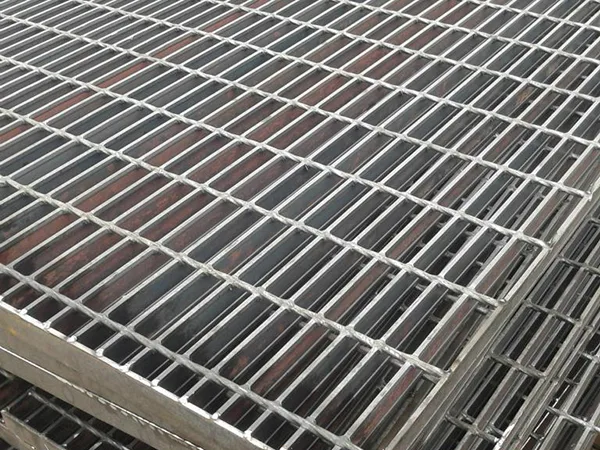
What Does the YB/T4001.1-2019 Standard Add Compared With the 2007 Standard?
The main technical changes compared with the old standard are as follows
The standards and inspection items to check are as follows:
The chapter structure was adjusted. Chapter 6 (ordering information) and Chapter 8 (weight and area calculation of steel grating) were merged into Chapter 10, Order Contract, Weight, Area and Delivery Settlement.
The technical requirements for raw materials of steel grating were revised. Previously the flat bearing bars could be made of Q235-A or grade B steel to GB/T 700; now flat bearing bars are to use carbon structural steel or low-alloy high-strength structural steel conforming to GB/T700, GB/T1591 and GB/T702, or austenitic and duplex stainless steel conforming to GB/T4237 and GB/T3280.
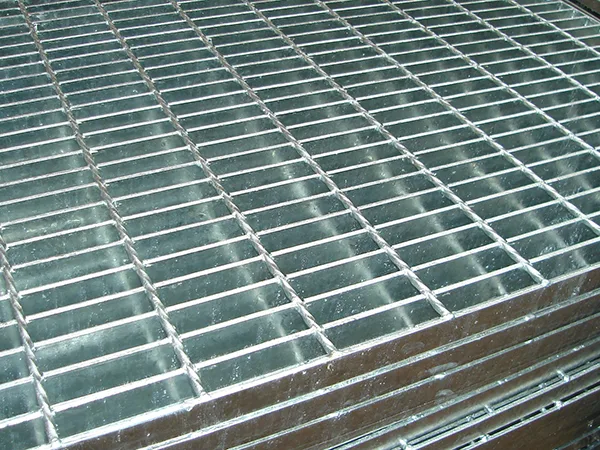
Edge banding of steel grating is subdivided into decorative banding and load-bearing banding.
Inspection requirements and sampling rules were added.
Appendix B, Steel Grating Trench Covers, was deleted.
Appendix C, Load and Deflection Testing, was changed to Appendix A, and the static load test of steel grating was revised as a specified inspection item.
Appendix B, Installation and Fixing of Steel Grating, was added.
Appendix D, Calculation of Applied Load and Deflection of Steel Grating, and Appendix E, Safe Load and Deflection Tables, were merged into Appendix C, Calculation of Safe Load and Deflection of Steel Grating.
We recommend checking each clause above during acceptance and keeping the factory inspection records.
Bigger is not always better. Steel grating should be selected as economically as possible while meeting load requirements; over-thickening adds weight and cost and complicates installation. The product page gives a fuller comparison for hot-dip galvanized steel grating, which is worth checking before deciding.
Typical Applications
Main applications are as follows:
- Industrial Platforms & Maintenance Walkways: equipment platforms and inspection passages in power plants, chemical plants and steel-structure workshops;
- Municipal & Landscape: road drainage trench covers, rainwater grates, tree grates, park boardwalks;
- Transportation & Ports: wharf trestles, multi-story parking garage lanes, railway bridge walkways;
- Environmental & Water Treatment: walkways in wastewater treatment plants, tank platforms, screening machine platforms;
- Others: elevated tower platforms, stair treads, fences and railings, etc.
If your working conditions fall outside the above range, you can provide site photos and dimensions, and our technicians will help assess them.
Requirements vary by application: pedestrian walkways emphasize slip resistance and comfort, vehicle areas emphasize panel stiffness and fixing reliability, and drainage trench covers emphasize water flow area and theft prevention. Define the use first, then look at specifications - this avoids detours, and the same logic applies to hot-dip galvanized steel grating.
Key Conditions to Confirm During Selection
- First clarify the span and support beam spacing to determine the required series;
- Then check load requirements by usage type (pedestrian, maintenance, vehicular);
- Finally, determine the surface treatment by service environment (dry indoor, outdoor, coastal, chemical).
Actual parameters for the same model may vary slightly between manufacturers, so acceptance should be based on measured values. Key dimensions of steel grating should be sampled, especially for bulk deliveries. The corresponding parameters of galvanized steel grating can be checked the same way, with any deviation reported promptly.
Further reading: Sizing reference for galvanized grating and hot-dip galvanized steel grating
Besides what this article covers, galvanized grating is also common in actual projects. It shares similarities with this article's subject in structure and fabrication; for selection, check span, load and service environment in the same order. If both types of components are used in the same project, we recommend unifying material and surface treatment to avoid later galvanic corrosion or inconsistent appearance.
- For all product specifications and theoretical weights by series, visit Steel Grating Product Center
- To estimate cost by size and quantity, use Instant Quote PageSubmit Requirements
- To see how similar projects were executed, refer to Project Cases field applications
FAQ
How to choose between hot-dip galvanizing and cold galvanizing?
The two anti-corrosion mechanisms differ: hot-dip galvanizing immerses steel in molten zinc to form a metallurgically bonded coating, thick and long-lasting, suitable for outdoor and humid environments; cold galvanizing is electrochemical deposition with a thinner, more uniform appearance, suitable for dry indoor environments or applications requiring high dimensional precision.
Can the values in the article be applied directly?
Values in this article come from relevant standard clauses or common industry practice. For actual selection, recalculate based on site span, load class and service environment; direct copying is not recommended.
Where can I find specific specifications?
our websiteProductsCommon specifications and theoretical weights are organized by series, also available in Instant Quote PageEstimate by size, or contact us directly for sizing advice.
The above is for sizing and construction reference. To verify specific parameters or request a quotation, please visitInstant Quote Page, or contact our technical staff.
The above is general guidance. For a specific project, we still recommend submitting span, load class and service environment to our technicians for review. Steel grating is a load-bearing component; rework caused by wrong specification choices costs far more than the time spent on upfront calculation.