







This article focuses on steel grating and covers three parts in turn: specifications for steel grating weight calculation, supplementary notes on weight calculation, and basic concepts, with practical advice added after each part. If you are comparing options or preparing a purchase, check the items in the order given; parts relating to galvanized steel grating can be cross-checked against the entries here, and adjusted where site conditions differ.
Specifications for Steel Grating Weight Calculation
Main specification comparison is as follows:
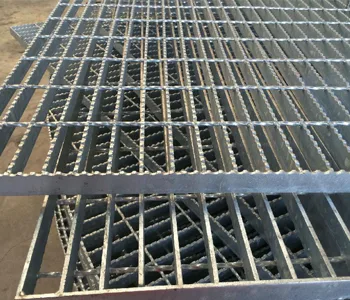
Steel grating is calculated with the weight formula and the formula is: Wt=(b1t1N1+b2t2N2+2b3t3)ρμ×10-6
Wt - grating weight, in kilograms per square meter (kg/m2);
b1 - bearing bar thickness, in millimeters (mm);
t1 - bearing bar width, in millimeters (mm);
N1 - number of bearing bars per square meter of grating;
b2 - cross bar thickness, in millimeters (mm);
t2 - cross bar width, in millimeters (mm);
N2 - number of cross bars per square meter of grating;
b3 - edging flat bar thickness, in millimeters (mm);
t3 - edging flat bar width, in millimeters (mm);
The above are common specifications; actual ordered dimensions and tolerance requirements shall be confirmed against the layout drawing.
What is most easily overlooked in spec tables are tolerances and end treatment. Steel grating usually has machining allowance in the length direction; if embedded installation is used on site, edge closing and corner notch requirements must be stated in advance. Galvanized grating is handled similarly in these details; we recommend marking them clearly on the drawings as well.
Supplementary Notes on Steel Grating Weight Calculation
The following aspects most need to be confirmed in advance in actual procurement and use:
ρ - material density, in kilograms per cubic meter (kg/m3),
The steel density is calculated as 7850kg/m3;
The above points can serve as a pre-purchase checklist; confirm each item before moving to the quotation stage.
A practical tip for specification confirmation: write bearing bar specs, bearing bar pitch, cross bar pitch and overall dimensions into the purchase list at the same time; specifying only one or two often leads to mismatched deliveries. The specification marking system is fully cross-referenced on the product page; number and check each panel against the layout drawing before ordering. The same applies to galvanized grating.
μ - surface treatment weight gain factor; hot-dip galvanizing is taken as 1.06
Choosing a surface treatment is essentially a trade-off between initial cost and later maintenance. Requirements for steel grating used in dry indoor environments can be relaxed somewhat, while outdoor or humid environments call for a higher grade. The same logic applies when selecting hot-dip galvanized steel grating.
Further notes: Common combinations of galvanized grating and hot-dip galvanized steel grating
If a project uses both galvanized grating and hot-dip galvanized steel grating, we recommend planning them on the same layout drawing. This way edge closing, fixing and cutouts at junctions can be handled uniformly, avoiding dimension conflicts during installation and making later maintenance easier.
- For all product specifications and theoretical weights by series, visit Steel Grating Product Center
- To estimate cost by size and quantity, use Instant Quote PageSubmit Requirements
- To see how similar projects were executed, refer to Project Cases field applications
FAQ
How to choose between hot-dip galvanizing and cold galvanizing?
The two anti-corrosion mechanisms differ: hot-dip galvanizing immerses steel in molten zinc to form a metallurgically bonded coating, thick and long-lasting, suitable for outdoor and humid environments; cold galvanizing is electrochemical deposition with a thinner, more uniform appearance, suitable for dry indoor environments or applications requiring high dimensional precision.
What information is needed for custom sizes?
Usually you need to provide the panel dimensions (length x width), bearing bar specs and direction, center-to-center pitch of bearing bars and cross bars, surface treatment, and special requirements such as cutouts, corner notches and banding. Site photos or sketches are even better.
Why do different manufacturers quote different weights for the same specifications?
The main difference lies in the actual measured thickness and tolerance control of the bearing bars. When bars are supplied at the lower tolerance limit, weight per unit area falls below the theoretical value, and load capacity drops accordingly. We recommend specifying thickness tolerance clearly when purchasing.
The above is for sizing and construction reference. To verify specific parameters or request a quotation, please visitInstant Quote Page, or contact our technical staff.
Note that this article presents sizing approaches and general practice, and does not constitute a strength commitment for any specific project. For load-bearing safety-critical areas, the design drawings and on-site calculations shall prevail; contact our technical staff if in doubt.