







This article explains press-locked steel grating in order: what it is, main advantages, and its four categories, giving directly actionable judgment methods rather than just principles. If you have drawings or site dimensions, check them against the key points; galvanized grating can follow the same evaluation order.
What Are the Four Categories of Press-Locked Steel Grating
Below we first briefly explain the relevant concepts and basic construction to make the following parameters and sizing content easier to understand.
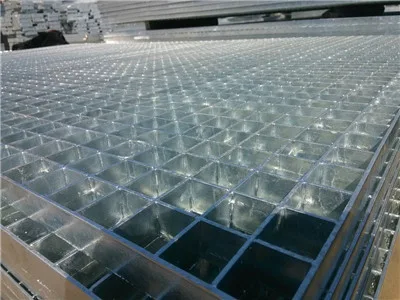
Press-locked steel grating, also called press-locked grating, is manufactured from plain-carbon flat bars, stainless steel, brass plates or aluminum plates of specified sizes through slotting (punching), insertion, welding and finishing processes. It retains the high strength, corrosion resistance and maintenance-free features of ordinary steel grating, and uniquely features uniform and precise composition, a light and elegant structure, natural harmony and refined style. It is widely used for trench covers, stair treads and tank covers.
Once you grasp these basic concepts, the specifications and sizing recommendations that follow will be much easier to understand.
Bigger specifications are not always better. The selection of press-locked steel grating should be as economical as possible while meeting load requirements; excessive thickening increases self-weight and cost and complicates installation. The product page provides more complete reference for hot-dip galvanized steel grating; refer to it before making a decision.
Key Advantages
Main features can be summarized as follows:
Features of press-locked steel grating: firm weld points, uniform bar spacing and a flat mesh surface, plus attractive design, practicality, light weight, high strength, corrosion resistance, maintenance-free operation and many other features.
Overall, selection should weigh span, load and service environment together.
Choosing a surface treatment is essentially a trade-off between initial investment and later maintenance. Requirements can be relaxed for press-locked steel grating in dry indoor environments, but raised for outdoor or humid environments. Hot-dip galvanized steel grating can be selected with the same approach.
Application Scenarios of the Four Categories of Press-Locked Steel Grating
Main applications are as follows:
Applications: widely used in civil and commercial buildings, theaters, subways, light rail and other municipal engineering fields, for suspended ceilings, interior and exterior decoration, platform walkways, ventilation windows (shafts), advertising signboards and various covers. Press-locked grating has firm weld points, uniform bar spacing and a flat mesh surface; attractive in design and practical, it is both a utility product and a work of art. Over the years, more than one hundred varieties have been developed, with products exported to sixteen countries favored by customers. Press-locked steel grating is widely used for suspended ceilings or interior decoration in factory halls, theaters and shopping malls, as well as platform walkways.
If your working conditions fall outside the above range, you can provide site photos and dimensions, and our technicians will help assess them.
Different application scenarios have different priorities for press-locked steel grating: pedestrian walkways emphasize anti-slip and comfort, vehicle areas emphasize panel stiffness and fixing reliability, and drainage trench covers emphasize open area and anti-theft. Clarify the use first, then the specifications, to avoid detours; the same applies to hot-dip galvanized steel grating.
Common Models and Sizes of the Four Categories of Press-Locked Steel Grating
Common specifications and corresponding parameters are summarized below; confirm each item before ordering:
Press-locked steel grating types can be divided into four: by different insertion methods and insertion angles, it can be classified into press-fitted steel grating, heavy-duty steel grating, integral steel grating and sun-shade steel grating. 1. Press-fitted press-locked steel grating: after the bearing flat bars are notched, the cross bar flat bars are press-locked into shape. Generally, the maximum processing height for ordinary steel grating is 100mm, and grating length is usually less than 2000mm.
Heavy-duty press-locked steel grating is a product where tall bearing bars and cross flat bars interlock and are pressed tight under 1200 tons of pressure. It is suitable for high-load, long-span applications.
Integral press-locked steel grating: the bearing flat bars and cross bar flat bars have the same height; the notch depth is 1/2 of the bearing flat bar. Grating height is not more than 100mm, and grating length is usually less than 2000mm.
Sun-shade press-locked steel grating: the bearing flat bars have 30° or 45° inclined slots, and the cross bar flat bars are slotted and press-locked into shape. Other pitches and specifications of grating can be produced to meet different needs, using ordinary carbon steel, stainless steel, aluminum and other materials. The grating height is less than 100mm.
The above are common specifications; actual ordered dimensions and tolerance requirements shall be confirmed against the layout drawing.
The most easily overlooked items in a specification table are tolerances and end treatment. The length direction of press-locked steel grating usually retains machining allowance; if site installation is recessed, edge closing and corner-cutting requirements should be stated in advance. Galvanized grating is handled similarly in such details; mark them clearly on the drawings.
Further notes: Common combinations of galvanized grating and hot-dip galvanized steel grating
If a project uses both galvanized grating and hot-dip galvanized steel grating, we recommend planning them on the same layout drawing. This way edge closing, fixing and cutouts at junctions can be handled uniformly, avoiding dimension conflicts during installation and making later maintenance easier.
- For all product specifications and theoretical weights by series, visit Steel Grating Product Center
- To estimate cost by size and quantity, use Instant Quote PageSubmit Requirements
- To see how similar projects were executed, refer to Project Cases field applications
FAQ
What maintenance is required during daily use?
Maintenance mainly involves periodically checking whether fasteners are loose, whether touch-up paint has peeled off, and whether the panel surface shows obvious deformation or rust. Issues found should be dealt with promptly; overall maintenance is minimal.
Where can I find specific specifications?
our websiteProductsCommon specifications and theoretical weights are organized by series, also available in Instant Quote PageEstimate by size, or contact us directly for sizing advice.
Can the values in the article be applied directly?
Values in this article come from relevant standard clauses or common industry practice. For actual selection, recalculate based on site span, load class and service environment; direct copying is not recommended.
The above is for sizing and construction reference. To verify specific parameters or request a quotation, please visitInstant Quote Page, or contact our technical staff.
Note that this article presents sizing approaches and general practice, and does not constitute a strength commitment for any specific project. For load-bearing safety-critical areas, the design drawings and on-site calculations shall prevail; contact our technical staff if in doubt.