







About galvanized steel grating, this article explains, in the order of what its slip resistance is, its main advantages, and why its slip resistance is excellent, item by item, giving directly executable judgment methods rather than only principles. Those with drawings or site dimensions can check the key points one by one; hot-dip galvanized steel grating can follow the same judgment order.
What Is the Excellent Slip Resistance of Galvanized Steel Grating
This section first clarifies the basic concepts, structural forms and common names, laying the groundwork for what follows.
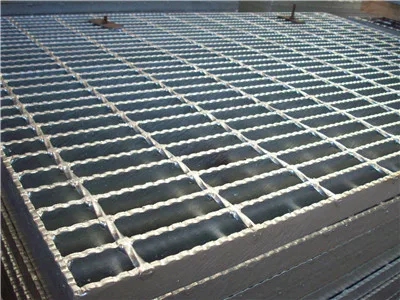
Galvanized steel grating is a widely used grating product, mainly selected for all kinds of platforms in factories, workshops, mining and ports; attractive and easy to install, it is a new-generation building product.
Once you grasp these basic concepts, the specifications and sizing recommendations that follow will be much easier to understand.
For material selection, do not simply chase the highest grade. The material of galvanized steel grating should match the load requirements and service environment; over-specifying causes unnecessary cost increases. The corresponding treatment for hot-dip galvanized steel grating can be found on the product page, chosen against actual conditions.
Key Advantages
Its overall performance focuses on the following aspects; we suggest comparing item by item in actual selection:
How is the slip resistance of galvanized steel grating? Generally speaking, there is no need to worry too much about this: the slip resistance of steel grating is very good, so you can buy with confidence. Although its protective performance is excellent, buyers should still pay attention and ensure that the steel grating purchased is of guaranteed quality; if quality cannot be guaranteed, the slip resistance may not be reliable either.
Overall, selection should weigh span, load and service environment together.
Regarding corrosion protection, one thing is easily overlooked: on-site cutting and welding damage the original coating, and these areas need zinc touch-up after construction, otherwise rust often starts from the cut edges. Hot-dip galvanized steel grating has the same issue; it is best to include this in the technical requirements at the construction disclosure.
Application Scenarios of Slip-Resistant Galvanized Steel Grating
Typical applications mainly include the following categories, which can help you judge suitability for your project:
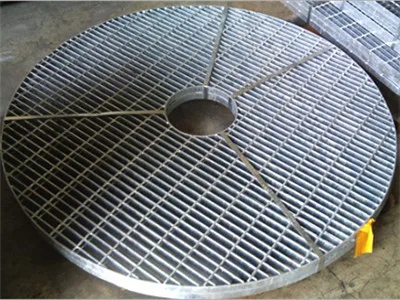
Features of platform steel grating:
- Toe plates (kerb plates), checkered plate guards, connection fittings and other accessories can be welded around the perimeter of the steel grating.
- Banding can use flat bars of a different size from the bearing bars, or angle steel, channel steel, square tube and the like.
- Handles and hinges can be installed on platform steel grating that is frequently moved or opened.
- Generally, the banding welding standard for platform steel grating is: Series 1 - one weld per five bars; Series 2 - one weld per four bars; Series 3 - one weld per three bars. The weld is a single-side fillet weld of not less than 3mm, with a weld length of 20mm.
If your working conditions fall outside the above range, you can provide site photos and dimensions, and our technicians will help assess them.
A practical tip for confirming specifications: write the bar size, bar center spacing, cross bar spacing and overall dimensions together into the purchase list; writing only one or two items easily leads to goods not matching the order. The specification notation of galvanized steel grating is fully compared on the product page; before ordering, check each panel against the layout drawing by number - the same applies to hot-dip galvanized steel grating.
Basic Concepts of Galvanized Steel Grating Slip Resistance
When buying galvanized steel grating, you must also check the quality carefully. To ensure there are no quality problems, pay attention to the product quality inspection report; reviewing it is a good way to understand the product quality and know whether the product is good. When the quality is good, you can buy with confidence without worrying about problems.
The choice of surface treatment is essentially a trade-off between initial investment and later maintenance. Requirements can be relaxed appropriately when galvanized steel grating is used in dry indoor environments, and should be raised accordingly for outdoor or humid environments. The selection of hot-dip galvanized steel grating can be judged on the same basis.
Further notes: How to combine hot-dip galvanized steel grating and hot-dip galvanized steel grating in use
Hot-dip galvanized steel grating and hot-dip galvanized steel grating are different specification forms within the same product system. The selection logic is the same as described in this article: first the usage type, then span and load to determine specifications, and finally the environment to determine surface treatment. Their corrosion protection and anti-slip requirements may differ; state them separately when ordering rather than writing one general technical requirement.
- For all product specifications and theoretical weights by series, visit Steel Grating Product Center
- To estimate cost by size and quantity, use Instant Quote PageSubmit Requirements
- To see how similar projects were executed, refer to Project Cases field applications
FAQ
What is most often overlooked during installation and acceptance?
First, bearing bars installed in the wrong direction reduce load capacity; second, insufficient fixing points or missing zinc touch-up paint; third, support beam spacing inconsistent with the layout drawing. These three items are most often overlooked on site.
Where can I find specific specifications?
our websiteProductsCommon specifications and theoretical weights are organized by series, also available in Instant Quote PageEstimate by size, or contact us directly for sizing advice.
What information is needed for custom sizes?
Usually you need to provide the panel dimensions (length x width), bearing bar specs and direction, center-to-center pitch of bearing bars and cross bars, surface treatment, and special requirements such as cutouts, corner notches and banding. Site photos or sketches are even better.
The above is for sizing and construction reference. To verify specific parameters or request a quotation, please visitInstant Quote Page, or contact our technical staff.
Note that this article presents sizing approaches and general practice, and does not constitute a strength commitment for any specific project. For load-bearing safety-critical areas, the design drawings and on-site calculations shall prevail; contact our technical staff if in doubt.