







This article focuses on trench covers and covers three parts in order: why the flat bearing bars of trench covers must never be reversed, basic concepts, and specification parameters, with practical advice added after each section. If you are comparing options or preparing a purchase, check the points in order; the parts concerning galvanized steel grating can be verified against the same list, and any mismatch with site conditions should be adjusted accordingly.
Specification Parameters: Why the Flat Bearing Bars of Trench Covers Must Never Be Reversed
Main specification comparison is as follows:
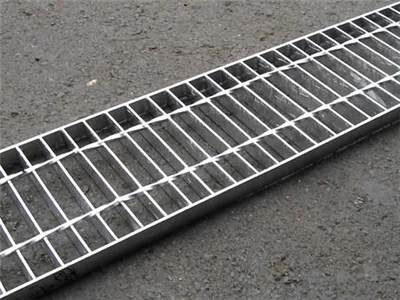
The flat bearing bars of trench covers must never be reversed:
The above are common specifications; actual ordered dimensions and tolerance requirements shall be confirmed against the layout drawing.
A practical tip for specification confirmation: list the flat bar size, bearing bar pitch, cross bar pitch and overall dimensions together on the purchase order. Listing only one or two of them often results in a delivery mismatch. The full specification notation for trench covers is given on the product page; number each panel against the layout drawing before ordering, and the same applies to galvanized steel grating.
Basic Concepts: Why the Flat Bearing Bars of Trench Covers Must Never Be Reversed
This section first clarifies the basic concepts, structural forms and common names, laying the groundwork for what follows.
For trench covers, the direction of the flat bars refers to the length of the cover, while the width is the dimension measured along the cross bars, i.e., the twisted square bars. For example, with a drainage trench cover, the trench width generally refers to the length of the cover (including the required bearing width) and is the length of the flat bars, while the longitudinal direction of the trench forms the width of the cover.
Once you grasp these basic concepts, the specifications and sizing recommendations that follow will be much easier to understand.
Bigger is not always better. Trench covers should be selected as economically as possible while meeting load requirements; over-thickening adds weight and cost and complicates installation. The product page gives a fuller comparison for hot-dip galvanized steel grating, which is worth checking before deciding.
Common Models and Sizes: Why the Flat Bearing Bars of Trench Covers Must Never Be Reversed
How to determine the direction of the flat bearing bars in trench covers:
Because the main load capacity of steel grating is concentrated along the flat bars, support beams or support grooves are provided at both ends of the grating in the length direction, i.e., along the flat bars. When ordering trench covers, if you can provide complete engineering drawings, our technicians will determine the flat bar direction for you; if drawings are not available, describe the project in general terms and we will provide drawings free of charge for division, layout and installation of the steel grating.
Actual parameters for the same model may vary slightly between manufacturers, so acceptance should be based on measured values. Key dimensions of trench covers should be sampled, especially for bulk deliveries. The corresponding parameters of galvanized steel grating can be checked the same way, with any deviation reported promptly.
Further notes: Common combinations of galvanized grating and hot-dip galvanized steel grating
Galvanized grating and hot-dip galvanized steel grating are different specification forms within the same product system. The selection logic is the same as described in this article: first the usage type, then span and load to determine specifications, and finally the environment to determine surface treatment. Their corrosion protection and anti-slip requirements may differ; state them separately when ordering rather than writing one general technical requirement.
- For all product specifications and theoretical weights by series, visit Steel Grating Product Center
- To estimate cost by size and quantity, use Instant Quote PageSubmit Requirements
- To see how similar projects were executed, refer to Project Cases field applications
FAQ
What is most often overlooked during installation and acceptance?
First, bearing bars installed in the wrong direction reduce load capacity; second, insufficient fixing points or missing zinc touch-up paint; third, support beam spacing inconsistent with the layout drawing. These three items are most often overlooked on site.
How to choose between hot-dip galvanizing and cold galvanizing?
The two anti-corrosion mechanisms differ: hot-dip galvanizing immerses steel in molten zinc to form a metallurgically bonded coating, thick and long-lasting, suitable for outdoor and humid environments; cold galvanizing is electrochemical deposition with a thinner, more uniform appearance, suitable for dry indoor environments or applications requiring high dimensional precision.
Can the values in the article be applied directly?
Values in this article come from relevant standard clauses or common industry practice. For actual selection, recalculate based on site span, load class and service environment; direct copying is not recommended.
The above is for sizing and construction reference. To verify specific parameters or request a quotation, please visitInstant Quote Page, or contact our technical staff.
Note that this article presents sizing approaches and general practice, and does not constitute a strength commitment for any specific project. For load-bearing safety-critical areas, the design drawings and on-site calculations shall prevail; contact our technical staff if in doubt.