







Many projects purchase steel grating stair treads based on price alone, overlooking specification matching and corrosion protection requirements, which often leads to rework later. This article lists, in order, the design techniques of steel grating stair treads, their technical requirements, and the live loads of steel inclined ladders according to actual requirements, and explains how to choose for common working conditions. Content related to galvanized grating can be used directly as a reference for technical disclosure.
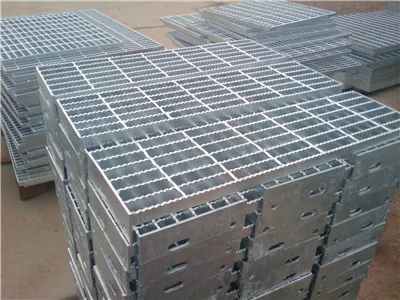
Design Techniques and Installation Requirements for Steel Grating Stair Treads
The main standard clauses and acceptance requirements involved are as follows:
We recommend checking each clause above during acceptance and keeping the factory inspection records.
The installation stage most affects the later user experience. When laying steel grating stair treads, the direction must not be reversed; the bearing flat bars should be aligned with the main load direction, a point most easily overlooked on site. The number of fasteners should also be complete according to the layout drawing; a missing one can cause local loosening. The same requirement applies to hot-dip galvanized steel grating.
Technical Requirements for Steel Grating Stair Treads
The main standard clauses and acceptance requirements involved are as follows:
- The stair width should preferably be 700 mm, not more than 1100 mm at maximum and not less than 600 mm at minimum.
- The stair height should preferably not exceed 5 m; when it exceeds 5 m, an intermediate platform should be provided and the stairs should be divided into sections.
- Steel inclined ladders should be entirely connected by welding. The welding requirements should comply with GBJ205.
- The stair stringer steel should have performance not lower than Q235-A steel. Its cross-section dimensions should be determined by calculation.
- The treads should use checkered steel plate no less than 4 mm thick, or ordinary steel plate with anti-slip treatment, or a lattice plate welded from 25x4 flat bars and small angle steel.
- The handrail height should be 900 mm, or consistent with the railing height specified in GB4053.3, using pipe with an outer diameter of 30~50 mm and a wall thickness of no less than 2.5 mm.
- The posts should use angle steel with a cross-section no less than 40x40x4 or pipe with an outer diameter of 30~50 mm. They should start from the first tread, with spacing preferably not greater than 1000 mm. The horizontal bars should use round steel no less than 16 mm in diameter or 30x4 flat bars, fixed at the middle of the posts.
- When a steel inclined ladder is connected to a platform beam attached to equipment, the connection should use bolts with slotted holes.
- The surface of all components should be smooth and free of burrs, and the installed steel inclined ladder should have no skewing, twisting, deformation, or other defects.
- After installation, the steel inclined ladder must be carefully derusted and given an anti-corrosion coating.
We recommend checking each clause above during acceptance and keeping the factory inspection records.
Regarding corrosion protection, one thing is easily overlooked: on-site cutting and welding damage the original coating, and these areas need zinc touch-up after construction, otherwise rust often starts from the cut edges. Galvanized grating has the same issue; it is best to include this in the technical requirements at the construction disclosure.
The live load of the steel inclined ladder should be taken according to actual requirements, but not less than the following values
The standards and inspection items to check are as follows:
a. The standard value of the live load on the horizontal projection area of the steel inclined ladder is 3.5 kN/m2.
b. The concentrated live load at the midpoint of the stair tread is 1.5 kN/m2.
c. The horizontal concentrated live load at the top of the handrail is 0.5 kN/m.
d. The deflection should not exceed 1/250 of the span of the bending member.
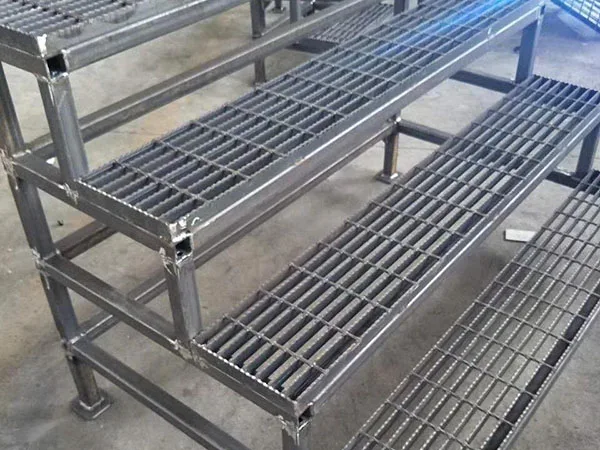
We recommend checking each clause above during acceptance and keeping the factory inspection records.
After installation is complete, an overall inspection is recommended: whether the panel surface is warped, whether the fasteners are complete, and whether the height difference between adjacent panels is obvious. Such problems with steel grating stair treads are cheapest to fix at the acceptance stage; rework after they are put into use is much more troublesome. Acceptance points for hot-dip galvanized steel grating can follow the same standard.
Installation Requirements for Grating Stair Treads
The main standard clauses and acceptance requirements involved are as follows:
| Item | Standard Requirements |
|---|---|
| Fixed steel inclined ladder | A steel ladder fixed to a building or equipment at an angle of 30~75 degrees to the horizontal. |
| Stair stringer | The side beams on both sides of the inclined ladder, usually made of channel steel. |
| Stair Treads | The horizontal component stepped on when going up and down the stairs. Common forms are steel stair treads made of checkered plate and steel grating. |
| Tread rise | The vertical distance between two adjacent treads. |
| Stair width | The distance between the inner sides of the two stair stringers. |
| Stair Height | The vertical distance from the top of the stair stringer to the reference plane at the bottom. |
| Handrail | The safety handrail installed at both ends of the steel ladder. |
We recommend checking each clause above during acceptance and keeping the factory inspection records.
In terms of installation sequence, lay out first and then fix; avoid making changes while laying. Once the layout drawing of the steel grating stair treads is confirmed, try not to cut panels at will on site; if adjustment is really needed, the fixing and edge treatment of the galvanized grating should be adjusted at the same time to avoid leaving hidden loosening risks.
Handrail height: the vertical distance from the upper edge of the handrail to the front edge of the stair tread
This part on steel grating stair treads may seem basic, but it is often the source of later disputes. In communication, specifying the structural form, material, and surface treatment clearly is far more reliable than agreeing on a name alone. The selection of galvanized grating can follow the same breakdown approach.
Further notes: Common combinations of galvanized grating and hot-dip galvanized steel grating
If a project uses both galvanized grating and hot-dip galvanized steel grating, we recommend planning them on the same layout drawing. This way edge closing, fixing and cutouts at junctions can be handled uniformly, avoiding dimension conflicts during installation and making later maintenance easier.
- For all product specifications and theoretical weights by series, visit Steel Grating Product Center
- To estimate cost by size and quantity, use Instant Quote PageSubmit Requirements
- To see how similar projects were executed, refer to Project Cases field applications
FAQ
What maintenance is required during daily use?
Maintenance mainly involves periodically checking whether fasteners are loose, whether touch-up paint has peeled off, and whether the panel surface shows obvious deformation or rust. Issues found should be dealt with promptly; overall maintenance is minimal.
What is most often overlooked during installation and acceptance?
First, bearing bars installed in the wrong direction reduce load capacity; second, insufficient fixing points or missing zinc touch-up paint; third, support beam spacing inconsistent with the layout drawing. These three items are most often overlooked on site.
Why do different manufacturers quote different weights for the same specifications?
The main difference lies in the actual measured thickness and tolerance control of the bearing bars. When bars are supplied at the lower tolerance limit, weight per unit area falls below the theoretical value, and load capacity drops accordingly. We recommend specifying thickness tolerance clearly when purchasing.
The above is for sizing and construction reference. To verify specific parameters or request a quotation, please visitInstant Quote Page, or contact our technical staff.
The above is general guidance. For a specific project, we still recommend submitting span, load class and service environment to our technicians for review. Steel grating is a load-bearing component; rework caused by wrong specification choices costs far more than the time spent on upfront calculation.