







This article focuses on galvanized steel grating and introduces in turn: 1. galvanized steel grating specifications; 3. fixing methods of steel gratings; 4. product features of steel gratings, with practical suggestions added after each section. If you are comparing solutions or preparing for procurement, you can check item by item in the order of the article; for parts involving hot-dip galvanized steel gratings, refer to the items in this article as well, and adjust according to actual site conditions where they differ.
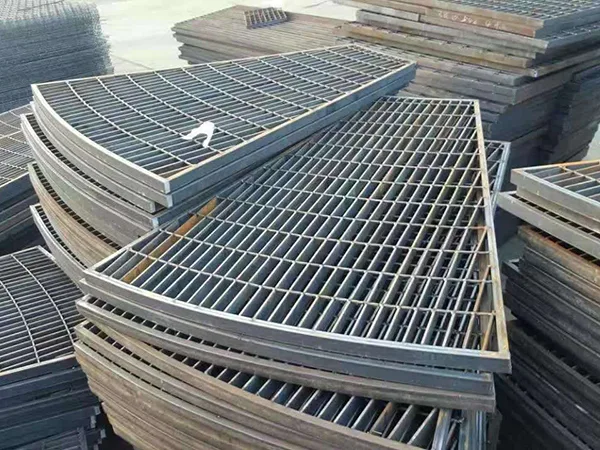
Galvanized steel grating is a steel panel product made by cross-arranging flat bars at certain distances with cross bars and welding them into square mesh openings. It is mainly used for trench covers, steel structure platforms, steel stair treads, etc. The cross bars are generally twisted square bars. The panels are usually made of carbon steel; hot-dip galvanizing the surface prevents oxidation. Steel gratings can also be made of stainless steel.
1. Galvanized steel grating specifications
Main specification comparison is as follows:
| Item | Parameter Description |
|---|---|
| Bearing flat bar pitch | The center distance between two adjacent bearing flat bars; 30mm and 40mm are commonly used. |
| Surface treatment | Hot-dip galvanizing, cold galvanizing, spray-painting. |
| Cross Bar Pitch | The center pitch of adjacent cross bars is usually 50mm or 100mm; other specifications can be customized. |
| Bearing Bar | Commonly used models include 20X3, 25X3, 30X3, 32X3, 32X5, 40X4, 50X5, etc. |
2.Production standard of steel gratings: (China steel grating standard) YB/T4001.1-2007; in addition, the United States, the United Kingdom, Australia, and New Zealand have their own standards. Steel standards follow GB700-88 and GB1220-92.
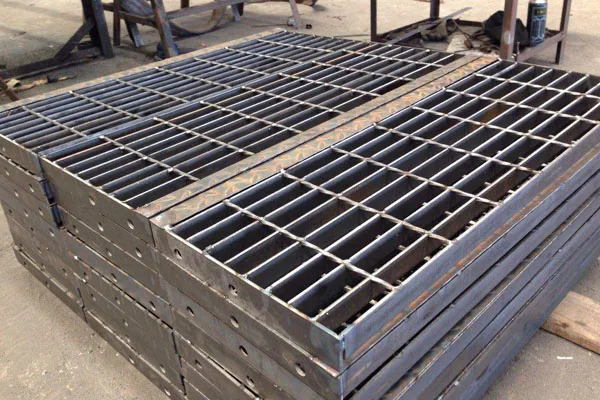
The above are common specifications; actual ordered dimensions and tolerance requirements shall be confirmed against the layout drawing.
There is a practical technique for confirming specifications: write the flat bar specification, flat bar center pitch, cross bar pitch, and overall dimensions into the purchase list at the same time; writing only one or two of them easily leads to mismatched deliveries. The specification notation of galvanized steel grating is fully compared on the product page; before ordering, number and check panel by panel against the layout drawing; the same applies to galvanized gratings.
3. Fixing methods of steel gratings
Key points for construction and fixing are as follows:
Two fixing methods are available: welding and mounting clips.
The advantage of welding is permanent fixation without loosening; the welds are located on the first flat bar at each corner of the steel grating, with fillet welds no less than 20mm long and no less than 3mm high.
The advantage of mounting clips is that they do not damage the hot-dip galvanized coating and allow easy disassembly; each panel requires at least 4 sets of clips, and the number increases with panel length.
The safest method is to omit the bottom clip and weld the screw heads directly onto the beam, ensuring that the steel grating will not slide off the beam due to loose clips.
After installation, check each panel's fixing points and flatness; put into use only after confirming no warping or looseness.
Regarding corrosion protection, one thing is easily overlooked: on-site cutting and welding damage the original coating, and these areas need zinc touch-up after construction, otherwise rust often starts from the cut edges. Galvanized grating has the same issue; it is best to include this in the technical requirements at the construction disclosure.
4. Product features of steel gratings
Main features can be summarized as follows:
Galvanized steel grating features attractive appearance, excellent drainage, strong rust resistance, maintenance-free and replacement-free, anti-theft, investment saving, high strength, and a wide range of specifications.
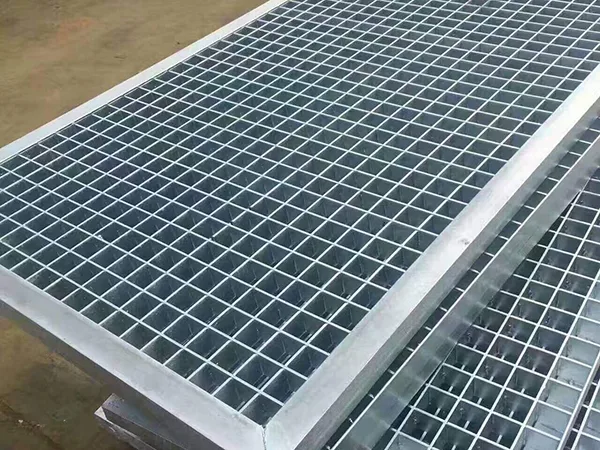
Overall, selection should weigh span, load and service environment together.
Actual parameters of the same model may vary slightly between manufacturers; acceptance shall be based on measured values. We recommend sampling key dimensions of galvanized steel grating, especially for bulk deliveries. Corresponding parameters of hot-dip galvanized steel grating can be checked the same way; communicate promptly if deviations are found.
5. Series classification of steel gratings by use
Main specification comparison is as follows:
Series 1 (30mm pitch) steel grating: the most commonly used type, used across all industrial fields. The bearing flat bar center distance of this series is 30mm, complying with American standards; among the entire steel grating series, it has the strongest resistance to surface impact.
It is widely used for platforms, walkways, drainage trench covers, stair treads, etc. in power plants, refineries, sewage treatment plants, grain depots, chemical plants, highways, airports, and docks. Among them, serrated steel gratings can be used in humid and slippery places, especially suitable for offshore oil production platforms. Easy installation and removal: steel grating ceilings are indoor ceiling products designed and manufactured with steel gratings. They feature the light structure, attractive appearance, high strength and walkability of steel gratings, and simple installation; the surface of steel grating ceilings is hot-dip galvanized, providing 60 years of corrosion resistance and durability without painting maintenance.
Series 2 (40mm pitch) steel grating: the most economical and lightest type, complying with British standard specifications for fixed platforms, walkways, and stairs. In occasions with small spans, it is the ideal product, even under loads such as transport equipment walkways; it can also be used for warehouse racks, mezzanine flooring panels, trestles, protective fences, sun shades, etc.
Series 3 (60mm pitch) steel grating: a type developed specifically for mining industry applications, solving the problem of mineral spillage on the panel surface. This series has nominal openings of 50*60mm, allowing most spilled materials to fall through, thus keeping the panel surface clean and safe. This product is often used as panel surfaces in crushing systems, walkways on conveying lines, ball mills, processing plants, and transfer stations.
High strength, light weight: steel grating ceilings can be widely used for ceilings of industrial and civil buildings such as tobacco manufacturing, industrial plants, large stadiums, convention and exhibition centers, large commercial buildings, stations, docks, airports, and large flour mills.
The above are common specifications; actual ordered dimensions and tolerance requirements shall be confirmed against the layout drawing.
Bigger specifications are not always better. The selection of galvanized steel gratings should be as economical as possible while meeting load requirements; excessive thickening increases weight and cost and causes inconvenience in installation. The product page provides more complete comparison notes on galvanized gratings for reference before making a decision.
Further notes: How to combine hot-dip galvanized steel grating and galvanized grating in use
If a project uses both hot-dip galvanized steel grating and galvanized grating, we recommend planning them on the same layout drawing. This way edge closing, fixing and cutouts at junctions can be handled uniformly, avoiding dimension conflicts during installation and making later maintenance easier.
- For all product specifications and theoretical weights by series, visit Steel Grating Product Center
- To estimate cost by size and quantity, use Instant Quote PageSubmit Requirements
- To see how similar projects were executed, refer to Project Cases field applications
FAQ
What information is needed for custom sizes?
Usually you need to provide the panel dimensions (length x width), bearing bar specs and direction, center-to-center pitch of bearing bars and cross bars, surface treatment, and special requirements such as cutouts, corner notches and banding. Site photos or sketches are even better.
Why do different manufacturers quote different weights for the same specifications?
The main difference lies in the actual measured thickness and tolerance control of the bearing bars. When bars are supplied at the lower tolerance limit, weight per unit area falls below the theoretical value, and load capacity drops accordingly. We recommend specifying thickness tolerance clearly when purchasing.
Where can I find specific specifications?
our websiteProductsCommon specifications and theoretical weights are organized by series, also available in Instant Quote PageEstimate by size, or contact us directly for sizing advice.
The above is for sizing and construction reference. To verify specific parameters or request a quotation, please visitInstant Quote Page, or contact our technical staff.
The above is general guidance. For a specific project, we still recommend submitting span, load class and service environment to our technicians for review. Steel grating is a load-bearing component; rework caused by wrong specification choices costs far more than the time spent on upfront calculation.