







Applying steel grating in real projects is not complicated; the challenge lies in matching specifications, material and service environment. This article explains the material and surface, application scope and engineering fields, and basic concepts of the park water purification project in turn, giving you a complete framework for judging hot-dip galvanized steel grating.
Materials and Surface Treatment for the Park Water Purification Project
Material and surface treatment are key to service life. Common practices and suitable environments are as follows:
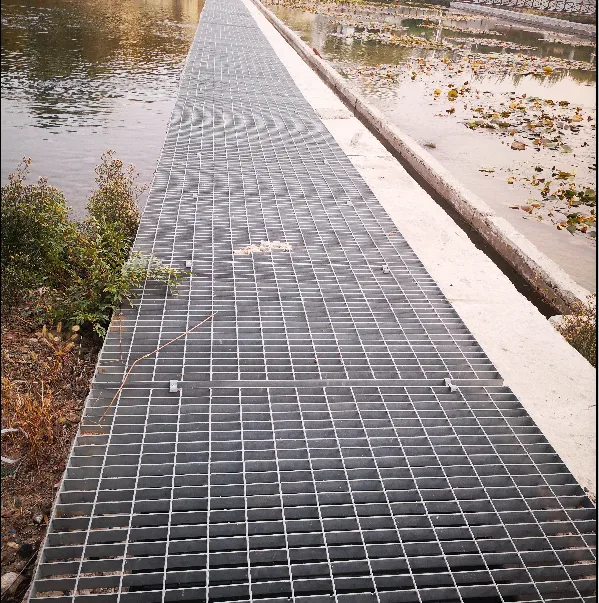
For water purification projects, stainless steel grating can be used for its good rust resistance and long service life; to save costs, Q235 grating with a hot-dip galvanized surface can be used to prevent rust.
Once material and surface treatment are decided, we recommend writing zinc coating thickness and appearance requirements into the technical agreement.
Regarding corrosion protection, one thing is easily overlooked: on-site cutting and welding damage the original coating, and these areas need zinc touch-up after construction, otherwise rust often starts from the cut edges. Hot-dip galvanized steel grating has the same issue; it is best to include this in the technical requirements at the construction disclosure.
Scope of Application & Engineering Fields
Main applications are as follows:
Our steel grating products are widely used in highways, petrochemicals, chemicals, ports, alloys, power, papermaking, steel, building materials, municipal works, petroleum, wastewater treatment, general industrial plants and municipal construction. With proven product quality and timely after-sales service, strong R&D capability and rich project experience, we serve customers in more than 30 provinces, cities and autonomous regions across China and in parts of Southeast Asia, across the power, petroleum, chemical and metallurgical industries and large industrial and mining enterprises.
If your working conditions fall outside the above range, you can provide site photos and dimensions, and our technicians will help assess them.
A practical tip for specification confirmation: put all four items - bearing bar size, bearing bar center pitch, cross bar pitch and overall dimensions - into the purchase list at once; listing only one or two of them easily leads to a mismatch on delivery. The full reference for marking steel grating specifications is on the product page; before ordering, check each panel by number against the layout drawing. The same applies to hot-dip galvanized steel grating.
Further notes: Common combinations of hot-dip galvanized steel grating and galvanized grating
In engineering, galvanized grating is often used together with the components mentioned in this article. The two differ in load carrying and installation practices; when combining them, pay special attention to the connection of support conditions and fixing methods, as junction treatment is often where problems arise. For unified drawings, submit dimensions of both types and our technicians will process them under the same layout logic.
- For all product specifications and theoretical weights by series, visit Steel Grating Product Center
- To estimate cost by size and quantity, use Instant Quote PageSubmit Requirements
- To see how similar projects were executed, refer to Project Cases field applications
FAQ
What information is needed for custom sizes?
Usually you need to provide the panel dimensions (length x width), bearing bar specs and direction, center-to-center pitch of bearing bars and cross bars, surface treatment, and special requirements such as cutouts, corner notches and banding. Site photos or sketches are even better.
Why do different manufacturers quote different weights for the same specifications?
The main difference lies in the actual measured thickness and tolerance control of the bearing bars. When bars are supplied at the lower tolerance limit, weight per unit area falls below the theoretical value, and load capacity drops accordingly. We recommend specifying thickness tolerance clearly when purchasing.
What is most often overlooked during installation and acceptance?
First, bearing bars installed in the wrong direction reduce load capacity; second, insufficient fixing points or missing zinc touch-up paint; third, support beam spacing inconsistent with the layout drawing. These three items are most often overlooked on site.
The above is for sizing and construction reference. To verify specific parameters or request a quotation, please visitInstant Quote Page, or contact our technical staff.
If you already have drawings or site dimensions, submit them directly and we will help verify specifications and layout, avoiding on-site cutting and rework caused by mismatched models. Without drawings, site photos and approximate dimensions are enough for an estimate.