







This article focuses on steel grating, introducing in sequence typical application scenarios, conditions to confirm during selection, and basic concepts, with practical suggestions added after each part. If you are comparing solutions or preparing for procurement, check each item in the order presented; the parts involving galvanized steel grating can be cross-checked against this article, and adjusted according to actual site conditions when inconsistent.
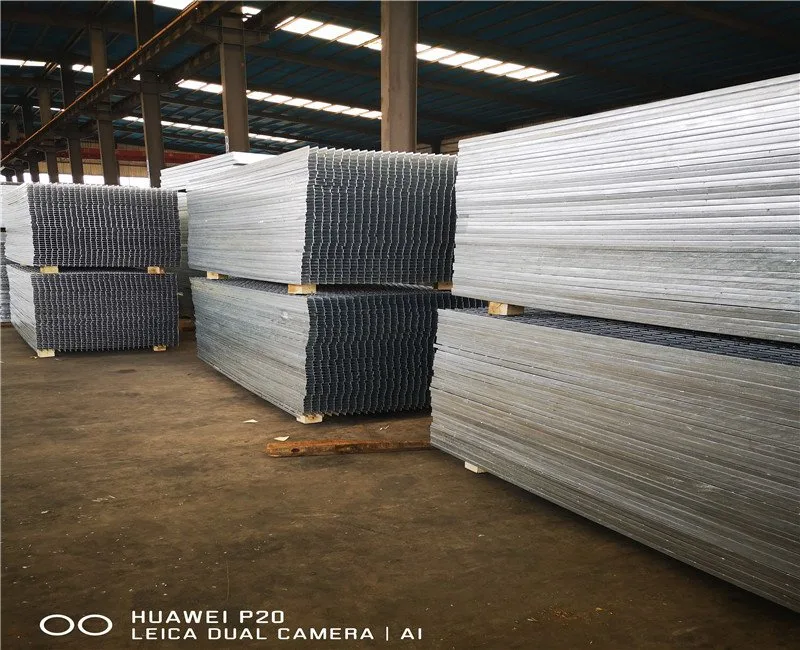
Before galvanized steel grating leaves the factory, the manufacturer usually appliesstrapping bands + corner guards + spacerstriple protection: bundles are strapped together with steel or plastic-steel bands, corner guards are added at the four corners to prevent edge damage, and soft spacers are placed between panels to avoid direct friction of zinc surfaces. For transportation, note the following:
| Stage | Correct practice | Function |
|---|---|---|
| Stage | Practice | Purpose |
| Packing | Corner guards + spacers + steel bands | Prevent edge damage and friction |
| Loading | Stack flat and level | Prevent deformation |
| Transport | Cover with tarpaulin | Prevent water accumulation and rust |
| Unloading | Pad soft material on slings | Prevent zinc coating scratches |
- Stack flat and level when loading to avoid deformation from unsupported stress
- Cover with tarpaulin for long distances to prevent rainwater soaking the seams
- Add soft padding where forklifts and slings contact the panels
- After arrival, check the zinc coating on edges and corners piece by piece; if exposed steel is found, touch up with zinc-rich paint promptly. With details done well, the panels will still be bright and clean when they reach the site.
Typical Applications
Typical applications mainly include the following categories, which can help you judge suitability for your project:
- Industrial Platforms & Maintenance Walkways: equipment platforms and inspection passages in power plants, chemical plants and steel-structure workshops;
- Municipal & Landscape: road drainage trench covers, rainwater grates, tree grates, park boardwalks;
- Transportation & Ports: wharf trestles, multi-story parking garage lanes, railway bridge walkways;
- Environmental & Water Treatment: walkways in wastewater treatment plants, tank platforms, screening machine platforms;
- Others: elevated tower platforms, stair treads, fences and railings, etc.
If your working conditions fall outside the above range, you can provide site photos and dimensions, and our technicians will help assess them.
Different applications have different priorities for steel grating: pedestrian walkways value anti-slip and comfort, vehicle areas value panel stiffness and fixing reliability, and drainage trench covers value open area and theft resistance. Clarify the usage type before looking at specifications to save detours; the same applies to galvanized grating.
Key Conditions to Confirm During Selection
Items to confirm before procurement are as follows:
- First clarify the span and support beam spacing to determine the required series;
- Then check load requirements by usage type (pedestrian, maintenance, vehicular);
- Finally, determine the surface treatment by service environment (dry indoor, outdoor, coastal, chemical).
Placing the order after confirming these items effectively avoids specification mismatch and on-site rework.
What is most easily overlooked in spec tables are tolerances and end treatment. Steel grating usually has machining allowance in the length direction; if embedded installation is used on site, edge closing and corner notch requirements must be stated in advance. Galvanized grating is handled similarly in these details; we recommend marking them clearly on the drawings as well.
Further notes: How to combine galvanized grating and hot-dip galvanized steel grating in use
Galvanized grating and hot-dip galvanized steel grating are different specification forms within the same product system. The selection logic is the same as described in this article: first the usage type, then span and load to determine specifications, and finally the environment to determine surface treatment. Their corrosion protection and anti-slip requirements may differ; state them separately when ordering rather than writing one general technical requirement.
- For all product specifications and theoretical weights by series, visit Steel Grating Product Center
- To estimate cost by size and quantity, use Instant Quote PageSubmit Requirements
- To see how similar projects were executed, refer to Project Cases field applications
FAQ
What information is needed for custom sizes?
Usually you need to provide the panel dimensions (length x width), bearing bar specs and direction, center-to-center pitch of bearing bars and cross bars, surface treatment, and special requirements such as cutouts, corner notches and banding. Site photos or sketches are even better.
How to choose between hot-dip galvanizing and cold galvanizing?
The two anti-corrosion mechanisms differ: hot-dip galvanizing immerses steel in molten zinc to form a metallurgically bonded coating, thick and long-lasting, suitable for outdoor and humid environments; cold galvanizing is electrochemical deposition with a thinner, more uniform appearance, suitable for dry indoor environments or applications requiring high dimensional precision.
Can the values in the article be applied directly?
Values in this article come from relevant standard clauses or common industry practice. For actual selection, recalculate based on site span, load class and service environment; direct copying is not recommended.
The above is for sizing and construction reference. To verify specific parameters or request a quotation, please visitInstant Quote Page, or contact our technical staff.
The above is general guidance. For a specific project, we still recommend submitting span, load class and service environment to our technicians for review. Steel grating is a load-bearing component; rework caused by wrong specification choices costs far more than the time spent on upfront calculation.