







About hot-dip galvanized steel grating, this article covers, item by item: maintenance and care, installation and fixing methods, and basic concepts, trying to give directly executable judgment methods rather than just principles. If you have drawings or site dimensions, check them against the key points; galvanized steel grating can follow the same judgment sequence.
Maintenance and care of hot-dip galvanized steel grating
Key inspection and maintenance points during use are as follows:
The actual service life of hot-dip galvanized steel grating is mainly determined byenvironmental corrosion gradeandzinc coating thicknessand decided. The national standard requires an average zinc coating thickness of no less than 65μm (YB/T 4001.1); in dry inland areas it can last decades, but humid, coastal or chemical plant environments shorten it. The table below gives reference lifespans:
| Environment | Service life | Remarks |
|---|---|---|
| Operating Environment | Reference service life | Description |
| Dry inland / indoor | 40-50 years | Extremely weak corrosion |
| Ordinary outdoor atmosphere | 20-30 years | Regular platforms and walkways |
| Coastal / humid | 10-15 years | Salt spray accelerates corrosion |
| Chemical plants / acid-alkali areas | 5-10 years | Thicker coating or stainless steel recommended |
Regular inspection and maintenance as required effectively extends service life and reduces replacement costs.
Material and surface treatment determine the durability of hot-dip galvanized steel grating on site. The same steel grating is treated very differently in dry indoor environments versus coastal or chemical environments; the service environment should be stated as the primary condition during selection. The same judgment applies to hot-dip galvanized steel grating.
Installation and Fixing Method
On-site construction generally follows the steps and technical requirements below; complete the technical disclosure before starting work:
It should be noted that:cutting, welding and drillingwill damage the zinc layer, and exposed areas must be touched up with zinc-rich paint; avoid long-term water and dust accumulation after installation. With these points done, ordinary indoor and outdoor platforms can easily last 20-30 years.
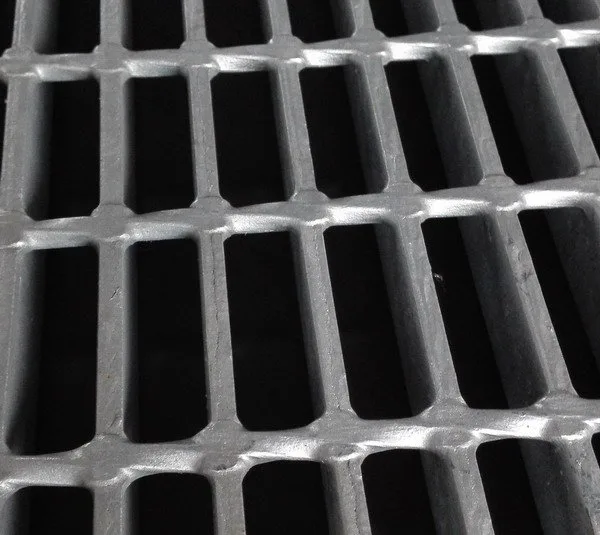
After installation, check each panel's fixing points and flatness; put into use only after confirming no warping or looseness.
The choice of surface treatment is essentially a trade-off between initial investment and later maintenance. Requirements for hot-dip galvanized steel grating can be appropriately relaxed in dry indoor environments, and raised accordingly outdoors or in humid environments. Galvanized steel grating selection can also follow this approach.
Further reading: Sizing reference for galvanized grating and hot-dip galvanized steel grating
In engineering, hot-dip galvanized steel grating is often used together with the components mentioned in this article. The two differ in load carrying and installation practices; when combining them, pay special attention to the connection of support conditions and fixing methods, as junction treatment is often where problems arise. For unified drawings, submit dimensions of both types and our technicians will process them under the same layout logic.
- For all product specifications and theoretical weights by series, visit Steel Grating Product Center
- To estimate cost by size and quantity, use Instant Quote PageSubmit Requirements
- To see how similar projects were executed, refer to Project Cases field applications
FAQ
What is most often overlooked during installation and acceptance?
First, bearing bars installed in the wrong direction reduce load capacity; second, insufficient fixing points or missing zinc touch-up paint; third, support beam spacing inconsistent with the layout drawing. These three items are most often overlooked on site.
What maintenance is required during daily use?
Maintenance mainly involves periodically checking whether fasteners are loose, whether touch-up paint has peeled off, and whether the panel surface shows obvious deformation or rust. Issues found should be dealt with promptly; overall maintenance is minimal.
Why do different manufacturers quote different weights for the same specifications?
The main difference lies in the actual measured thickness and tolerance control of the bearing bars. When bars are supplied at the lower tolerance limit, weight per unit area falls below the theoretical value, and load capacity drops accordingly. We recommend specifying thickness tolerance clearly when purchasing.
The above is for sizing and construction reference. To verify specific parameters or request a quotation, please visitInstant Quote Page, or contact our technical staff.
If you already have drawings or site dimensions, submit them directly and we will help verify specifications and layout, avoiding on-site cutting and rework caused by mismatched models. Without drawings, site photos and approximate dimensions are enough for an estimate.