







The application of steel grating in real projects is not complicated; the difficulty lies in matching specifications, materials and service environment. This article explains the application scenarios of trench grate types, their basic concepts and related essentials in turn, giving you a complete judgment framework for hot-dip galvanized steel grating.
Application Scenarios of Trench Grate Types
Typical applications mainly include the following categories, which can help you judge suitability for your project:
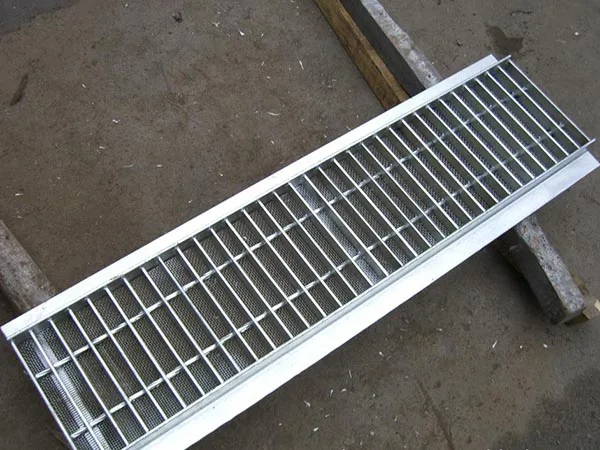
Advantages of serrated steel grating: welded from flat bars with a saw-toothed surface, it offers the features and uses of ordinary steel grating plus strong slip resistance, especially suitable for wet, slippery places and offshore oil platforms. With hot-dip galvanized surface treatment, it has strong rust resistance - maintenance-free and replacement-free for 30 years.
Complete list of serrated trench cover types: 3 serrated steel grating types, 4 advantages of toothed trench covers, common specifications of serrated trench covers. The difference between serrated flat bars and ordinary flat bars is that one side of the trench cover flat bar has uneven serrations
If your working conditions fall outside the above range, you can provide site photos and dimensions, and our technicians will help assess them.
For material selection, pursuing high grades alone is not recommended. The material of steel grating should match load requirements and service environment; over-specifying causes unnecessary cost increases. For the treatment of hot-dip galvanized steel grating, refer to the product page and choose according to actual service conditions.
Basic Concepts of Trench Grate Types
Below we first briefly explain the relevant concepts and basic construction to make the following parameters and sizing content easier to understand.
The key lies in slip resistance. We use slit-rolled flat bars cut from steel plates. Twisted square bars (also called twisted square steel) are usually made of 5x5, 6x6 and 8x8 square steel twisted into bars.
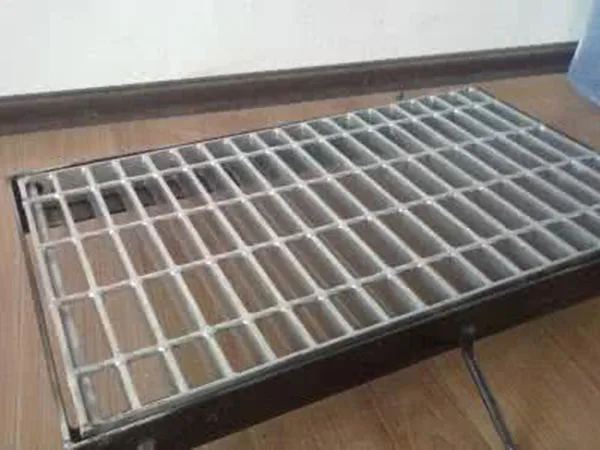
Once you grasp these basic concepts, the specifications and sizing recommendations that follow will be much easier to understand.
Actual parameters of the same model may vary slightly between manufacturers; acceptance shall be based on measured values. We recommend sampling key steel grating dimensions, especially for bulk deliveries. Corresponding parameters of hot-dip galvanized steel grating can be checked the same way; communicate promptly if deviations are found.
Scope of Application & Engineering Fields
The trench cover of this product can be hinged to the frame - anti-theft, safe and easy to open. Made of carbon steel, the steel grating has high strength: strength and toughness far exceed cast iron, suitable for docks, airports and other large-span, heavy-load environments. Large mesh openings give excellent drainage: open area reaches 83.3%, more than twice that of cast iron. Attractive appearance: simple lines, silver finish, modern style, and material savings that cut investment: for large spans and heavy loads it costs less than cast iron, and saves the cost of replacing cast iron covers that are stolen or crushed.
Steel grating actually has a wider range of applications than many think, from industrial platforms to municipal landscaping. The difference: industrial scenarios focus more on load capacity and corrosion protection, while municipal scenarios also consider appearance, anti-theft and pedestrian safety. Common practices for hot-dip galvanized steel grating panels in these scenarios can be seen on the case pages.
Further reading: Sizing reference for hot-dip galvanized steel grating and hot-dip galvanized steel grating
Hot-dip galvanized steel grating and hot-dip galvanized steel grating are different specification forms within the same product system. The selection logic is the same as described in this article: first the usage type, then span and load to determine specifications, and finally the environment to determine surface treatment. Their corrosion protection and anti-slip requirements may differ; state them separately when ordering rather than writing one general technical requirement.
- For all product specifications and theoretical weights by series, visit Steel Grating Product Center
- To estimate cost by size and quantity, use Instant Quote PageSubmit Requirements
- To see how similar projects were executed, refer to Project Cases field applications
FAQ
How to choose between hot-dip galvanizing and cold galvanizing?
The two anti-corrosion mechanisms differ: hot-dip galvanizing immerses steel in molten zinc to form a metallurgically bonded coating, thick and long-lasting, suitable for outdoor and humid environments; cold galvanizing is electrochemical deposition with a thinner, more uniform appearance, suitable for dry indoor environments or applications requiring high dimensional precision.
Where can I find specific specifications?
our websiteProductsCommon specifications and theoretical weights are organized by series, also available in Instant Quote PageEstimate by size, or contact us directly for sizing advice.
What is most often overlooked during installation and acceptance?
First, bearing bars installed in the wrong direction reduce load capacity; second, insufficient fixing points or missing zinc touch-up paint; third, support beam spacing inconsistent with the layout drawing. These three items are most often overlooked on site.
The above is for sizing and construction reference. To verify specific parameters or request a quotation, please visitInstant Quote Page, or contact our technical staff.
If you already have drawings or site dimensions, submit them directly and we will help verify specifications and layout, avoiding on-site cutting and rework caused by mismatched models. Without drawings, site photos and approximate dimensions are enough for an estimate.