







Many projects purchase steel cover plates on price alone and ignore specification matching and anti-corrosion requirements, which often leads to rework. This article lists, in order, the treatment of deformation, material and anti-corrosion requirements, and basic concepts to confirm, and explains how to weigh them under common working conditions; content related to hot-dip galvanized steel grating can be used directly as a technical disclosure reference.
Installation and Construction Points for Steel Cover Plates
On-site construction generally follows the steps and technical requirements below; complete the technical disclosure before starting work:
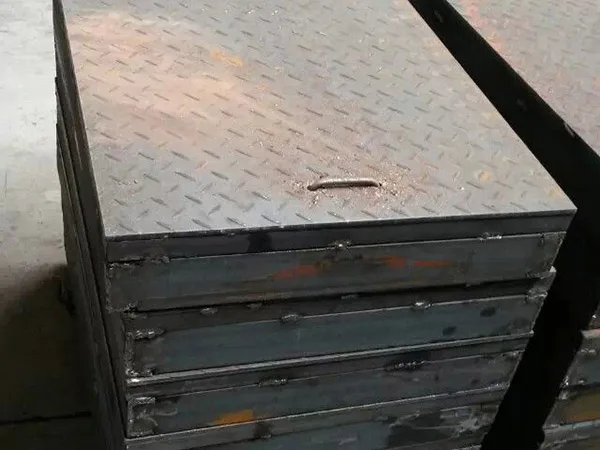
Steel cover plates can be fixed by welding or installation clips. Welding offers permanent fixing without loosening; the detailed position is on one edge bar at each corner of the product, with fillet welds no less than 20mm long and no less than 3mm high.
After installation, check each panel's fixing points and flatness; put into use only after confirming no warping or looseness.
Installation most affects later experience. When laying steel cover plates, the direction must not be reversed; the bearing flat bars should align with the main load direction, which is most easily overlooked on site. The number of fixings should also be complete per the layout drawing; one missing fixing can cause local loosening. This requirement applies equally to hot-dip galvanized steel grating.
Material and Anti-Corrosion Requirements
Common materials and surface treatments are as follows:
The advantage of installation clips is that they do not damage the hot-dip galvanized layer and allow easy removal; each panel needs at least 4 sets of clips, and the number increases with panel length. A safer method is to skip the lower clip and weld the screw heads directly to the steel beam, ensuring the panel will not slide off the beam due to clip loosening.
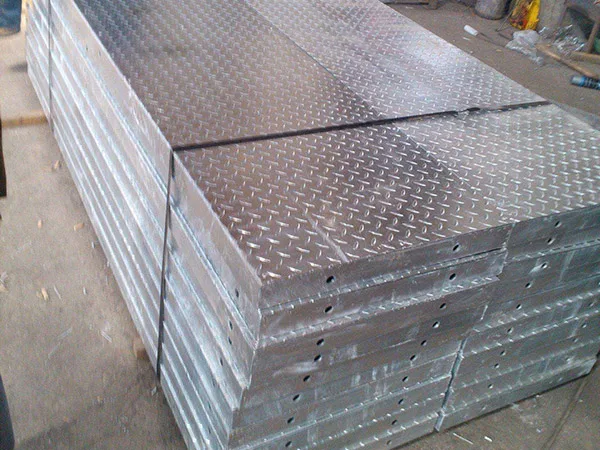
Once material and surface treatment are decided, we recommend writing zinc coating thickness and appearance requirements into the technical agreement.
Choosing a surface treatment is essentially balancing initial investment against later maintenance. Requirements can be relaxed appropriately for indoor dry environments and raised for outdoor or humid environments. Hot-dip galvanized steel gratings can be judged the same way.
What Is the Treatment of Deformed Steel Cover Plates
A steel cover plate is a product composed of load-spanning steel grating and a checkered plate sealing the surface. The following explains how to treat deformed steel cover plates:
When reading these contents, connect them with the following chapters: the front part clarifies the steel cover plate itself, and the later parts cover specifications and installation. If you only need a quick conclusion, read the key points of this section first; for procurement, write the relevant requirements for hot-dip galvanized steel grating into the technical agreement.
Standards and Inspection
1. When a compound steel grating has a large diagonal deviation due to improper loading, two people are advised to stand the panel upright and repeatedly tap the corner with the longer diagonal against the ground with light force. If the panel is bent and warped, place it on sleepers, bricks or other raised objects with the warped side up, so the most bent part contacts the raised object; two people stand at both ends of the warp and apply gentle force.
This section describes common practice for steel cover plates in most projects. If your site conditions are special - corrosive media, large temperature differences or frequent disassembly - adjust the treatment accordingly. Hot-dip galvanized steel gratings also need separate confirmation under such conditions; consult with site photos before deciding.
Key Points on the Treatment of Deformed Steel Cover Plates
2. When the banding bar of the product is deformed by impact, correct the deformed position with a sledgehammer or wrench; note that the force must not be too great.
Note that the specific practice for steel cover plates varies with project conditions; what is given here is a general approach rather than a fixed answer. Before execution, confirm the site span, support conditions and traffic requirements, then implement this section item by item; for hot-dip galvanized steel grating the judgment logic is the same, and a re-check before ordering is still recommended.
Further notes: Common combinations of hot-dip galvanized steel grating and hot-dip galvanized steel grating
In engineering, hot-dip galvanized steel grating is often used together with the components mentioned in this article. The two differ in load carrying and installation practices; when combining them, pay special attention to the connection of support conditions and fixing methods, as junction treatment is often where problems arise. For unified drawings, submit dimensions of both types and our technicians will process them under the same layout logic.
- For all product specifications and theoretical weights by series, visit Steel Grating Product Center
- To estimate cost by size and quantity, use Instant Quote PageSubmit Requirements
- To see how similar projects were executed, refer to Project Cases field applications
FAQ
How to choose between hot-dip galvanizing and cold galvanizing?
The two anti-corrosion mechanisms differ: hot-dip galvanizing immerses steel in molten zinc to form a metallurgically bonded coating, thick and long-lasting, suitable for outdoor and humid environments; cold galvanizing is electrochemical deposition with a thinner, more uniform appearance, suitable for dry indoor environments or applications requiring high dimensional precision.
Can the values in the article be applied directly?
Values in this article come from relevant standard clauses or common industry practice. For actual selection, recalculate based on site span, load class and service environment; direct copying is not recommended.
What maintenance is required during daily use?
Maintenance mainly involves periodically checking whether fasteners are loose, whether touch-up paint has peeled off, and whether the panel surface shows obvious deformation or rust. Issues found should be dealt with promptly; overall maintenance is minimal.
The above is for sizing and construction reference. To verify specific parameters or request a quotation, please visitInstant Quote Page, or contact our technical staff.
If you already have drawings or site dimensions, submit them directly and we will help verify specifications and layout, avoiding on-site cutting and rework caused by mismatched models. Without drawings, site photos and approximate dimensions are enough for an estimate.