







Many projects purchase steel grating based on price alone, overlooking specification matching and corrosion protection requirements, which often leads to rework later. This article lists, in order, the causes of white rust on galvanized steel grating, methods to prevent white rust, and basic concepts, and explains how to choose for common working conditions. Content related to hot-dip galvanized steel grating can be used directly as a reference for technical disclosure.
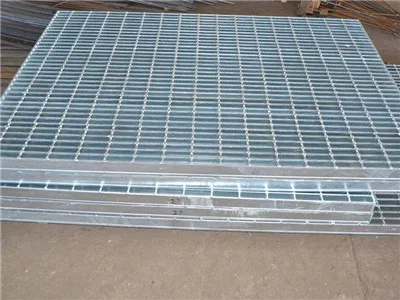
The Main Causes of White Rust on Galvanized Steel Grating
Material and surface treatment are key to service life. Common practices and suitable environments are as follows:
- Poor passivation, insufficient or uneven passivation film thickness
- Surface not oiled or moisture remaining on the strip surface
- Moisture on the strip surface during coiling
- Passivation not fully dried
- Dampness or rain exposure during transport or storage
- Finished products stored too long
- Galvanized plates in contact with or stored together with corrosive media such as acids and alkalis.
Once material and surface treatment are decided, we recommend writing zinc coating thickness and appearance requirements into the technical agreement.
For material selection, simply pursuing the highest grade is not recommended. The material of steel grating should match the load requirements and service environment; over-specifying causes unnecessary cost increases. The corresponding treatment of hot-dip galvanized steel grating can refer to the product page description, selected according to actual working conditions.
Methods to Prevent White Rust on Galvanized Steel Grating
Common materials and surface treatments are as follows:
1. Immerse the galvanized steel grating in a chromic acid solution to form a low-activity film on the zinc layer surface. Even if this chromic acid film is slightly broken, the chromate near the break will dissolve in water and gather at the broken spot, forming a new film again, which can effectively prevent white rust.
2. Apply oil on the galvanized steel grating to prevent direct contact between air and zinc. Note that if painting is to be carried out, the oil on the grating surface must be wiped off first; if the galvanized steel grating is to be painted, phosphate film treatment can be applied. The phosphate firmly adheres to the surface of the galvanized steel grating, forming a loose porous layer that provides a good foothold for paint, achieving strong adhesion.
Store the produced galvanized steel grating in a well-ventilated place, or use dryers or drying furnaces in seasons with high humidity or large temperature differences to prevent condensation. Be careful not to let it get soaked; if wetted by dew or water, dry it, or unpack the packaging and blow it dry with fans. Store in a well-ventilated place, avoiding spots prone to condensation where temperature differences are large.
Once material and surface treatment are decided, we recommend writing zinc coating thickness and appearance requirements into the technical agreement.
Material and surface treatment determine the durability of steel grating on site. Even for the same steel grating, the treatment differs greatly between dry indoor use and coastal or chemical environments, so the service environment should be raised as the primary condition during selection. This judgment also holds for hot-dip galvanized steel grating.
Further notes: How to combine hot-dip galvanized steel grating and hot-dip galvanized steel grating in use
If a project uses both hot-dip galvanized steel grating and hot-dip galvanized steel grating, we recommend planning them on the same layout drawing. This way edge closing, fixing and cutouts at junctions can be handled uniformly, avoiding dimension conflicts during installation and making later maintenance easier.
- For all product specifications and theoretical weights by series, visit Steel Grating Product Center
- To estimate cost by size and quantity, use Instant Quote PageSubmit Requirements
- To see how similar projects were executed, refer to Project Cases field applications
FAQ
What maintenance is required during daily use?
Maintenance mainly involves periodically checking whether fasteners are loose, whether touch-up paint has peeled off, and whether the panel surface shows obvious deformation or rust. Issues found should be dealt with promptly; overall maintenance is minimal.
Can the values in the article be applied directly?
Values in this article come from relevant standard clauses or common industry practice. For actual selection, recalculate based on site span, load class and service environment; direct copying is not recommended.
Why do different manufacturers quote different weights for the same specifications?
The main difference lies in the actual measured thickness and tolerance control of the bearing bars. When bars are supplied at the lower tolerance limit, weight per unit area falls below the theoretical value, and load capacity drops accordingly. We recommend specifying thickness tolerance clearly when purchasing.
The above is for sizing and construction reference. To verify specific parameters or request a quotation, please visitInstant Quote Page, or contact our technical staff.
Note that this article presents sizing approaches and general practice, and does not constitute a strength commitment for any specific project. For load-bearing safety-critical areas, the design drawings and on-site calculations shall prevail; contact our technical staff if in doubt.