







This article introduces steel grating in the order of installation methods, typical applications and basic concepts. Each part gives practical judgement methods where possible; if you only need a quick conclusion, read the key points at the start of each part. The same method applies to hot-dip galvanized steel grating.
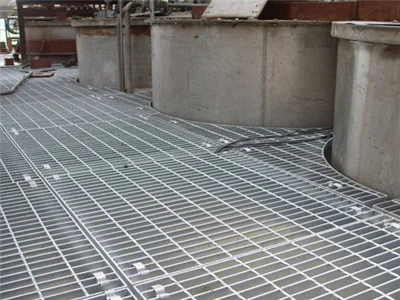
Installation Methods for Steel Grating
Key points for construction and fixing are as follows:
Steel grating can be installed by welding or with installation clips.
1. For permanent installations that need no dismantling, welding can be used to fix the grating to the supports. Specifically, at the first bearing bar in each corner of the panel, use a fillet weld with a length of not less than 20 mm and a height of not less than 3 mm.
2. Installation clips do not damage the zinc coating and are easy to remove; use at least four clips per panel, and for larger panels fit additional clips on available supports where possible.
The direction of the bearing bars also matters during installation: the bearing bars run perpendicular to the steel beams, and their length is the load-carrying direction. Be careful not to reverse them during installation, or the load capacity will be reduced.
After installation, check each panel's fixing points and flatness; put into use only after confirming no warping or looseness.
Material and surface treatment determine the on-site durability of steel grating. For the same steel grating, the treatment differs greatly between dry indoor use and coastal or chemical environments; service environment should be raised as the primary condition in selection. The same applies to hot-dip galvanized steel grating.
Typical Applications
Main applications are as follows:
- Industrial Platforms & Maintenance Walkways: equipment platforms and inspection passages in power plants, chemical plants and steel-structure workshops;
- Municipal & Landscape: road drainage trench covers, rainwater grates, tree grates, park boardwalks;
- Transportation & Ports: wharf trestles, multi-story parking garage lanes, railway bridge walkways;
- Environmental & Water Treatment: walkways in wastewater treatment plants, tank platforms, screening machine platforms;
- Others: elevated tower platforms, stair treads, fences and railings, etc.
If your working conditions fall outside the above range, you can provide site photos and dimensions, and our technicians will help assess them.
To judge whether steel grating suits a given application, check three angles quickly: whether corrosive media are present, whether traffic is pedestrian or vehicular, and roughly what span is involved. Once these are clear, you can basically determine the required specification and surface treatment for hot-dip galvanized steel grating.
Key Conditions to Confirm During Selection
- First clarify the span and support beam spacing to determine the required series;
- Then check load requirements by usage type (pedestrian, maintenance, vehicular);
- Finally, determine the surface treatment by service environment (dry indoor, outdoor, coastal, chemical).
What is most easily overlooked in spec tables are tolerances and end treatment. Steel grating usually has machining allowance in the length direction; if embedded installation is used on site, edge closing and corner notch requirements must be stated in advance. Hot-dip galvanized steel grating is handled similarly in these details; we recommend marking them clearly on the drawings as well.
Further notes: Common combinations of hot-dip galvanized steel grating and hot-dip galvanized steel grating
If a project uses both hot-dip galvanized steel grating and hot-dip galvanized steel grating, we recommend planning them on the same layout drawing. This way edge closing, fixing and cutouts at junctions can be handled uniformly, avoiding dimension conflicts during installation and making later maintenance easier.
- For all product specifications and theoretical weights by series, visit Steel Grating Product Center
- To estimate cost by size and quantity, use Instant Quote PageSubmit Requirements
- To see how similar projects were executed, refer to Project Cases field applications
FAQ
What is most often overlooked during installation and acceptance?
First, bearing bars installed in the wrong direction reduce load capacity; second, insufficient fixing points or missing zinc touch-up paint; third, support beam spacing inconsistent with the layout drawing. These three items are most often overlooked on site.
Can the values in the article be applied directly?
Values in this article come from relevant standard clauses or common industry practice. For actual selection, recalculate based on site span, load class and service environment; direct copying is not recommended.
Where can I find specific specifications?
our websiteProductsCommon specifications and theoretical weights are organized by series, also available in Instant Quote PageEstimate by size, or contact us directly for sizing advice.
The above is for sizing and construction reference. To verify specific parameters or request a quotation, please visitInstant Quote Page, or contact our technical staff.
Note that this article presents sizing approaches and general practice, and does not constitute a strength commitment for any specific project. For load-bearing safety-critical areas, the design drawings and on-site calculations shall prevail; contact our technical staff if in doubt.