







This article focuses on steel grating and explains, in turn, the design loads of steel grating platforms and walkways, the 4kN/m2 uniformly distributed load used for maintenance platforms, and basic concepts, with practical advice added after each section. If you are comparing options or preparing a purchase, check each point in the order given; items concerning hot-dip galvanized steel grating can be verified against the same entries, and adjusted where site conditions differ.
Application Scenarios: Design Loads for Steel Grating Platforms and Walkways
Typical applications mainly include the following categories, which can help you judge suitability for your project:
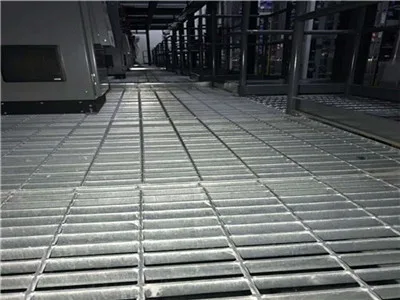
Design Loads for Steel Grating Platforms and Walkways
1. For a single-operator work platform, the design load is normally 1.5kN, distributed over the whole area of 200mm x 200mm
If your working conditions fall outside the above range, you can provide site photos and dimensions, and our technicians will help assess them.
What is most easily overlooked in spec tables are tolerances and end treatment. Steel grating usually has machining allowance in the length direction; if embedded installation is used on site, edge closing and corner notch requirements must be stated in advance. Galvanized grating is handled similarly in these details; we recommend marking them clearly on the drawings as well.
Maintenance platforms are generally designed for a uniformly distributed load of 4kN/m2.
Key inspection and maintenance points during use are as follows:
Regular inspection and maintenance as required effectively extends service life and reduces replacement costs.
One point worth noting: price is not the only consideration. Later maintenance costs, difficulty of replacement and service life all affect the total cost of steel grating, and a low-price option may not pay off in these respects. When budgeting, factor in the full life-cycle cost of galvanized steel grating.
For a steel grating walkway used by one person at a time, the uniformly distributed load capacity shall be not less than 3.0kN/m2.
- For a two-way steel grating walkway, the uniformly distributed load capacity shall be not less than 5.0kN/m2.
- For a steel grating walkway carrying dense pedestrian traffic, the uniformly distributed load capacity shall be not less than 7.5kN/m2.
- When the design load is applied, the deflection of the steel grating shall not exceed 1/200 of the span, and the height difference between a loaded panel and an adjacent unloaded panel shall not exceed 4mm.
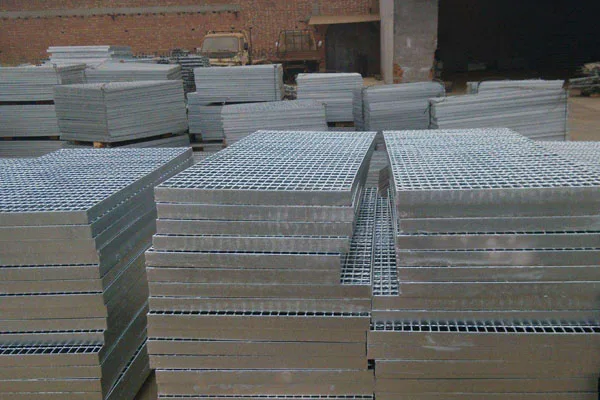
In addition to meeting the above design requirements, steel grating stair treads must also give full consideration to firm installation and ease of walking.
It should be noted that the exact approach for steel grating varies with project conditions; what is given here is a general framework rather than a fixed answer. In practice, first confirm the site span, support conditions and traffic requirements, then work through the points in this section; the same logic applies to galvanized steel grating, and a final review before ordering is still recommended.
Further notes: Common combinations of hot-dip galvanized steel grating and galvanized grating
Besides what this article covers, hot-dip galvanized steel grating is also common in actual projects. It shares similarities with this article's subject in structure and fabrication; for selection, check span, load and service environment in the same order. If both types of components are used in the same project, we recommend unifying material and surface treatment to avoid later galvanic corrosion or inconsistent appearance.
- For all product specifications and theoretical weights by series, visit Steel Grating Product Center
- To estimate cost by size and quantity, use Instant Quote PageSubmit Requirements
- To see how similar projects were executed, refer to Project Cases field applications
FAQ
Can the values in the article be applied directly?
Values in this article come from relevant standard clauses or common industry practice. For actual selection, recalculate based on site span, load class and service environment; direct copying is not recommended.
What maintenance is required during daily use?
Maintenance mainly involves periodically checking whether fasteners are loose, whether touch-up paint has peeled off, and whether the panel surface shows obvious deformation or rust. Issues found should be dealt with promptly; overall maintenance is minimal.
What information is needed for custom sizes?
Usually you need to provide the panel dimensions (length x width), bearing bar specs and direction, center-to-center pitch of bearing bars and cross bars, surface treatment, and special requirements such as cutouts, corner notches and banding. Site photos or sketches are even better.
The above is for sizing and construction reference. To verify specific parameters or request a quotation, please visitInstant Quote Page, or contact our technical staff.
The above is general guidance. For a specific project, we still recommend submitting span, load class and service environment to our technicians for review. Steel grating is a load-bearing component; rework caused by wrong specification choices costs far more than the time spent on upfront calculation.